
Can I Get a Home Loan with a Default in NZ? Your 2026 Guide to Saying Yes

What if your credit default was just a minor speed bump instead of a brick wall? If you’ve been asking yourself, “can i get a home loan with a default nz,” the answer is a resounding yes. It’s completely natural to feel judged by mainstream banks or stressed about interest rates, especially with the OCR now at 2.50% and house prices sitting about 18% lower than their previous peak. You might feel like a past financial mistake is holding you back, but a default is just one chapter of your story, not the whole book.

We agree that life happens, and a missed utility bill from years ago shouldn’t stop you from owning a home today. In this 2026 guide, you’ll discover how to find lenders who look at the reason behind your credit score and value your current financial stability. We’ll provide a clear roadmap to approval and explain how professional advocacy can help you secure a loan, even when the big banks say no.

Key Takeaways

  • Understand why a credit default stays on your New Zealand record for five years and why mainstream banks often use automated systems to decline these applications.
  • Discover how to answer the question “can i get a home loan with a default nz” by looking beyond big banks to 2nd tier lenders who specialise in unique situations.
  • Learn the essential steps to prepare your file, including how to organise your bank accounts to show perfect conduct for at least three months before you apply.
  • Find out how working with a seasoned professional can help you navigate the non-bank market and find a lender who values your current stability over past mistakes.

What Does Having a Default Actually Mean for Your Home Loan?

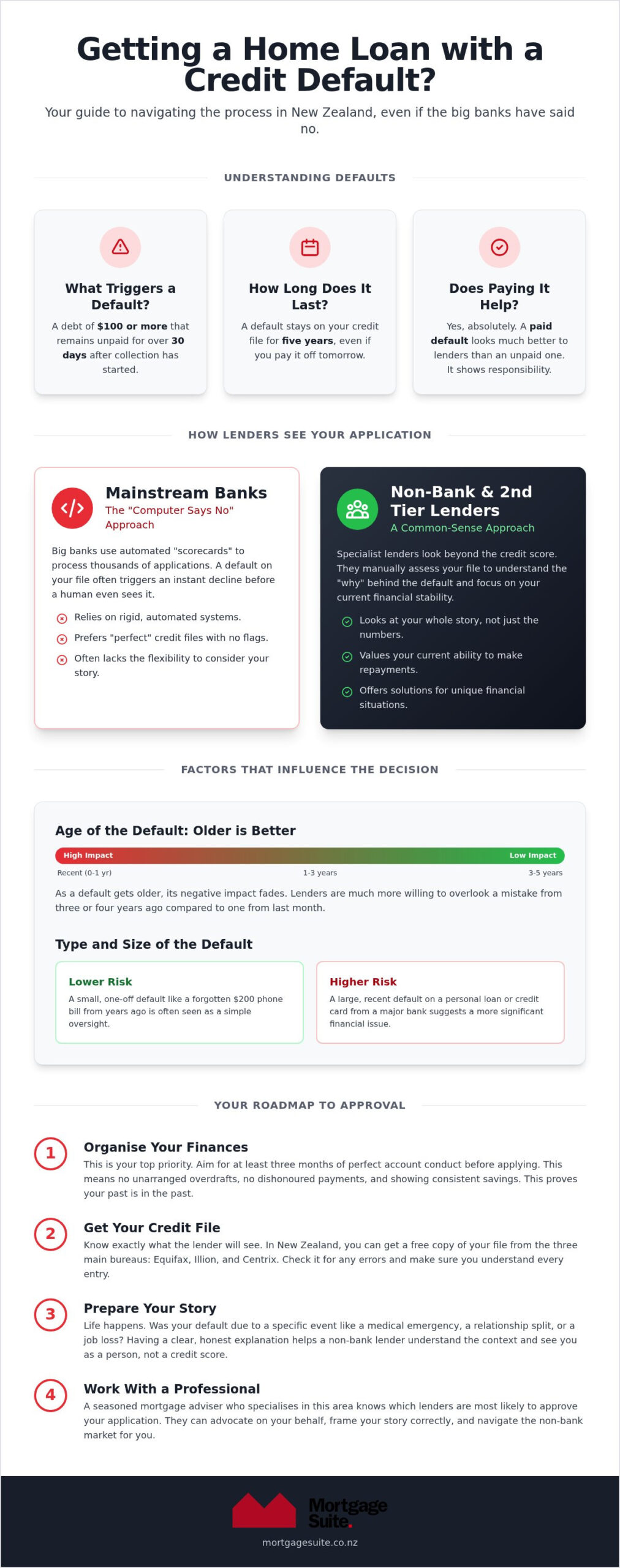
A default isn’t just a missed payment; it’s a formal flag on your credit file. In New Zealand, this happens when a debt of at least $100 remains unpaid for more than 30 days and the provider has started a collection process. Once that mark is on your record, it stays there for five years. This remains true even if you settle the debt the very next day, though a paid default looks much better to a lender than an unpaid one.

When you’re wondering, “can i get a home loan with a default nz,” it helps to see things from the lender’s perspective. To a mainstream bank, a default is often viewed as a red flag regarding your reliability. They use it as a shortcut to judge whether you’ll keep up with mortgage repayments. An unpaid default suggests a debt is still outstanding and creates an immediate barrier, while a paid default proves you’ve taken responsibility for your past obligations, making you a much more viable candidate for a loan.

How NZ Credit Bureaus Score Your History

New Zealand’s financial landscape relies on three main bureaus: Equifax, Illion, and Centrix. These agencies collect data from various sources to help lenders understand what a credit score is and how it reflects your individual financial habits. Most lenders now use comprehensive credit reporting. This is actually good news for you, as it means your file shows your positive habits, like on-time utility payments, alongside any past defaults.

While your numerical score is a quick reference point, it’s rarely the final word in the non-bank sector. We find that the story behind the entries is far more important than the score itself. If your default was caused by a specific life event, such as a medical emergency or a relationship breakdown, rather than a long-term pattern of overspending, we can use that context to advocate for your application.

The Impact of Default Age and Type

Lenders don’t treat every default the same way. There is a significant difference between a small, forgotten internet bill and a large default on a previous credit card or personal loan. A $200 telco default from four years ago is often viewed as a simple oversight. However, a $5,000 default from a major bank just twelve months ago suggests a more serious level of financial risk that requires a specialist approach.

The age of the default is a massive factor in your favour. As a default gets older, its negative impact on your ability to secure a home loan starts to fade. A lender is much more likely to say yes to someone with a three or four-year-old paid default than someone with a fresh mark from last month. We specialise in identifying which 2nd tier lenders are most comfortable with your specific history, ensuring we present your case to the right people at the right time.

Why Mainstream NZ Banks Say No (And Why It’s Not the End)

Mainstream institutions like ANZ, ASB, and Westpac process thousands of applications every month. To keep up with this volume, they rely on automated “scorecards” to filter out anyone who doesn’t meet their perfect profile. If you’ve been searching for an answer to “can i get a home loan with a default nz,” you’ve likely discovered that these systems aren’t built for nuance. When a default shows up on your record, the bank’s software often triggers an automatic decline. This “low-touch” approach is efficient for the bank, but it means a human lender may never hear the context behind your past financial situation.

These major banks are currently facing tighter internal risk appetites. With the FMA recently taking over CCCFA oversight in July 2026, many institutions have become even more cautious. They prefer “clean” credit files that don’t require manual investigation or extra paperwork. It’s a common worry to think “can i get a home loan with a default nz” after a big bank turns you down, but it’s helpful to remember that their “no” is often just a “no for now.” It simply means your application doesn’t fit their current, narrow set of rules.

The Automated Decline vs. Manual Assessment

The biggest hurdle at a main bank is that their computers often filter out your application before a person ever looks at it. In years past, you could sit down with a local manager who understood your history. Today, the New Zealand banking culture has moved toward a much more rigid, policy-driven style of lending. If the computer sees a “red flag” like a default, the process usually stops. This “computer says no” situation is incredibly frustrating, especially if you now have a stable job and a solid deposit.

Meeting the Standard Bank Criteria

Learning how to qualify for a home loan NZ involves looking at more than just your yearly income. Mainstream banks want to see perfect account conduct, particularly in the six months before you apply. Even if you’re earning a great salary, a recent default can be a total deal-breaker for them. They want to see that you’re managing every cent with care. Before you start the process, you should Check your own credit record for free to make sure there aren’t any surprises waiting for you.

When the big banks won’t look past the automated scorecards, it’s time to find a dedicated advocate who can present your case to lenders who actually value a manual assessment.

Exploring 2nd Tier and Non-Bank Lending Options

If the big banks have turned you away because of an automated scorecard, don’t lose heart. There is a whole layer of the New Zealand mortgage market specifically designed for your situation. These institutions are known as 2nd tier lenders. While they don’t hold a full banking licence like the big four, they have significant capital and specialise in what we call “non-conforming” loans. These are simply mortgages that don’t fit into the standard, rigid boxes that mainstream banks prefer. If you’ve been asking yourself, “can i get a home loan with a default nz,” these lenders are often the most likely path to a yes.

The biggest difference you’ll notice is the human element. Instead of a computer algorithm making the final call, 2nd tier lenders use manual underwriting. This means a real person actually reviews your application, looks at your current income, and listens to the story behind your past credit issues. Because these lenders take on files that mainstream banks consider higher risk, their interest rates are typically higher than standard bank rates to reflect that increased risk level. However, for many Kiwis, this is a fair trade-off to get onto the property ladder.

The Benefits of Non-Bank Lenders

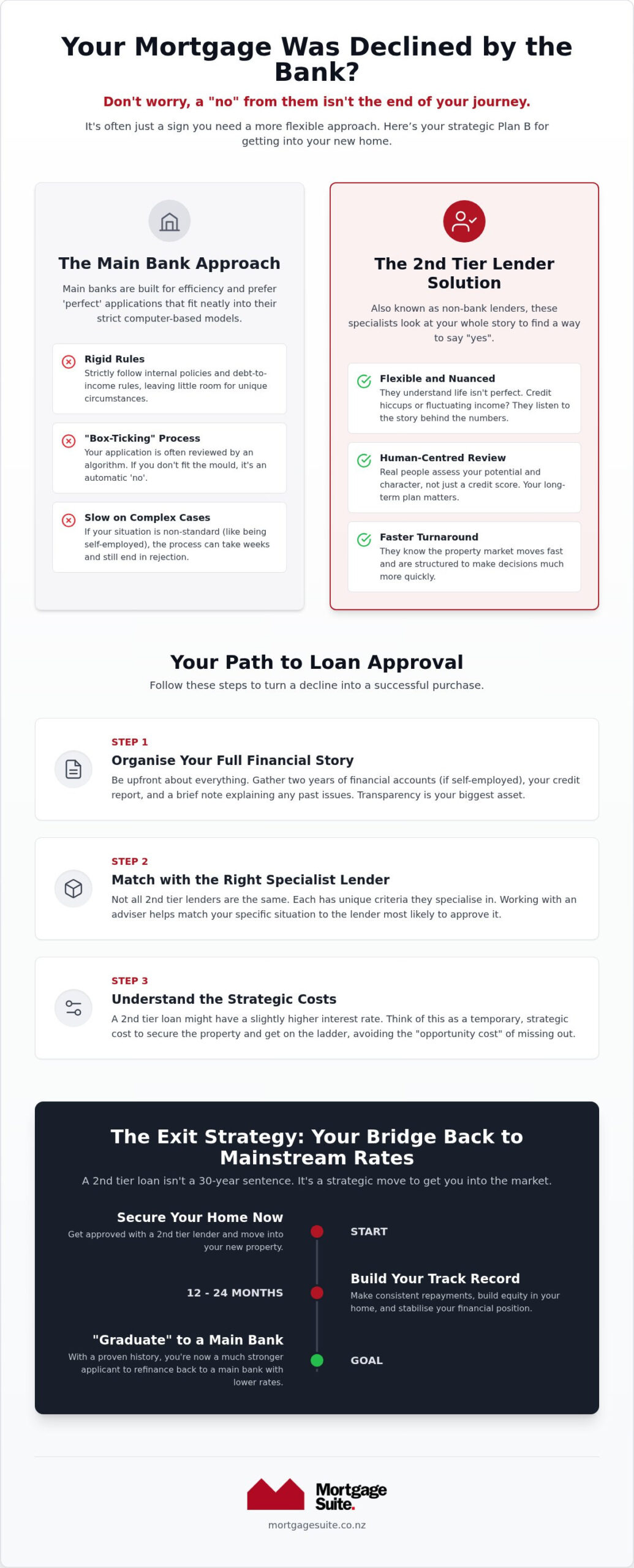
Non-bank lenders offer a level of flexibility you simply won’t find at a traditional branch. In some cases, they can be more lenient with deposit requirements or offer “Alt-Doc” options for self-employed people who might not have two years of perfect tax returns ready to go. We often view these lenders as a helpful bridge. The goal isn’t necessarily to stay with them for thirty years. Instead, we focus on an “exit strategy” where you build a solid repayment history for two or three years before we help you move back to a mainstream bank at a lower rate.

What to Expect with a 2nd Tier Loan

It’s important to go into this process with your eyes open. You can find more detail in our 2nd tier lender New Zealand guide, but the main thing to understand is risk-based pricing. This means your specific interest rate is determined by the “weight” of your credit file. For example, in mid-2026, specialist rates from providers like Avanti Finance or Pepper Money might range anywhere from 6.35% to over 11% depending on the age and size of your default. You should also be prepared for establishment fees, which are often higher than the standard fees charged by the big banks. We’ll always talk you through these costs upfront so there are no surprises on settlement day.

When you’re wondering “can i get a home loan with a default nz,” the answer usually lies in finding the right 2nd tier partner who sees your potential rather than just your past.

Can I Get a Home Loan with a Default in NZ? Your 2026 Guide to Saying Yes

How to Organise Your Finances for a Successful Application

When you’re asking “can i get a home loan with a default nz,” the answer depends heavily on the preparation you do before we even approach a lender. Think of this as your “pre-flight” checklist. While a default is a hurdle, your recent behaviour is what proves you are a safe bet for a mortgage. Non-bank lenders are looking for a clear shift in how you manage your money, and there are four specific steps you should take to get your file in top shape.

  • Clear the debt: If you haven’t already, pay off the default. Once it’s settled, ask the provider for a “Letter of Release.” This is a formal document proving the debt is gone, which is much more powerful than simply having a “paid” status on your credit report.
  • Show perfect conduct: Lenders will look at your bank statements for the last three to six months. They want to see zero unarranged overdrives, zero missed payments, and no “dishonoured” fees. Every cent needs to be accounted for.
  • Aim for a 20% deposit: While some lenders might look at smaller deposits, 20% is often the “magic number” for people with defaults. It lowers the lender’s risk and can help you secure a much better interest rate.
  • Write your story: Prepare a Letter of Explanation. This is your chance to show the person behind the paperwork and explain exactly what happened when that default occurred.

If you want to get your application ready for a lender, we can guide you through every step of this checklist to ensure you’re presenting the best possible version of your financial self.

Writing the Letter of Explanation

Lenders in the 2nd tier space aren’t robots; they want to understand the “why.” If your default was caused by a specific life event like a redundancy, a serious illness, or a relationship split, be honest about it. Keep your explanation concise and professional. Avoid “sob stories” and stick to the facts. The most important part of this letter is showing what has changed in your life to ensure that those past mistakes won’t happen again. You want to demonstrate that you’re now in a position of stability and control.

Cleaning Up Your Credit File

Before you apply, you should request a copy of your credit report from Centrix, Equifax, and Illion. Check for any errors or small debts you might have forgotten about. It’s vital to pay all your current bills on time, including your power, phone, and even your Netflix subscription. These small “on-time” markers build a positive history. Also, avoid applying for any new credit in the lead-up to your mortgage. Applying for things like car loans or “buy now, pay later” services like Afterpay can make you look desperate for credit, which is the last thing you want when trying to answer “can i get a home loan with a default nz.”

Partnering with Mortgage Suite Ltd to Navigate the Process

Being turned down by a bank is a setback, but it certainly isn’t a dead end. When you are still trying to figure out “can i get a home loan with a default nz,” the most effective strategy is to have an expert who understands the 2nd tier landscape inside out. This is where the value of a seasoned mentor becomes clear. Krish Krishna brings over 20 years of banking and brokerage experience to your side. He doesn’t just pass on your paperwork; he “translates” your financial history into a language that lenders understand, highlighting your current strengths while providing the necessary context for past defaults.

Working with Mortgage Suite Ltd means moving away from a transactional mindset. We don’t just look for any loan; we look for a partnership that supports your long-term financial health. As dedicated negotiators, we know exactly which 2nd tier lenders are currently active and which ones have an appetite for your specific type of credit file. This insider knowledge is vital for avoiding another “no” and building a direct path to “yes.” We take the stress of the unknown off your shoulders and replace it with a steady, professional hand.

The Advantage of a Seasoned Professional

One of the biggest benefits of partnering with a specialist is access. Many 2nd tier and non-bank lenders in New Zealand do not deal directly with the public; they only accept applications through trusted brokers. We know how to structure your application to mitigate the impact of a default, focusing on your stable income and account conduct instead. This expertise ensures your file isn’t just another number in a pile. It’s a professional presentation that demands a manual review by a real person who can see your potential.

Your Next Steps Toward Home Ownership

Our goal is to answer “can i get a home loan with a default nz” with a clear, actionable plan that puts you back in control of your future. We start with a no-obligation chat to assess where you stand right now. From there, we create what we call a “road to bank” plan. This is a strategy designed to get you into a home now using a 2nd tier lender, with the ultimate aim of moving you back to a mainstream bank once your credit file has cleared. It’s about more than just a house; it’s about a long-term relationship built on trust and results.

Ready to stop guessing and start planning? Book a consultation with Mortgage Suite Ltd today to see what’s possible for your situation.

Your Path to Home Ownership Starts Now

A credit default might feel like a permanent “no,” but it’s actually just a prompt to look in the right direction. By focusing on non-bank lenders who value manual assessments over automated scorecards, you can find a way forward that mainstream banks simply can’t offer. This guide has shown that your recent account conduct and a clear explanation of your past are your strongest tools. If you’ve been wondering, “can i get a home loan with a default nz,” the reality is that with the right preparation and professional advocacy, you certainly can.

At Mortgage Suite Ltd, we use over 20 years of banking expertise to act as your dedicated negotiators for non-bank lending. We are specialists in hard-to-place home loans and are committed to helping you build a bridge back to long-term financial health. You don’t have to face the paperwork or the stress alone. Talk to Krish and the team about your home loan options today and let’s start working on your plan. Your goal of owning a home in New Zealand is still within reach, and we’re here to help you grab it.

Frequently Asked Questions

Can I get a home loan with an unpaid default in NZ?

Yes, it is possible, but your options will be much more limited than if the debt was settled. Mainstream banks almost always require defaults to be paid before they consider an application. Some 2nd tier lenders may approve a loan with an unpaid default if the amount is small, like a minor phone bill, but they usually expect you to pay it off using your loan proceeds at settlement.

How much deposit do I need for a home loan if I have a default?

You will generally need a deposit of at least 20% when applying with a credit default. While mainstream banks sometimes offer lower deposit options for first home buyers with perfect credit, non-bank lenders require more equity to offset the risk. Having a larger deposit shows the lender that you’re committed and provides a safety buffer for their investment.

Will my interest rate be higher because of a credit default?

Yes, you should expect to pay a higher interest rate than the standard bank “special” rates. Because 2nd tier lenders are taking on more risk, they use risk-based pricing. While major banks have floating rates around 6.04% in July 2026, specialist non-bank rates can range from 6.35% to over 11% depending on how recent or serious your default was.

How long after a default can I apply for a mortgage?

You can apply for a mortgage at any time, but your chances of approval increase significantly once the default is at least 6 to 12 months old. Lenders want to see a clear period of “clean” financial behaviour after the event occurred. If you’ve been asking “can i get a home loan with a default nz” shortly after a missed payment, focusing on six months of perfect bank statements is the best way to start.

Does paying a default improve my chances of getting a loan?

Paying your default is the most effective way to improve your chances of a successful application. It transforms you from someone with an active debt into someone who has taken responsibility and cleared their obligations. Most non-bank lenders will ask for a “Letter of Release” from the original provider to prove the matter is fully settled before they issue an approval.

Can a mortgage broker help me if I’ve been declined by my own bank?

A specialist broker is often the best resource after a bank decline because we have access to lenders that don’t deal with the public. We can help you answer “can i get a home loan with a default nz” by manually presenting your case to a human underwriter. This bypasses the automated computer systems that mainstream banks use to auto-decline anyone with a less-than-perfect credit score.

What is the difference between a default and a judgement on a credit file?

A default is a record from a service provider or lender about an unpaid debt, whereas a judgement is a formal court order. Judgements are more serious because they indicate the debt reached a legal level of enforcement. Both stay on your New Zealand credit report for five years, but a judgement will require a more detailed explanation and proof of settlement for a lender to consider your file.

Can I use my KiwiSaver for a deposit if I have a default?

Yes, a credit default does not stop you from withdrawing your KiwiSaver funds for a first home deposit. As long as you meet the standard criteria set by your provider, those funds are yours to use. This can be a huge help in reaching the 20% deposit mark that many non-bank lenders require when they see a default on a credit file.

Article by

Krish Krishna

Experienced Financial Adviser with over 46 years of Banking and Mortgage broking experience and over $2.0 Billion in loan settlements.

2nd Tier Lender New Zealand: Your 2026 Guide to Alternative Home Loans

What if the bank’s “no” isn’t actually the end of your home-buying journey, but just a sign you’re looking in the wrong place? It is incredibly disheartening to feel like a mere tick-box on a spreadsheet, especially when a slightly messy credit history or self-employed income makes you “too hard” for traditional lenders. Finding a 2nd tier lender New Zealand wide can be the breakthrough you need, offering a common-sense approach that looks at your whole financial picture rather than just a computer-generated score.

We understand the anxiety that comes with being turned away, but these alternative options are designed for people who need a partner, not just a processor. This guide explores how to secure a flexible home loan that respects your unique situation, providing a fair go when the big banks won’t budge. You will discover exactly how these lenders operate in 2026, the specific benefits they offer for non-standard financial profiles, and how to create a clear strategy for eventually refinancing back to a mainstream bank once your circumstances settle.

Key Takeaways

  • Understand that 2nd tier lenders are professional, legitimate institutions that offer a genuine alternative when big banks won’t help.
  • Discover how a 2nd tier lender New Zealand wide uses a common-sense approach to look at your whole financial picture rather than just ticking boxes.
  • Learn why flexibility often comes with a slightly higher interest rate and how the speed of these lenders can save your property deal.
  • Find out how to organise a professional paper trail and why being upfront about your history helps secure a faster approval.
  • Explore how seasoned expertise can bridge the gap between rigid banking rules and your personal goal of home ownership.

What is a 2nd Tier Lender in New Zealand?

Think of a 2nd tier lender as a specialised financial institution that focuses purely on helping people secure property. Unlike the big banks you see on every street corner, these organisations don’t offer everyday savings accounts, credit cards, or travel insurance. They aren’t “retail banks” in the traditional sense; instead, they are professional lenders who use their own capital or institutional funds to provide mortgages. This narrow focus is actually their greatest strength because it allows them to be far more flexible than a bank that’s trying to be everything to everyone.

The main difference you’ll notice is the way they look at your application. While big banks often rely on rigid computer algorithms that spit out a “yes” or “no” based on strict “tick-box” criteria, a 2nd tier lender New Zealand homeowners use often applies a common-sense approach. They’re interested in the “why” behind your financial situation. If you’re self-employed and your income fluctuates, or if you had a minor credit hiccup a few years ago, these lenders are more likely to look at the big picture rather than just the numbers on a screen. They provide a vital alternative for Kiwis who have the ability to pay a mortgage but don’t quite fit the narrow mould of mainstream banking.

Non-Bank vs. 2nd Tier: Is there a difference?

No worries if you’re a bit confused by the different names; they basically mean the same thing in our local market. “Non-bank” describes their legal structure, meaning they are a non-bank financial institution that doesn’t hold a full banking licence from the Reserve Bank. “2nd tier” describes their position as a secondary option to the “Big Four” banks. Whether you call them non-banks or 2nd tier, the result is the same: a professional lender that offers a different path to home ownership.

Why they are a safe bet for Kiwis

Some people worry that stepping away from a big bank means less protection, but that isn’t the case. Every 2nd tier lender New Zealand has must follow the Credit Contracts and Consumer Finance Act (CCCFA). This means they are legally required to be responsible lenders, just like the household names. These institutions have been a solid part of our property market for decades. Many are backed by massive global investment firms or well-known local institutions, ensuring they have the stability and reputation to support your long-term goals. They aren’t “last resorts” but rather strategic partners for those who need a more personalised touch.

Why the Mainstream Banks Might Say ‘No’

It’s a sinking feeling when you’ve done everything right, saved your deposit, and found the perfect home, only to have a bank manager shake their head. The reality is that the Big Four banks are massive machines built for speed and volume. To keep things moving, they rely on rigid, one-size-fits-all rules. If your financial situation has even a tiny bit of “colour” or complexity, you often fall outside their very narrow appetite for risk. A “no” from a mainstream lender usually isn’t a reflection of your ability to pay; it’s simply a sign that you don’t fit their specific, pre-programmed mould.

This is where a 2nd tier lender New Zealand wide provides a much-needed alternative. While banks look for reasons to say no to protect their high-volume systems, 2nd tier lenders look for reasons to say yes. They take the time to understand the story behind the numbers. They recognise that modern lives are rarely tidy, and they’re willing to look at the big picture of your financial health rather than just a computer-generated score.

Common hurdles for the ‘Big Four’

There are several reasons why a perfectly capable borrower might get a “thanks, but no thanks” from a traditional bank. These hurdles are often non-negotiable for mainstream lenders:

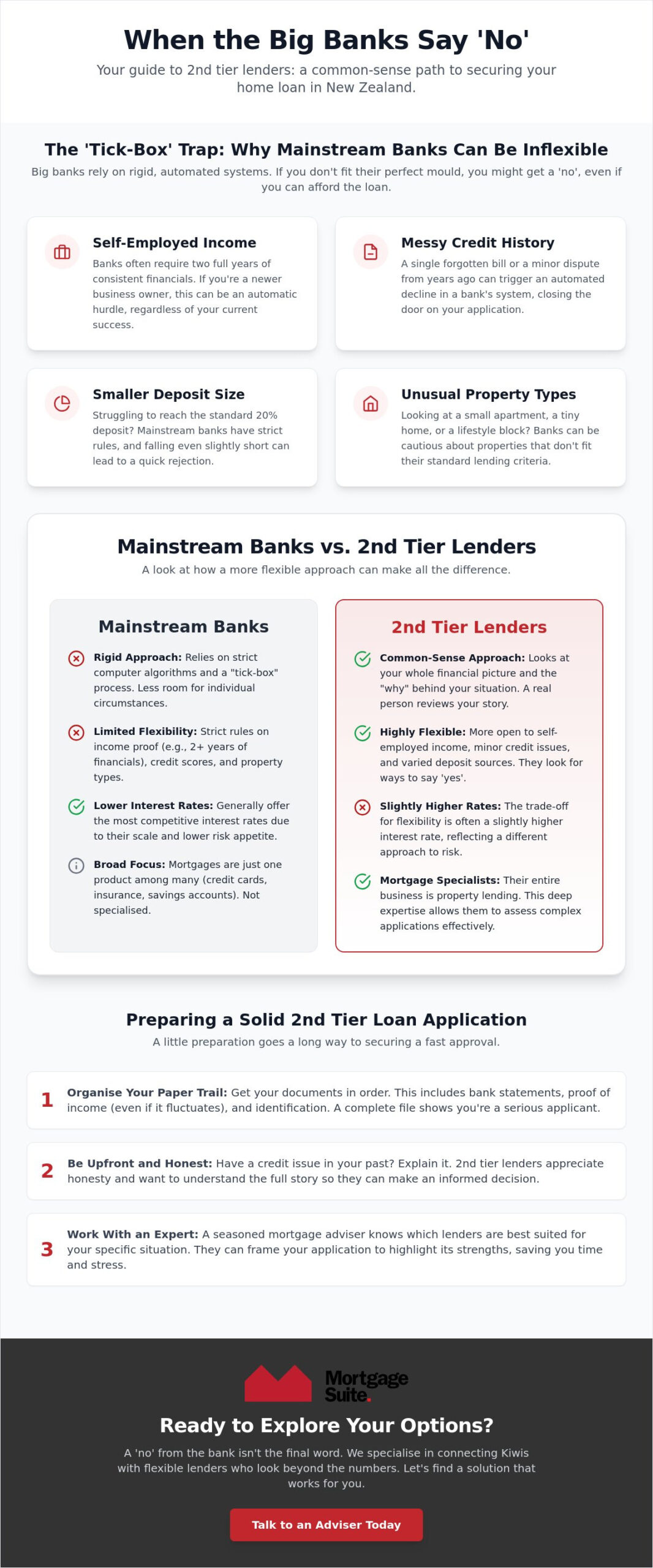
  • Self-employed income: Banks usually demand two full years of perfect financial records. If you’ve been in business for 12 months and are doing well, a bank might still decline you simply because you haven’t reached that two-year mark.
  • Deposit size: With government rules often requiring a 20% deposit for owner-occupiers, many Kiwis find themselves just a few thousand dollars short.
  • Credit history: A forgotten power bill from three years ago or a minor credit card dispute can stay on your file and trigger an automatic decline in a bank’s system.
  • Property types: Banks are often wary of apartments under a certain size, tiny homes, or lifestyle blocks with unusual titles.

The ‘Tick-Box’ trap

Modern banking relies heavily on automated software. When you submit an application, an algorithm scans for specific data points. If one “box” isn’t ticked, the system can auto-decline the application before a person even looks at it. In contrast, the 2nd tier space relies on a human-led decision-making process. These are experienced professionals who can see that a past credit hiccup was a one-off event or that your self-employment income is stable and growing. This approach is the foundation for non-conforming loans, which are specialised products designed specifically for “out-of-the-box” situations that don’t meet standard bank criteria. If you’re feeling stuck in this tick-box trap, it might be time to talk to an expert who knows how to present your case to the right people. If you’ve already received a formal rejection, our comprehensive guide for those declined by bank home loan NZ applicants explains exactly what steps to take next to recover and find a path to approval.

Comparing 2nd Tier Lenders vs. Mainstream Banks

Choosing between a big bank and a 2nd tier option isn’t about finding a “better” lender, but rather the right lender for your current situation. Mainstream banks are great for people who fit a very specific profile and want the lowest possible interest rate. However, that low rate often comes with a lack of flexibility and a slow, complicated process. If you need a lender who can look past a messy bank statement or move quickly to secure a property, a 2nd tier lender New Zealand wide offers a level of service the big banks simply aren’t built to provide.

One of the biggest advantages is the personalised approach. You won’t find yourself stuck in a massive call centre queue or waiting weeks for a computer to process your paperwork. Instead, you’re working with people who understand that every borrower has a unique story. They can be far more creative with loan structures, such as offering longer periods where you only pay the interest. This can help with your cash flow while you’re getting established or finishing a renovation. It’s about finding a solution that fits your life, not forcing your life to fit their rules. For property investors in particular, this flexibility extends to residential investment property loans NZ borrowers use to grow their portfolios when mainstream banks won’t budge on LVR restrictions.

Interest rates and fees: The real story

Let’s be upfront about the trade-offs. Because these lenders take on more complex cases, their interest rates are generally higher than the “special” rates advertised by the Big Four. For many Kiwis, the slightly higher cost is a small price to pay for the value of actually getting into a home. It’s often a short-term strategy to get into the market now rather than waiting years to save a larger deposit. To help with the initial costs, many of these lenders allow you to add the setup fees to your total loan balance, meaning you don’t need even more cash upfront to get the deal across the line.

Flexibility and Speed

Speed is where these lenders truly shine. While a big bank might take weeks to give you a definitive answer, a 2nd tier lender can often organise a conditional approval in as little as 48 hours. This is a game-changer if you’re trying to secure a property at auction or need a short-term loan to cover the gap between selling one home and buying another. They are experts in providing non-conforming home loans New Zealand families use to navigate tricky transitions. Whether it’s a short-term fix or a long-term plan, their ability to move fast ensures you don’t miss out on the right opportunity just because a bank’s internal rules changed overnight. This same speed and flexibility makes them a natural fit for those seeking property development loans NZ wide, where tight project timelines and complex income structures often rule out the big banks entirely.

2nd Tier Lender New Zealand: Your 2026 Guide to Alternative Home Loans

How to Prepare a Solid 2nd Tier Loan Application

Getting your ducks in a row before you talk to a lender makes a world of difference. When you apply with a 2nd tier lender New Zealand wide, you aren’t just submitting a pile of numbers; you’re telling a story. These lenders are looking for a reason to say yes, but they need to see that you’re professional and organised. Gathering a clear paper trail is the first step to proving you’re a reliable partner who takes their finances seriously. It shows you’ve moved past the “too hard” basket and are ready to take control of your property journey.

Honesty is your best policy here. We always tell our clients that lenders hate surprises but they love honesty. If you have a bit of a colourful credit history or a period of low income, it’s much better to be upfront about it. When you explain the “why” behind a past mistake, it allows the lender to focus on your current ability to afford the repayments. They want to see that you have a stable income now and a clear plan for the future. This is where a mortgage broker becomes your best mate. We know exactly which lenders are comfortable with your specific situation and how to present your case so it stands out for the right reasons. If you’re unsure what went wrong with a previous application, our step-by-step recovery guide for Kiwis declined by bank home loan NZ wide can help you understand the reasons behind the rejection and how to address them before reapplying.

The ‘Exit Strategy’: Planning your return to the bank

Think of this loan as a bridge, not a destination. You don’t necessarily need a 2nd tier loan for a full 30-year term. Instead, many Kiwis use these products for 12 to 24 months to “clean up” their financial profile. During this time, you can prove a stable income or wait for old credit marks to fall off your record. Once your situation has settled, Mortgage Suite Ltd can help you refinance back to a mainstream bank with a lower rate. You can learn more about how this transition works in our guide to non-bank lenders nz.

The documentation you’ll need

To give yourself the best chance of a fast approval, you’ll need to have your paperwork ready to go. Lenders will look closely at your recent bank statements to check how you manage your bank accounts. They want to see that you’re handling your money well, without unarranged overdrafts or missed payments. You’ll also need to prepare:

  • Proof of deposit: This could be your savings, a gift from family, or equity you’ve built up in another property.
  • Income verification: For those who work for themselves, this might include recent sets of accounts or GST returns to show your business is healthy. Self-employed borrowers who struggle to meet traditional documentation requirements may also want to explore low doc home loans NZ lenders offer as an alternative path to approval.
  • A written explanation: A short, honest note explaining any past credit issues helps you get ahead of the lender’s questions and shows you’re proactive.

If you’re ready to stop guessing and start moving forward with a plan tailored to you, the best next step is to get in touch for a personalised chat about your options.

How Mortgage Suite Ltd Connects You to Alternative Funding

At Mortgage Suite Ltd, we believe everyone deserves a fair go at owning a home. Our founder, Krish Krishna, brings more than 20 years of deep banking experience to your side of the table. This isn’t just a number on a CV; it’s your secret weapon. Because Krish has spent two decades understanding the inner workings of the financial world, he knows exactly how to navigate the systems that often feel like a maze to everyday Kiwis. He has seen the process from both sides and knows what it takes to get a deal across the line.

Our role is to act as a bridge between you and the right 2nd tier lender New Zealand has available. We take your complex situation, whether you’re self-employed, have a non-standard income, or a few credit marks, and ‘translate’ it into a language that lenders understand and respect. We don’t just pass on your paperwork. Mortgage Suite Ltd builds a professional case for you, highlighting your strengths and providing clear context for any past hurdles. This hands-on approach often makes the difference between a quick decline and a solid approval. Our process is built on several key advantages:

  • Direct access to a wide range of lenders you won’t find on the high street.
  • Deep knowledge of “hidden” lending criteria that changes from month to month.
  • A proactive attitude toward overcoming obstacles that stop big banks in their tracks.
  • A long-term commitment to your financial success, not just a one-off transaction.

Expert negotiation on your behalf

We don’t just stop at the first “yes” we receive. Our goal is to fight for the best possible terms for your specific needs. Because Mortgage Suite Ltd has established relationships with a huge range of lenders across the country, we have access to options that the general public cannot reach directly. Every lender has its own unique appetite for risk at any given time. We know which ones are looking for your type of deal right now. From the top of the North Island to the bottom of the South, we provide national reach for all types of property loans, including residential investment property loans NZ investors need to unlock equity and grow their portfolios in 2026, ensuring you get a solution that works for your long-term goals.

Ready for a fair go?

If you’ve been turned away by your bank, please remember that it’s just a detour, not the end of the road. We invite you to reach out for a confidential, judgment-free chat about your situation. Mortgage Suite Ltd has seen every possible scenario and we know how to find a path forward. Our commitment is to partner with you for your long-term financial success, helping you get into your home now while planning for your eventual return to a mainstream bank. When you’re ready to explore what’s possible, you can book a consultation with our team. Let’s get to work on making your home ownership goals a reality.

Your Path to Home Ownership Starts Here

Securing a mortgage doesn’t have to be a stressful battle against a bank’s rigid computer system. Alternative options provide the flexibility and common-sense approach that modern Kiwis need to move forward. Whether you’re navigating self-employment income or a non-standard credit history, finding the right 2nd tier lender New Zealand wide can be the bridge that gets you into your home sooner rather than later. By focusing on a clear exit strategy and preparing a professional application, you can turn a bank’s decline into a successful new beginning.

With over 20 years of banking and mortgage expertise, Mortgage Suite Ltd specialises in these complex, non-conforming loans. Our founder-led service ensures you receive personalised attention from someone who truly knows how to negotiate with alternative lenders to get the best possible result for your situation. You don’t have to figure this out on your own. Chat with Mortgage Suite Ltd about your 2nd tier loan options today and let us help you find a fair go in the property market. Your dream home is still within reach, and we’re here to help you secure it.

Frequently Asked Questions

Is a 2nd tier lender safe to use in New Zealand?

Yes, they are completely safe and professional organisations. Every 2nd tier lender New Zealand has must comply with the Credit Contracts and Consumer Finance Act (CCCFA). This ensures they follow strict responsible lending rules just like the big banks. Many are backed by large investment firms; providing a secure and regulated environment for your home loan. You can feel confident that your rights are protected under New Zealand law.

Will my interest rate be much higher with a 2nd tier lender?

Generally, yes, the interest rates are slightly higher than those offered by mainstream banks. This reflects the extra flexibility they provide and the higher risk they take on. However, for many people, the small increase in cost is a fair trade for actually getting into a home. It is often a short-term solution while you work toward qualifying for a standard bank rate in the future.

Can I move back to a mainstream bank later on?

Absolutely, and for most clients, this is the ultimate goal. We often set up these loans with a 12 to 24 month plan in mind. Once you have built up more equity or cleaned up your credit history, we can help you refinance back to a mainstream bank. This “exit strategy” ensures you aren’t paying a higher rate for any longer than you actually need to.

Do 2nd tier lenders require a bigger deposit?

Not necessarily. In some cases, a 2nd tier lender New Zealand wide might actually be more flexible with deposit sizes than a big bank. While banks are often restricted by tight government rules on low-deposit lending, alternative lenders have more freedom to look at your individual situation. They focus more on your ability to make the repayments rather than just the cash you have upfront.

How long does it take to get a 2nd tier loan approved?

These lenders are typically much faster than traditional banks. You can often get a conditional approval within 48 hours, whereas a big bank might take two weeks or more. Because they are smaller and more focused, they don’t have the same layers of bureaucracy. This speed is a huge advantage if you are trying to buy a property at auction or have a tight deadline.

Can I get a 2nd tier loan if I’m self-employed?

Yes, they are often the best option for business owners and contractors. Banks often demand two years of perfect financial records, which many self-employed Kiwis don’t have. Alternative lenders are happy to look at other proof of income, such as GST returns or recent bank statements. They understand how business income works and won’t penalise you for having a complex financial structure. If you want to understand all the options available to you as a business owner, our detailed guide to low doc home loans NZ self-employed borrowers use in 2026 covers exactly how alternative documentation can work in your favour.

What happens if I have bad credit history?

They take a common-sense approach to your past. Instead of an automatic “no” from a computer, a human will look at why the credit issue happened and what has changed since then. If you can show that you are back on track and can afford the loan now, they are often willing to help. It’s about your current character and ability to pay, not just a past mistake.

Are 2nd tier lenders the same as ‘payday’ lenders?

No, they are completely different. Payday lenders offer very small, high-interest loans for a few weeks. In contrast, 2nd tier lenders provide long-term property finance and mortgages. They are professional financial institutions that offer competitive alternatives to the big banks. They are a legitimate part of the New Zealand property market and help thousands of families secure their own homes every year.

Article by

Krish Krishna

Experienced Financial Adviser with over 46 years of Banking and Mortgage broking experience and over $2.0 Billion in loan settlements.