

Borrowing Power Calculator NZ: How Much Can You Really Afford in 2026?

What if the number you see on a standard borrowing power calculator nz is actually underselling your potential to buy a home? It is completely normal to feel a bit anxious about your mortgage prospects right now, especially with the Reserve Bank’s Debt-to-Income (DTI) rules and the rising cost of living making every dollar feel smaller. You might even worry that a “no” from a big bank means your home-ownership dreams are on ice for good.

I understand how frustrating it is to feel like you are doing everything right but still coming up short. That is why this guide is designed to help you discover how to accurately estimate your mortgage potential and the practical steps you can take to boost your borrowing limit before you submit an application. We will explore how to navigate the current 2026 lending landscape, including the impact of the OCR sitting at 2.50 per cent and why looking beyond mainstream lenders might be the key to your success. By the end, you will have a clear path toward finding a loan that actually fits your unique financial situation and goals.

Key Takeaways

  • Using a borrowing power calculator nz is the best way to set a realistic budget and avoid the heartbreak of falling in love with a home you cannot afford.
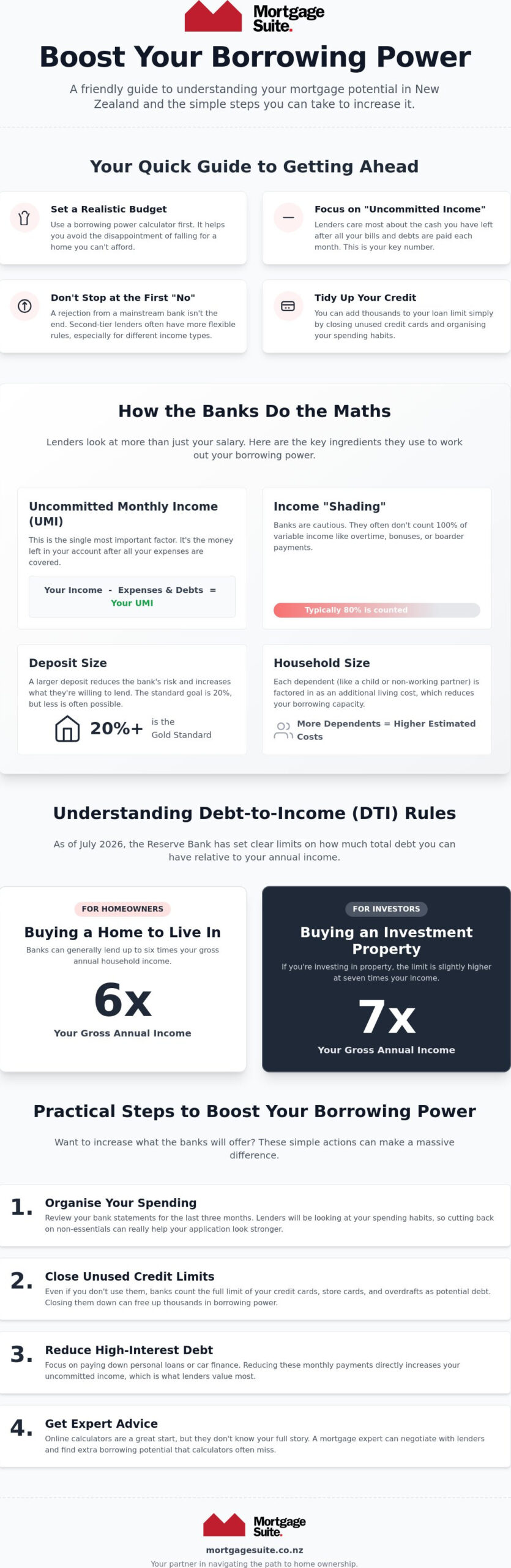
  • Lenders focus heavily on your “uncommitted income,” which is the amount of cash you have left over every month after all your bills and debts are paid.
  • A rejection from a mainstream bank does not mean your journey is over, as 2nd tier lenders often offer more flexible rules for different types of income.
  • You can often increase your loan limit by thousands of dollars just by closing unused credit cards and organising your spending three months before you apply.
  • While online tools provide a great starting point, a mortgage expert can often find extra borrowing potential through direct negotiation with lenders.

What is a Borrowing Power Calculator and Why Should You Use One?

A borrowing power calculator nz is essentially a digital health check for your finances. It takes a look at your income, your regular bills, and any debts you currently have to give you a rough idea of what a bank might be willing to lend you. Think of it as a helpful warm-up before you start the actual race of buying a home. Before you dive into the details, it helps to understand the basics of What is a mortgage and how these loans function as a long-term commitment. Using a tool like this early in the piece allows you to identify any spending habits that might look like red flags to a bank, such as high credit card limits or too many small “buy now, pay later” debts.

The main reason to use a calculator is to set a realistic budget for your property search. There is nothing more heartbreaking than falling in love with a beautiful home, only to find out later that your bank won’t even consider lending you that much. By getting an estimate first, you can narrow your search to houses you can actually afford. Fundamentally, your borrowing power is the balance between your gross income and your ability to service a loan comfortably. It is a measurement of how much breathing room you have in your budget after the mortgage is paid.

The Difference Between Borrowing Power and Affordability

It is vital to remember that there is a big difference between what a bank could give you and what you should take. Borrowing power is the maximum limit a lender sets based on their internal rules. Affordability, on the other hand, is about your daily life. Can you still afford a holiday, a new car, or even just the weekly grocery shop if you take that maximum loan? You should never aim for the absolute ceiling the calculator shows. Lenders also use interest rate “stress tests,” calculating your repayments at a much higher rate than the current market to ensure you can handle future changes without stress.

Why 2026 is a Unique Year for NZ Borrowers

This year has brought some specific challenges and opportunities for Kiwis. With the Official Cash Rate (OCR) sitting at 2.50 per cent as of July 2026, mortgage rates have shifted, directly impacting how much you can borrow. Before you start crunching numbers, take a look at the current Mortgage Rates NZ to see where the market stands. We are also seeing the full effect of Debt-to-Income (DTI) rules, which limit your total debt based on your yearly earnings. These changes mean the goalposts have shifted, making it more important than ever to have an accurate picture of your financial standing before you apply.

How the Math Works: The Key Factors Lenders Look At

Lenders don’t just look at your total salary and call it a day. They are far more interested in what we call “uncommitted income.” This is the actual cash you have left over once every single bill, grocery shop, and debt repayment is settled. When you play around with a borrowing power calculator nz, it tries to mirror this logic, but banks add their own layers of caution. For example, lenders often “shade” certain types of income, such as boarder payments or overtime, by typically counting only 80 per cent of the total to stay on the safe side. This buffer protects the bank if your extra shifts dry up or a flatmate decides to move out unexpectedly.

Your deposit size is another heavy hitter in the calculation, especially for first-home buyers. While a 20 per cent deposit is the standard goal, banks can still lend to those with less, though they will usually add a “low equity margin” to your interest rate to cover the extra risk. You also need to account for your household size and your deposit-to-loan ratios. Each dependent, whether it is a child or a non-working adult, is seen as an additional cost. This naturally reduces the amount of money the bank believes you have available to pay back a loan each month.

Understanding Income-to-Debt Limits

As of July 2026, the Reserve Bank has set firm boundaries that every borrower needs to understand. For people buying a home to live in, banks generally limit new lending to six times your gross annual income. If you are a residential investor, that limit shifts to seven times your income. This means even a high salary won’t help you borrow more if you are already carrying significant debt from car loans or personal finance. To get a better feel for how these numbers fit into the wider home buying and selling process, it is worth checking out government resources that break down the practical steps of the journey. If you are finding that the standard tools aren’t giving you the full picture, a professional review of your numbers can often reveal options you might have missed.

The Impact of “Hidden” Expenses

Small habits can have a surprisingly large impact on your final loan offer. Lenders now look closely at buy now, pay later schemes, often treating your total available limit as an active debt, even if you don’t owe a cent at the moment. Your regular subscriptions, from Netflix to your local gym, also get added to your living cost declaration. Being accurate and honest about these costs is essential. If a bank spots a pattern of high spending that contradicts your application, it can lead to a quick decline. Taking the time to tidy up these small leaks in your budget three months before you apply can significantly boost your standing in the eyes of a lender.

Why Different Lenders Give You Different Numbers

It is a common source of frustration for many Kiwis. You sit down at night, open a borrowing power calculator nz on one bank’s website, and get a number that feels great. Then, you try another, and the limit drops by fifty thousand dollars. This happens because every lender in New Zealand has its own internal “risk appetite.” They don’t all use the same math to decide what you can afford. Some might be more generous with how they view your bonuses, while others might be much stricter about your childcare costs. Each bank has its own set of rules that act like a filter for your application.

Using a neutral tool like the Sorted mortgage calculator is a fantastic way to get a baseline. It gives you a clear, unbiased look at what your repayments might look like without the slant of a specific bank’s policy. However, even a great tool cannot tell you which lender is currently looking to grow its mortgage book by being more flexible with its criteria. A broker can compare multiple calculators at once to find the most generous offer, ensuring you don’t miss out on a property just because one bank’s “cookie-cutter” rules didn’t fit your life.

Mainstream Banks vs. Non-Bank Lenders

Mainstream banks are designed for regular salary earners. If you have been in your job for years and have a tidy 20 per cent deposit, they are usually your first port of call. But life isn’t always that tidy. If you are self-employed, working as a contractor, or trying to buy with a smaller deposit, you might find the big banks are quite quick to say no. This is when looking at a 2nd Tier Lender New Zealand becomes essential. These non-bank lenders often provide alternative paths for people with unique financial profiles. We focus on bridging this gap, using our 20 years of banking experience to find the options that a standard bank tool simply cannot see.

The Role of Credit Scores in Your Calculation

Your credit score is essentially your financial reputation. While a calculator asks for your income and expenses, it often doesn’t account for your credit history until you actually apply. A poor score can “lock” you out of certain tiers of lending, even if you earn a high salary. Some lenders will decline an application over a single minor credit hiccup from years ago; others are more pragmatic and will look at why it happened and how you have managed your money since. It is a smart move to check your credit report before you get too deep into the house-hunting process. Knowing your score allows us to target the right lenders from the start, saving you from unnecessary declines.
Borrowing Power Calculator NZ: How Much Can You Really Afford in 2026?

How to Boost Your Borrowing Power Before You Apply

The number you get from a borrowing power calculator nz is just the starting line. You actually have a lot of control over that final figure. To get the best result, you should start organising your finances at least three months before you plan to buy. Banks usually want to see your last 90 days of bank statements, so this is your window to show them you are a reliable borrower. If you can prove that you are disciplined with your cash, lenders are much more likely to trust you with a larger loan.

Presenting “clean” bank statements is one of the most effective things you can do. It requires a bit of planning, but it is a simple fix. Follow these steps to tidy up your records:

  • Cut back on the extras: You don’t need to live on bread and water, but reducing high-frequency spending like takeout or luxury subscriptions makes your living costs look much better on paper.
  • Avoid unarranged overdrafts: Even a small dip into the red can signal to a lender that you aren’t quite on top of your cash flow.
  • Clear your buy now, pay later services: Try to have all accounts for these services closed and cleared so they don’t appear as active credit limits.
  • Label your transfers: If you are moving money to savings, label it clearly so the bank sees it as a positive habit rather than a mystery expense.

Managing Your Income-to-Debt Ratio

Many Kiwis fall into the “credit card trap” without realising it. Even if you have a zero balance, a $10,000 credit card limit can slash your borrowing power by a massive amount. The bank assumes the worst. They calculate your ability to pay based on the possibility that you might max out that card tomorrow. Closing unused cards or lowering the limits is one of the fastest ways to see a jump in your potential loan amount. Often, focusing on increasing your deposit is more effective than trying to squeeze out a small pay rise, as it lowers the bank’s risk and improves your overall position.

Proving Your Income for Complex Situations

Self-employed Kiwis often struggle with standard applications because their income can look less predictable to a bank’s computer. You will generally need to show stability through at least two years of financial accounts, but we can help you present these in the best light. If you are a first-time buyer, you might also consider using rental income from a flatmate or boarder to tip the scales. This extra cash can be added to your ability to pay back the loan, which makes a significant difference to the final offer. For more specific tips on getting started, check out our Home Loans for First Home Buyers guide. If you want to know exactly how much these changes will help your specific case, you can request a professional review of your finances to see where you stand.

Moving Beyond the Tool: Why a Mortgage Broker is Essential

While a borrowing power calculator nz provides a useful snapshot, it is essentially a static tool. It cannot account for the fact that the lending market moves every single week. Banks change their internal policies, interest rates fluctuate, and new rules from the Reserve Bank can shift your potential loan limit overnight. This is where having a seasoned advocate like Krish Krishna makes the difference. With over 20 years of banking experience, we don’t just look at the numbers; we look at the story behind them. We know which lenders are currently open to negotiation and how to present your case to get exceptions that a computer program would simply ignore. Having a veteran industry expert on your side means you have someone who has seen every possible scenario and knows exactly how to navigate the hurdles.

Beyond just finding the maximum amount, we help you decide on the right structure for your loan. Choosing between fixed and floating rates is not just about the lowest number today. It is about your long-term goals and your comfort with risk. If you plan to pay off your debt quickly or if you need the stability of knowing exactly what your bills will be for the next few years, the right structure is vital. We act as your dedicated negotiator, bridging the gap between the rigid world of big banks and your personal needs as a borrower. This hands-on approach ensures that you aren’t just another file in a system, but a priority.

Personalised Strategy vs. Online Estimates

If an online tool gives you a “no,” it is not necessarily the end of the road. Online estimates are often based on the most conservative settings and “cookie-cutter” rules that don’t account for your unique situation. We take a different approach by tailoring your application to highlight your specific financial strengths, whether that is a solid career path or a history of disciplined saving. We also conduct a professional “stress test” of your budget. This gives you genuine peace of mind, knowing that you can comfortably afford your home even if life throws a curveball or interest rates rise in the future.

Your Next Steps to Home Ownership

Moving from an estimate to a real-world offer is a straightforward process when you have the right support. To get started, gather your last three months of bank statements and your most recent payslips. These documents tell the story of your financial health and are the first things any lender will want to see. Once you have those ready, reach out for a no-obligation chat. We can look at your real-world options and help you find a lender that fits your specific financial profile. Ready to see your true borrowing power? Contact Mortgage Suite today.

Take the Next Step Toward Your New Home

A borrowing power calculator nz is a fantastic first step, but it only tells part of the story. Your true potential depends on how you present your finances and which lender you choose to partner with. Whether you are a first-home buyer navigating the 2026 market or an investor looking for more flexible 2nd tier options, the right strategy can turn a “no” into a “yes.”

You don’t have to figure this out on your own. With over 20 years of banking and brokerage experience, we specialise in finding the “hidden” potential that standard tools often miss. We provide personalised advocacy for first-home buyers and expert guidance for those who don’t fit the standard bank criteria. If you are ready to move beyond estimates and get a real-world plan, book a free consultation with Krish to find your true borrowing power. Your home-ownership goals are within reach, and we are here to help you navigate every hurdle with confidence.

Frequently Asked Questions

How much can I borrow for a home loan in NZ?

You can generally borrow between five to six times your gross annual income, though this depends on your specific debts and expenses. A borrowing power calculator nz will give you a rough estimate, but lenders also apply “stress tests” using interest rates higher than the current market. These tests ensure you can still manage repayments if rates rise, which is why your final offer might be lower than your gross income suggests.

Does a student loan affect my borrowing power?

Yes, your student loan definitely has an impact because it reduces your take-home pay every fortnight. Lenders look at your “net” income to see what is left for mortgage repayments, so the 12 per cent deduction for student loan repayments lowers your servicing capacity. Clearing this debt before you apply can often boost the amount a bank is willing to lend you.

Can I use my KiwiSaver as part of my deposit calculation?

You certainly can use your KiwiSaver savings as part of your deposit, provided you have been a member for at least three years. This extra cash increases your total deposit, which improves your Loan-to-Value Ratio (LVR). A larger deposit often makes you a more attractive borrower to the banks and can sometimes help you avoid the extra costs associated with low-equity loans.

What is the current DTI limit for NZ mortgages in 2026?

As of July 2026, the Reserve Bank has set the Debt-to-Income (DTI) limit at six times your gross income for owner-occupiers. For residential investors, the limit is slightly higher at seven times your income. Banks are allowed to do a small amount of lending above these levels, but most applicants will need to stay within these boundaries to get their loan approved.

How do credit card limits affect my borrowing power?

Lenders look at the total credit limit on your cards, even if you never use them and the balance is zero. They assume you could spend that entire limit tomorrow, so they factor the potential repayments into your monthly costs. Closing down unused cards or reducing your limits to a couple of thousand dollars is a quick way to see your borrowing potential jump.

Can I still borrow if I am self-employed or have a “2nd tier” profile?

Absolutely, you can still borrow if you are self-employed or don’t fit the standard bank profile. While mainstream banks might be hesitant, 2nd tier lenders specialise in looking at the bigger picture for business owners and those with unique income types. We focus on finding these alternative paths to ensure you aren’t locked out of the market just because your paperwork looks a bit different.

How often should I re-run a borrowing power calculator?

It is a good idea to re-run a borrowing power calculator nz whenever your financial situation changes or interest rates shift. If you get a pay rise, pay off a car loan, or if the Reserve Bank changes the OCR, your borrowing limit will move. Keeping an eye on these numbers helps you stay realistic about which properties you should be looking at during your search.

Will a small deposit of 5% or 10% reduce how much I can borrow?

Having a smaller deposit of 5 or 10 per cent usually means you can borrow less than someone with a full 20 per cent deposit. This is because banks have strict “speed limits” on how many low-deposit loans they can give out. You will also likely face a “low equity margin,” which is an extra interest cost that reduces the total amount you can comfortably service.

Article by

Krish Krishna

Experienced Financial Adviser with over 46 years of Banking and Mortgage broking experience and over $2.0 Billion in loan settlements.

Low Doc Home Loans NZ: The 2026 Guide for Self-Employed Kiwis

What if the true value of your business wasn’t hidden behind a stack of two-year-old tax returns, but was found in the actual success you’re seeing right now? For many self-employed Kiwis, the dream of owning a home often feels like it’s on hold because mainstream banks refuse to look past rigid, traditional criteria. It’s frustrating to feel like your hard work doesn’t count just because your paperwork looks a bit different. While the market for low doc home loans nz has changed significantly under recent lending laws, the path to approval is still very much open if you know which doors to knock on.

I understand the anxiety that comes with a potential decline, which is why I’ve put together this updated 2026 guide to help you navigate the shift toward “Alt Doc” lending. You’ll discover how to secure a home loan using alternative proof like GST returns or bank statements, allowing you to move forward without waiting on the IRD. We’ll explore the specific documents that actually carry weight today and how to partner with lenders who appreciate business growth. By the end of this article, you’ll have a clear, stress-free strategy to get your application over the line and finally settle into your new home.

Key Takeaways

  • Understand why the shift from “Low Doc” to “Alt Doc” means you can now use alternative proof like GST returns to show your true business income.
  • Learn how to organise your bank statements and trading history to give lenders a clear, honest picture of your business’s success.
  • Discover why 2nd tier lenders often provide the flexibility you need, even if you only have a 20% deposit or a shorter trading history.
  • See how an expert broker acts as your advocate, packaging your application for low doc home loans nz to ensure it stands out to the right lenders.
  • Find out how to clear common hurdles like credit blips or a short time in business so you can move forward with confidence.

What is a Low Doc Home Loan in New Zealand Today?

When you’re running your own show, your finances don’t always fit into a neat little box. A home loan for the self-employed shouldn’t depend on whether you have a perfect set of tax returns from two years ago. In the current market, low doc home loans nz have evolved into what we now call “Alt Doc” or alternative documentation loans. This doesn’t mean you’re providing “less” information; it means you’re providing “different” information that better reflects your current success. It is a way to prove your income using real-time data rather than historical tax records.

Historically, a low-documentation loan (low-doc) might have carried a different reputation, but in 2026, it’s a legitimate strategy for contractors, freelancers, and small business owners who have been GST registered for at least six months. It’s vital to understand that “low doc” is never “no doc”. Lenders still have a legal duty to ensure you can comfortably handle your repayments. They just use different tools to verify your income, such as your business bank statements or GST filings, to get a clear picture of your actual earnings.

Why traditional banks often say no

Most mainstream banks still cling to the “two-year rule”. They want to see two full years of financial statements and personal tax summaries before they even consider your application. The problem is that many savvy business owners use legal expenses to lower their taxable income. While this is great for your tax bill, it can make you look like you aren’t able to afford the repayments on paper when a bank calculates your borrowing power. Added to this is the impact of the CCCFA, which has forced banks to become incredibly cautious and rigid with their lending criteria, often leaving self-employed Kiwis out in the cold. If you’ve already experienced this firsthand, our guide for those declined by bank home loan NZ lenders explains exactly what your next steps should be.

The rise of Alt Doc lending in 2026

The rise of Alt Doc lending is the biggest change for low doc home loans nz in 2026. This is where 2nd tier lenders have stepped up to fill the gap. Instead of looking at what happened in 2024, these lenders focus on your business’s current cash flow. They prioritise your valid NZBN and active GST status over ancient paperwork. By looking at your last six months of trading, they get a real-time view of your ability to manage a loan. If you want to see how these lenders operate, our 2nd tier lender New Zealand guide provides more detail on how they bridge the gap between rigid bank rules and your reality.

How to Prepare Your Alt Doc Application: A 5-Step Guide

Getting your ducks in a row before you talk to a lender is the best way to avoid the stress of a back-and-forth process. While the term low doc home loans nz might suggest a lack of paperwork, the secret to a quick approval is having the right alternative documents ready from the start. Follow these five steps to present a professional, clear case for your business success.

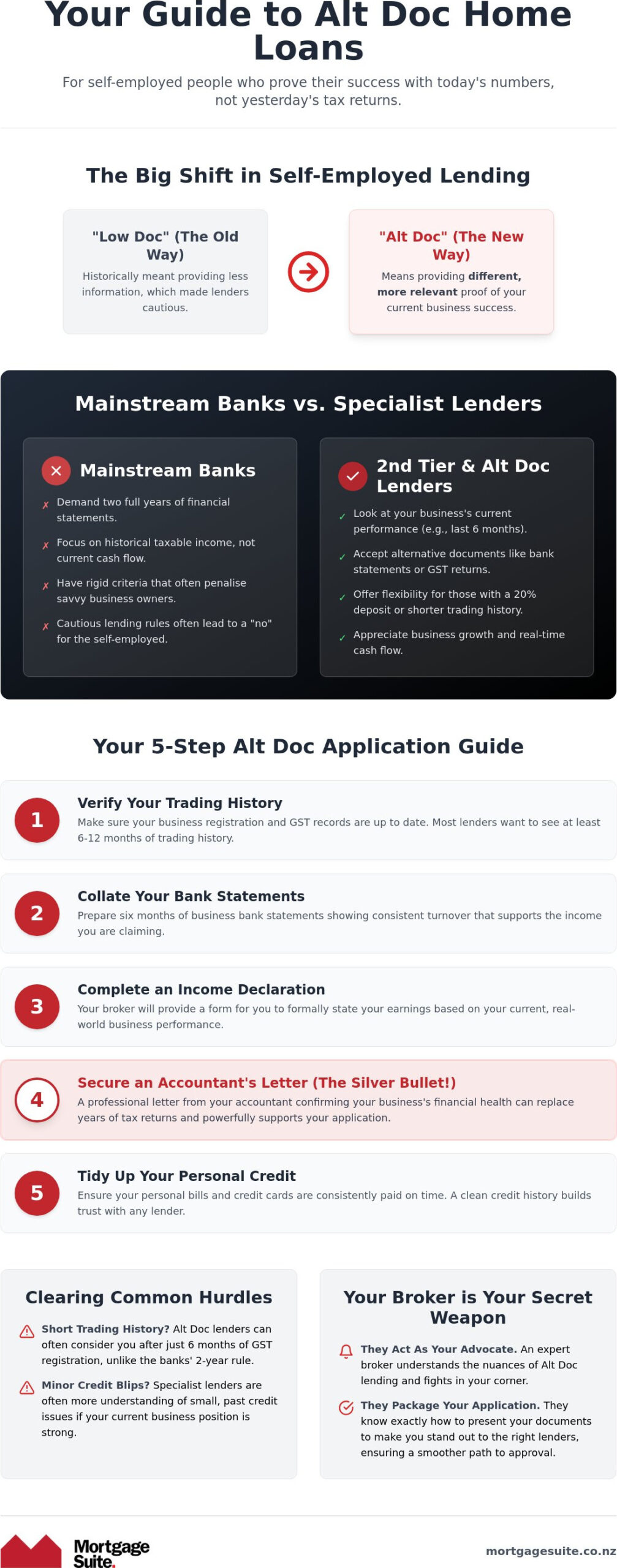
  • Step 1: Verify your trading history. Ensure your NZBN is active and your GST records are up to date. Most lenders want to see you’ve been trading for at least six months to a year.
  • Step 2: Pull your bank statements. You’ll need six months of business bank statements. These should show a consistent turnover that matches the income you’re claiming.
  • Step 3: Complete a declaration form. Your broker will provide a “Self-Employed Declaration of Income”. This is a formal document where you state your earnings based on your current business performance.
  • Step 4: Secure an accountant’s letter. A professional letter from your accountant can be a powerful substitute for traditional tax returns.
  • Step 5: Tidy up your personal credit. Small blips can happen, but ensuring your personal bills and credit cards are paid on time helps build trust with the lender.

The “Accountant’s Letter” advantage

A well-drafted letter from your accountant is often the “silver bullet” for Alt Doc applications. It needs to clearly state that your business is financially healthy, stable, and that you can afford the loan repayments without any struggle. This one page can effectively replace a year’s worth of tax returns because it provides professional validation of your current financial position. When you speak to your accountant, explain your home loan goals so they can focus the letter on your business’s ability to generate steady cash flow. It’s about showing the lender that your business isn’t just surviving, it’s thriving.

Proving income through bank statements

Lenders look at your business account to see the “rhythm” of your money. They want to see regular deposits that prove your turnover is stable. One common concern is large, one-off expenses, like buying a new van or a specialised piece of equipment. Don’t worry about these; we can often treat these as “add-backs”. This means we explain to the lender that these were one-time costs or non-cash expenses like depreciation, which shouldn’t count against your ability to pay a mortgage. If you’re unsure how your statements look, talking to the team at Mortgage Suite Ltd early on can help you identify and explain any potential red flags before the lender ever sees them.

Mainstream Banks vs. 2nd Tier Lenders: Comparing Your Options

Choosing between a big bank and a 2nd tier lender isn’t just about comparing interest rates; it’s about finding a partner who actually wants to hear your business’s story. Mainstream banks often rely on rigid, computer-based systems that look for reasons to say no if your tax returns don’t meet their exact standards. In contrast, 2nd tier lenders are built for the complex reality of running a business. While you’ll generally need a 20% deposit for low doc home loans nz, the flexibility you gain is often the key to getting your house keys sooner rather than later.

The trade-off for this flexibility is usually a slightly higher interest rate. However, it’s vital to look at the bigger picture. Non-bank lenders often move much faster than the “big four” banks, with some approvals coming through in a matter of days. When you’re trying to secure a property in a competitive market, that speed is a massive advantage. You aren’t just paying for a loan; you’re paying for the ability to act quickly and bypass the bureaucracy that stalls so many other buyers.

Think of an alternative loan as a bridge. It’s a stepping stone that gets you into the property market today. Once you’ve built up some equity and have those two years of financial statements the big banks crave, we can look at refinancing you back to a mainstream lender at a lower rate. This strategy prevents you from being locked out of the market while property prices continue to climb. It’s about getting the house now and fixing the rate later down the track.

When the bank says no, who says yes?

This is where the world of non-bank lenders in NZ truly shines. These institutions use a human-led loan assessment, which means a real person looks at your application instead of a computer simply rejecting it. They are far more comfortable with diverse income streams and business “add-backs”. For example, if your profit looks low because you claimed significant depreciation or had a one-off equipment purchase, a 2nd tier lender will often count those amounts back into your income, giving you a much higher borrowing capacity.

Understanding the costs involved

It’s important to be clear about the costs from the start. Alternative loans sometimes come with an establishment fee that you wouldn’t typically see at a mainstream bank. You need to weigh this cost against the “cost of waiting”. If property prices rise significantly while you’re waiting a year to get your tax returns ready, that delay could cost you far more than a one-off fee. Working with a broker ensures you find the most competitive non-bank rate available, making sure the path to your new home is as affordable as possible.

Low Doc Home Loans NZ: The 2026 Guide for Self-Employed Kiwis

Common Hurdles for Self-Employed Borrowers (and How to Clear Them)

The journey to home ownership for a business owner often feels like an uphill battle against a system designed for employees. Even when your business is thriving, you might face obstacles that make a standard bank manager shake their head. Whether it’s a “messy” financial year or a lack of recent tax records, these challenges are common. The good news is that low doc home loans nz are specifically designed to clear these hurdles. By focusing on your current success rather than past setbacks, we can find a path forward that values your business’s potential.

One of the biggest roadblocks is a short trading history. While mainstream banks usually demand two full years of profitable tax returns, many alternative lenders are happy to consider your application if you’ve been in business for just six to twelve months. Another frequent concern is a rough patch in your business’s past. If an unexpected bill or a slow season caused a dip in your credit score, non-conforming home loans can provide a lifeline. These products are tailored for Kiwis who don’t fit the “perfect” borrower profile but have a solid plan to move forward.

Presenting your income correctly is also vital. You might pay yourself a mix of dividends and a small salary to be tax efficient. A bank might only look at the salary, but a specialist lender will look at the total business profit available to you. If you’re struggling with a deposit, remember that you can often use equity in other assets or even a gift from family to reach that 20% mark required for most Alt Doc products.

What if my tax returns aren’t filed yet?

It’s a common story; your business is flying, but your accountant hasn’t quite finished last year’s books. This isn’t the deal-breaker it used to be. We can use your latest GST returns as interim proof of income to show how your business is performing right now. Combined with management accounts from your software, like Xero or MYOB, we can tell a compelling story of your current financial health. Being behind on paperwork is a hurdle we can jump by using real-time data to prove you can afford the repayments.

The importance of a clean credit file

Small business owners often have “busy” credit files because they’re frequently applying for trade credit or equipment finance. This can sometimes look like a red flag to a computer, but a human lender understands the context. Before you apply, it’s a good idea to “polish” your file by ensuring all personal utilities and credit cards are paid on time. If there is a mark on your record, don’t panic. Often, a simple explanation of what happened and how you’ve fixed it is all a specialist lender needs to hear. If you’re ready to see how your business stacks up, you can explore your home loan options with us today.

Why a Mortgage Broker is Your Secret Weapon for Low Doc Loans

Applying for low doc home loans nz directly with a mainstream bank is often a recipe for disappointment. Banks rely on rigid systems that aren’t built to understand the ebbs and flows of business income. When you walk into a branch, you’re often met with a “computer says no” outcome simply because your tax returns aren’t current. This is where a broker becomes your most valuable asset. We don’t just pass on your documents; we act as your advocate, translating your business success into a language that lenders understand and respect.

Our role is to package your application so it highlights your strengths rather than your paperwork gaps. We know which 2nd tier lenders are “hungry” for new business and which ones are currently offering the most flexible terms for your specific industry. By having a seasoned negotiator in your corner, you avoid the stress of multiple declines and protect your credit file from unnecessary enquiries. We use our 20 plus years of industry experience to navigate the hurdles we’ve discussed, ensuring your application lands on the desk of a human underwriter who can see the real value in your business.

A personal approach to complex finance

Krish Krishna has spent over two decades helping Kiwis navigate the complexities of the lending market. At Mortgage Suite Ltd, we believe in a partnership that lasts well beyond your initial settlement. We don’t just get you a loan and walk away; we help you build a long-term strategy. As we mentioned earlier, an Alt Doc loan is often a stepping stone. We’ll work with you over the coming years to monitor your business growth and identify the perfect moment to refinance you back to a mainstream bank once you have the traditional records they require.

Getting started with Mortgage Suite Ltd

We know that the thought of hunting down bank statements and GST records can feel overwhelming when you’re already busy running a business. Our goal is to take that weight off your shoulders. It all starts with a relaxed, no-obligation chat to see where you stand and what your goals are. We’ll give you a clear, honest assessment of your options and handle the heavy lifting of the application process for you. Ready to talk about your self-employed home loan? Get in touch with Mortgage Suite Ltd today.

Take the First Step Toward Your New Home Today

Running a business is a significant achievement, and it shouldn’t be the reason you’re locked out of the property market. We’ve seen how the shift toward alternative documentation means you can use real-time proof, like your GST returns and bank statements, to show lenders you’re a safe bet. Securing low doc home loans nz in 2026 isn’t about having less proof; it’s about using the right proof to tell your story. Whether you’re dealing with a short trading history or complex income streams, there’s almost always a path forward when you have the right advocate in your corner.

At Mortgage Suite Ltd, we bring over 20 years of banking and brokerage experience to the table. We specialise in 2nd tier and non-bank lending, providing tailored solutions for complex self-employed income that mainstream banks often overlook. You don’t have to navigate this paperwork hunt alone. We’re here to help you bridge the gap between your business success and your home ownership goals. Book a free consultation with our self-employed loan experts and let’s get your application moving. You’ve done the hard work of building your business; now let us do the hard work of securing your home.

Frequently Asked Questions

Can I get a low doc loan with only a 10% deposit in NZ?

The short answer is usually no. Most lenders providing low doc home loans nz require at least a 20% deposit because they are taking on more risk by not seeing your full tax returns. While some mainstream bank loans allow for a 10% deposit, those almost always require two years of perfect financial statements, which is exactly what Alt Doc products help you avoid.

Do low doc home loans have higher interest rates?

Yes, you’ll generally find that interest rates are slightly higher than standard bank rates. For example, as of July 2026, some specialist floating rates start around 7.65% p.a., while prime Alt Doc options might start closer to 5.64% p.a. You’re essentially paying a small premium for the flexibility and speed that a non-bank lender provides when your paperwork isn’t ready for a traditional bank.

How long do I need to be self-employed before I can apply for an alt doc loan?

You typically need to have been trading and GST registered for at least six months. While traditional banks almost always demand a two-year history, many 2nd tier lenders are happy to look at your business once you’ve crossed that six-month mark. They’ll use your interim GST returns and bank statements to prove that your business is stable and growing.

Is a low doc loan the same as a bad credit loan?

No, they are two different things. A low doc loan is for business owners with a strong income who simply don’t have up-to-date tax returns. A bad credit, or non-conforming loan, is designed for people who have had defaults or missed payments in the past. It’s possible to have a loan that is both Alt Doc and non-conforming, but they solve two different problems for the borrower.

What documents replace a tax return in a low doc application?

Lenders usually look for three main things: six months of business bank statements, your most recent GST returns, and a signed declaration of your income. An accountant’s letter confirming your business is profitable and solvent is also a very powerful document that can speed up your approval. These pieces of evidence give the lender a real-time view of your actual cash flow.

Can I use a low doc loan to buy an investment property?

Yes, you can certainly use these loans for residential investment properties. The main difference is that the deposit requirements might be slightly higher than for a home you plan to live in. While 20% is standard for owner-occupiers, some lenders might ask for a 25% deposit for an investment property to offset the extra risk.

Will a low doc loan allow me to refinance later?

Refinancing is actually the goal for most of our self-employed clients. You can use an Alt Doc loan to get into your home now, and then once you have two years of clean tax returns, we can look at moving you to a mainstream bank. This “stepping stone” strategy allows you to stop paying rent and start building equity while you get your long-term paperwork in order.

Do I need an accountant to get a low doc home loan?

While it isn’t always a strict legal requirement, having an accountant makes the process much smoother. Many 2nd tier lenders will ask for an “Accountant’s Letter” to verify your earnings. If you don’t have an accountant, we can still work with your bank statements and GST filings, but a professional letter often provides the extra level of trust that secures a faster approval.

Article by

Krish Krishna

Experienced Financial Adviser with over 46 years of Banking and Mortgage broking experience and over $2.0 Billion in loan settlements.

How to Qualify for a Home Loan in NZ: The 2026 Comprehensive Checklist

What if a "no" from a mainstream bank wasn’t a closed door, but a sign that you simply needed a more tailored approach to your finances? Many Kiwis feel a sense of dread when looking at their bank balance, especially with the 2024 debt-to-income (DTI) restrictions still making things difficult for first home buyers and investors alike. You’re likely searching for exactly how to qualify for a home loan NZ lenders will approve in 2026. With the Official Cash Rate at 2.25 percent and standard one-year rates sitting near 4.89 percent, the financial landscape requires a steady hand and a clear strategy.

It’s completely natural to feel anxious about your credit score or confused by the difference between a 5 percent and 20 percent deposit requirement. We believe that every borrower deserves a transparent path to home ownership. This comprehensive checklist will help you master the financial requirements and documentation needed to secure your New Zealand home loan with confidence. We’ll examine everything from modern servicing requirements to the 2nd tier lending options that provide a vital lifeline when mainstream banks hesitate.

Key Takeaways

  • Learn how the 2026 lending benchmarks, including the 2.25 per cent OCR and DTI restrictions, define your current borrowing power.
  • Discover how to qualify for a home loan NZ lenders will approve by mastering the “uncommitted monthly income” test and optimising your debt-to-income ratio.
  • Understand why a rejection from a mainstream bank isn’t the end of the road and how 2nd tier lenders offer flexible paths for non-conforming borrowers.
  • Secure a seamless application process by using our master checklist to gather “Golden Documents” and proactively fix credit report errors.
  • Gain the confidence of having a seasoned advocate to negotiate complex bank policies and ensure your financial readiness is presented in the best possible light.

Table of Contents

The Fundamental Pillars of Home Loan Qualification in New Zealand

Home Loan Qualification is the process of proving both financial stability and collateral security to a lender. In the 2026 market, this proof is measured against three specific benchmarks: the Official Cash Rate (OCR), Loan-to-Value Ratios (LVR), and Debt-to-Income (DTI) caps. With the OCR currently at 2.25 percent, banks have maintained a cautious approach to lending, making it essential to understand how to qualify for a home loan NZ lenders will actually approve. Understanding New_Zealand’s property market dynamics helps explain why these hurdles exist; they act as a safeguard for both the borrower and the financial system against future economic volatility.

The deposit you bring to the table remains the primary factor in determining your interest rate and lender options. While a 20 percent deposit is the gold standard for avoiding low equity margins and securing the best carded rates, many first-time buyers aim for the 10 percent or 5 percent thresholds. If you’re looking at a 5 percent deposit through the Kāinga Ora First Home Loan, you’ll need to stay within the income caps of $95,000 for a single buyer or $150,000 for couples or those with dependents. If your income exceeds these limits but your deposit is small, you aren’t necessarily out of options, but you’ll likely need to explore low deposit home loan NZ solutions through 2nd tier lenders who offer more flexibility.

Residency and Legal Status Requirements

Before you start visiting open homes, you must confirm your legal eligibility to purchase property. New Zealand citizens and permanent residents face the fewest obstacles. To be considered "ordinarily resident", you typically need to have lived in New Zealand for the preceding 12 months and held a valid residence class visa during that entire period. Australians and Singaporeans enjoy specific rights due to trade agreements, but most other visa holders will find the path more complex. If you’re on a work visa, banks often require a minimum 20 percent deposit and proof of your long-term intent to remain in the country.

The Deposit: KiwiSaver, Grants, and Savings

Your KiwiSaver account is likely to be your most significant tool for building a deposit. In 2026, you can withdraw your total balance, excluding the initial $1,000 government contribution, as long as you’ve been a member for at least three years. Don’t forget that the First Home Grant was discontinued on 22 May 2024, so it’s no longer a source of funding for new applicants. If you’re receiving financial help from family, lenders will require a formal gifting certificate. This document confirms the funds are a non-repayable gift, ensuring the bank doesn’t view the contribution as an undisclosed debt that would negatively impact your DTI ratio. Understanding the full picture of home loan deposit requirements NZ lenders apply in 2026 can help you plan your savings strategy with far greater precision.

Assessing Your Financial Fitness: Income, Expenses, and DTI

Securing a deposit is only half the battle. In 2026, understanding how to qualify for a home loan NZ lenders will sign off on requires a deep dive into your Debt-to-Income (DTI) ratio. Since the regulations introduced in mid-2024, banks are strictly limited in how much high-DTI lending they can provide. For most owner-occupiers, this means your total debt, including your new mortgage, should not exceed six times your gross annual income. If you’re looking at First Home Loan eligibility criteria, you’ll see that income caps and DTI limits work together to define your maximum borrowing ceiling.

Beyond the raw numbers of your salary, credit officers now scrutinise your "uncommitted monthly income". This is what remains after all your essential costs, existing debts, and a buffer for life’s surprises are deducted. It’s why your daily latte habit or frequent Uber Eats orders actually matter; they represent discretionary spending that could, in the bank’s eyes, be redirected toward mortgage repayments. Lenders stress-test your ability to pay at interest rates 2-3% higher than current market rates. This ensures that even if the OCR climbs further, your household budget won’t collapse under the weight of rising repayments.

Income Verification for Different Employment Types

The way you earn your living dictates the paperwork you’ll need to provide. PAYE employees usually have the simplest path, requiring three months of consecutive payslips and a summary of earnings from the IRD. If you’re self-employed, the requirements are more stringent. You’ll need at least two years of certified accounts and IRD tax summaries to prove your business is stable and profitable. Contractors and those in the gig economy often face more scrutiny due to irregular income. Lenders will look for a consistent history of contracts and a healthy "buffer" in your savings to offset periods between jobs. If your income structure is complex, speaking with a specialist can help you present your earnings in the most favourable light.

The Expense Audit: Cleaning Up Your Transaction History

Banks will typically request three to six months of transaction history to look for "red flag" behaviours. Frequent gambling transactions, heavy reliance on Buy Now Pay Later (BNPL) services, or a long list of unused subscriptions can signal poor financial discipline. We recommend "grooming" your accounts at least 90 days before you apply. This means clearing small debts and ensuring your bank statements reflect a disciplined, organised lifestyle. Existing liabilities like car loans or high credit card limits also reduce your borrowing power. Even if you don’t use your full credit limit, the bank calculates your DTI based on the total limit available to you, not just the balance you owe.

Mainstream Banks vs. 2nd Tier Lenders: Finding Your Best Path

Receiving a rejection letter from a major bank can be disheartening, but it certainly isn’t the end of your home ownership journey. The New Zealand financial market is more diverse than many realise. While mainstream banks have rigid, automated systems, 2nd tier lenders often take a more holistic, manual approach to assessing risk. If you are struggling with how to qualify for a home loan NZ banks have declined, these alternative lenders provide a vital pathway. They are often willing to look at the story behind the numbers, providing solutions for those who don’t fit the traditional "cookie-cutter" borrower profile.

The trade-off for this increased flexibility is typically a slightly higher interest rate and potentially different fee structures. However, this cost should be viewed as a strategic investment. At Mortgage Suite Ltd, we specialise in acting as the bridge between you and these alternative capital sources. We understand which lenders have an appetite for specific scenarios, ensuring you don’t waste time on applications destined for another decline. Our role is to negotiate the best possible terms, ensuring your path to property is as smooth and cost-effective as possible.

When to Consider a Non-Bank Lender

Non-bank lenders are an excellent option if your credit history has a few old marks, such as a past default that has since been resolved. They are also far more pragmatic when it comes to non-standard property types, including tiny homes, small inner-city apartments, or leasehold titles that mainstream banks often avoid. Additionally, self-employed individuals who have been trading for less than two years often find a much warmer reception here. These lenders focus on your current ability to service the debt rather than just your historical tax returns.

The Path Back to Mainstream Banking

We often recommend using 2nd tier lending as a short-term stepping stone, typically for a period of one to three years. During this time, your main goal is to build equity and maintain a flawless repayment history. This period allows you to "season" your financial profile and move past any previous credit issues. Once you have reached a stronger equity position or have established a consistent track record, we can then help you refinance back to a mainstream lender. This transition allows you to benefit from lower interest rates while having already secured the property you want.

How to Qualify for a Home Loan in NZ: The 2026 Comprehensive Checklist

Your Step-by-Step Home Loan Qualification Checklist

Securing a pre-approval is your most powerful tool when entering the 2026 property market. It transforms you from a casual browser into a serious buyer, giving you the confidence to bid at auction or make unconditional offers. Understanding how to qualify for a home loan NZ lenders will prioritise involves more than just a healthy savings account; it requires a disciplined approach to paperwork. Before you approach any lender, we strongly advise checking your credit report. You can access your report for free from major providers like Centrix or Equifax. Reviewing this early allows you to fix any administrative errors or old disputes before a credit officer sees them.

Organise your documents in a digital folder for instant access during negotiations.

This proactive step ensures that when a property catches your eye, you aren’t scrambling for old payslips while another buyer swoops in. Having your files ready also demonstrates to the bank that you are a reliable, low-risk borrower who manages their affairs with professional precision. It reflects a level of financial readiness that can often sway a lender’s decision in your favour.

The Documentation Master List

  • Identification: A current passport or New Zealand driver’s licence, along with a recent utility bill or bank statement as proof of address.

  • Financials: Three to six months of consecutive bank statements for every account you hold, including credit cards and savings.

  • Proof of Deposit: Latest KiwiSaver statements, a formal gift letter if family is assisting, or receipts for term deposits.

  • Employment Proof: Your three most recent payslips or a signed employment contract if you have recently started a new role.

The Final "Ready to Buy" Sanity Check

Before you sign a Sale and Purchase Agreement, perform a final audit of your timeline. If you are using KiwiSaver for your deposit, initiate the withdrawal process early, as it typically takes 10 to 15 working days for funds to clear. While the First Home Grant was discontinued on 22 May 2024, you should verify that any other scheme approvals, such as the First Home Loan, remain current and valid for your intended purchase. Finally, ensure you have maintained a strict "spending freeze" for at least 90 days. This means no new debt, no large luxury purchases, and no changes to your credit limits. If you’re ready to take the next step, you can apply for a home loan with our team to get your pre-approval underway.

The 2026 lending environment is a complex machine with many moving parts. Between the 2.25 percent OCR and the rigid DTI caps, simply walking into your local branch often leads to a dead end. Going direct to a single bank limits your options to their specific, often inflexible, criteria. We believe that understanding how to qualify for a home loan NZ lenders will back requires a more sophisticated approach. At Mortgage Suite Ltd, we leverage over 20 years of deep institutional banking experience to act as your dedicated advocate. We don’t just process applications; we negotiate on your behalf to find a solution that fits your unique financial reality.

Our consultative method ensures that your home loan is a foundation for long-term wealth, not just a monthly expense. We look beyond the immediate approval to see how your debt structure will perform over the next decade. Whether you are seeking a standard residential loan or require the flexibility of 2nd tier capital, our team is committed to the removal of obstacles. This seasoned perspective is particularly valuable for those who have been told "no" elsewhere. We know exactly how to present your case to the right people to get to "yes".

Why Expertise Matters in a Volatile Market

A home loan is more than just an interest rate. The fine print often contains the most significant risks and opportunities. We help you understand the long-term impact of interest-only periods, the benefits of offset accounts, and the potential sting of break fees if you need to refinance. If your situation is non-conforming, our access to 2nd tier loans ensures you aren’t left behind by the mainstream banking system. For those just starting out, our Home Loans for First Home Buyers in New Zealand: The 2026 Comprehensive Guide provides an even deeper look at the specific grants and schemes available this year.

Your Partnership for Success

Our relationship with you doesn’t end when you get the keys. We view ourselves as your long-term partners in success. As your equity grows, we can help you plan the transition from first-home buyer to property investor. We provide ongoing support, reviewing your rates and structure as the OCR shifts or your life circumstances change. This proactive management ensures you are always in the best possible position to build equity. Booking a no-obligation strategy session is the first step toward financial readiness. Contact Mortgage Suite Ltd to start your qualification journey today and take control of your property future with a steady hand by your side.

Take the Next Step Toward Your New Zealand Home

Mastering the details of your debt-to-income ratio and maintaining a disciplined expense audit are the true keys to success in today’s market. While the 2026 lending environment remains complex, you don’t have to face it alone. We’ve explored the necessity of digital document readiness and the strategic advantage of looking toward 2nd tier lenders when mainstream banks say no. Understanding how to qualify for a home loan NZ lenders will approve is about more than just numbers; it’s about presenting a story of financial reliability.

With over 20 years of banking and lending expertise, our team acts as dedicated negotiators for both first-home buyers and seasoned investors. We are specialists in 2nd tier and non-bank solutions, ensuring that every client has a viable path forward regardless of their initial bank feedback. Secure your financial future with a tailored home loan strategy from Mortgage Suite. Your property goals are within reach, and with the right advocate, you can navigate this market with absolute confidence.

Frequently Asked Questions

How much deposit do I really need for a home loan in NZ in 2026?

You generally need a 20 per cent deposit to access the best interest rates and avoid low equity margins in the current market. However, eligible first-home buyers can still secure a low deposit home loan NZ with as little as a 5 per cent deposit through the Kāinga Ora First Home Loan scheme. For those who don’t meet those specific income caps, a 10 per cent deposit is often the minimum required by mainstream banks, though lending at this level remains restricted.

Can I qualify for a home loan if I am self-employed with only one year of accounts?

Most mainstream banks require at least two years of certified accounts to prove income stability and business longevity. If you have only been trading for one year, banks can still consider your application if you can provide with a 12 months Profit & Loss projection and Cash Flow forecast. If your forecasts are consistent with your historical trading and or larger projections can be mitigated, then you are in the game. Failing, this then there are 2nd Tier Lenders that can assist you. These lenders take a more manual approach to your application, focusing on your current business performance and future potential rather than just a long historical track record.

What is the maximum Debt-to-Income (DTI) ratio NZ banks allow?

For owner-occupiers, the standard maximum DTI ratio is six, meaning your total debt cannot exceed six times your gross annual income. For property investors, the limit is slightly higher at seven. Banks are required to limit high-DTI lending to 20 per cent of their new loans, so staying below these thresholds is a critical part of how to qualify for a home loan NZ lenders will readily approve.

How does my credit score affect my ability to qualify for a mortgage?

Your credit score acts as a financial reputation check that lenders use to gauge your reliability and risk profile. A high score suggests disciplined financial habits, which can help you secure lower interest rates and faster approvals. If your score is lower due to past defaults, it won’t necessarily stop your journey, but it may mean you need to work with alternative lenders who are more comfortable with credit-impaired applications.

Can I use my KiwiSaver for a deposit if I have owned a home before?

Yes, you may be able to withdraw your KiwiSaver funds as a "second-chance" buyer if your financial position is deemed similar to that of a first-home buyer. You will need to apply to Kāinga Ora for a determination of your status before your provider can release the funds. This is a vital lifeline for those looking to re-enter the property market after a significant life change or a financial setback.

What happens if my home loan application is declined by a mainstream bank?

A decline from a mainstream bank is often just the start of a more tailored conversation about your options. We first review the specific reasons for the decline, such as a high DTI ratio or recent discretionary spending habits. From there, we can look toward 2nd tier lenders who offer more flexible criteria. This allows you to secure your property now while working on a plan to refinance back to a bank later.

How long does the home loan pre-approval process take in NZ?

You should typically allow between two and five working days for a standard pre-approval, though complex applications can take longer. Having your "Golden Documents" organised in a digital folder beforehand is the best way to speed up this process. Once issued, a pre-approval is usually valid for 90 days, giving you the breathing room to attend auctions and negotiate with sellers with total confidence.

Do banks count student loans as debt when qualifying for a mortgage?

Banks definitely include student loans in their assessment because the mandatory repayments reduce your "uncommitted monthly income". While the loan itself is interest-free, the deductions from your salary lower your ability to service a mortgage. When we calculate how to qualify for a home loan NZ, we factor these repayments into your DTI ratio to ensure your borrowing level remains sustainable and within current regulatory limits.

Article by

Krish Krishna

Experienced Financial Adviser with over 46 years of Banking and Mortgage broking experience and over $2.0 Billion in loan settlements.