
How to Get Parents to Guarantee Your NZ Home Loan

You’ve likely spent years saving every cent you can, only to find that the goalposts for a home deposit keep moving. It’s a common frustration, and for many, the dream of owning a home feels like it’s shifting further into the distance. If you’ve considered the idea of convincing parents to be a guarantor nz, you’ve probably also felt a bit of hesitation. It’s natural to worry about the awkwardness of the conversation or the fear of putting your family’s financial security at risk.

We believe that a guarantor loan shouldn’t be seen as a handout, but rather a strategic family partnership with a clear exit date. You deserve to feel confident and prepared when you sit down for that chat. This guide will show you how to have a professional, stress-free discussion with your parents so you can get into your first home sooner. We’ll explore how to present a solid plan, understand the safety nets that protect everyone involved, and ensure you get a “yes” without causing any tension at the next family dinner.

Key Takeaways

  • Learn why using a limited guarantee is a smarter move than waiting years to save a full 20% deposit in the current market.
  • Discover a step-by-step plan for convincing parents to be a guarantor nz by presenting your finances clearly and choosing the right moment to talk.
  • Understand how to address your family’s biggest worries by explaining the difference between using their home’s equity and handing over cash.
  • See how a mortgage broker acts as a neutral expert to handle the technical details and keep your family relationships stress-free.
  • Find out how to build a transparent budget that proves you’re ready for the responsibility of a home loan.

Why a Guarantor Loan is Your Secret Weapon in 2026

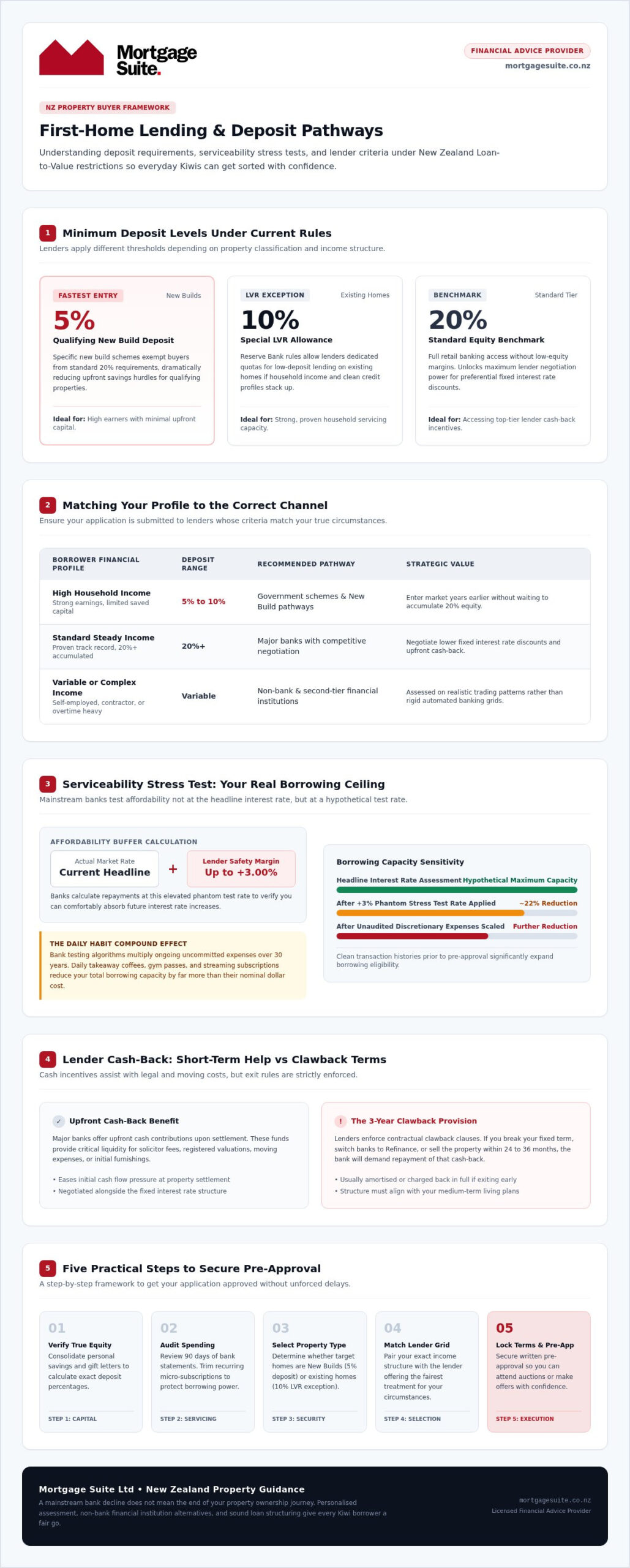
The reality of the 2026 NZ property market is a tough pill to swallow for many first-home buyers. With national median dwelling values sitting at $797,944 as of August 2026, a standard 20% deposit requires nearly $160,000 in cold, hard cash. For most people, saving that kind of money feels like chasing a ghost; as soon as you get close, the goalposts seem to move. This is why a guarantor loan is often the only realistic way to bridge the gap. Instead of waiting another decade to scrape together a deposit, you can use the equity your parents have already built up in their own home to get you across the line.

Many people feel a bit of anxiety when it comes to convincing parents to be a guarantor nz because they think they’re asking for a massive cash gift. It’s actually quite different. Your parents aren’t usually handing over their savings; they’re simply providing a promise to the bank using a portion of their home’s value. Understanding What is a loan guarantee? helps clarify that this is a legal commitment to cover a specific part of the loan if things go wrong. Most parents genuinely want to help their kids get a fair go, but they often don’t realise how the system works or that it can be structured to limit their risk.

Bridging the Deposit Gap

The numbers are simpler than you might think. If you’ve managed to save $50,000, you’re still a long way from the 20% mark on an average home. However, if your parents offer a limited guarantee using $110,000 of value from their property, the bank sees a combined “deposit” that meets their strict criteria. This gets you into your own place years earlier, allowing you to start building your own equity rather than paying off a landlord’s mortgage. It’s about giving the next generation a head start on the property ladder without forcing parents to empty their retirement accounts.

Saving Heaps on Extra Bank Insurance Fees

When you have less than a 20% deposit, banks usually charge extra. This might be a special higher interest rate for small deposits, which can range from 0.25% to 1.75% on top of your normal rate at several major lenders. If you’re using a First Home Loan underwritten by Kāinga Ora, you’ll also face a 1.2% premium for extra bank insurance fees. This is basically money down the drain that doesn’t go towards paying off the actual loan balance. By using a guarantor to reach that 20% threshold, you can dodge these extra fees entirely. You can use our mortgage calculator to see exactly how much lower your monthly repayments could be when you avoid those extra costs. This isn’t just about getting the bank to say yes; it’s about making your home loan significantly cheaper from day one.

What Does Being a Guarantor Actually Mean? (The Jargon-Free Version)

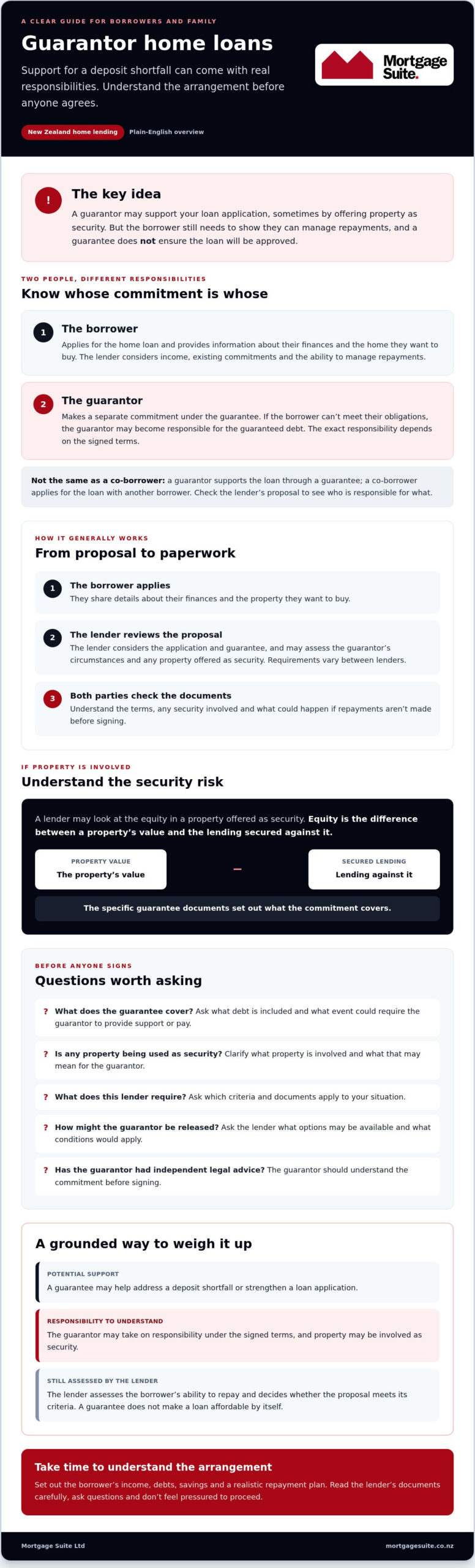
Mentioning the word “guarantor” at the dinner table often causes a sudden silence. It sounds like a heavy, lifelong burden that could put your parents’ entire future at risk. In reality, it’s usually just a slice of their home’s value acting as a safety net. When you’re convincing parents to be a guarantor nz, you need to explain that they aren’t actually handing over a suitcase of cash. A gifted deposit is money gone forever; guaranteed equity is simply a promise to the bank that says, “If my child can’t pay the last bit of their deposit, our house covers the difference.” Your parents don’t need to touch their savings or change their lifestyle. They certainly don’t have to make your weekly mortgage payments. You are the one responsible for the loan, while they act as a silent partner in the background.

Limited vs. Unlimited Guarantees

We almost always recommend a limited guarantee. This is a crucial distinction that keeps your parents’ retirement plans on track. Instead of being responsible for the whole house price, they only back the specific “gap” you need for your deposit. If you have a 10% deposit and the bank wants 20%, your parents only guarantee that missing 10%. Once you’ve paid down enough of the loan or the house value goes up, that guarantee can be removed entirely. It’s a temporary arrangement with a clear exit strategy, not a permanent anchor on their property.

The Role of the Bank

The bank isn’t just looking for a house to grab if things go south. They still do a deep dive into your own finances to make sure you can afford the mortgage on your own. They check your income, your spending, and your credit history just like any other loan. Understanding how guarantor mortgages work helps you see that the bank treats your parents’ home as a security backup, not a primary source of payment. If you’d like to see how we’ve helped other families manage this balance, feel free to read our client reviews to hear their stories. The bank wants to see that you are a reliable borrower first and foremost. They won’t approve the loan if they think you’ll struggle, which should give your parents some extra peace of mind.

Addressing the “Scary Stuff”: What Your Parents Are Worried About

Parents aren’t being difficult when they ask tough questions; they’re being protective of the life they’ve worked hard to build. The biggest fear is almost always the same: “What happens if you can’t pay the mortgage?”. It’s a heavy thought. When you’re convincing parents to be a guarantor nz, you need to be honest about this risk while showing them the layers of protection we put in place. The bank selling the house is the absolute last resort for any lender. Banks are in the business of collecting interest, not running property auctions. If you hit a rough patch, the first step is always a conversation to find a solution, such as temporary interest-only payments or extending the length of the loan.

We structure these loans to protect the person providing the guarantee from the very beginning. This includes making independent legal advice a mandatory part of the process. Your parents will need to speak with their own solicitor who doesn’t represent you or the bank. This ensures they fully understand their obligations and that no one is being pressured into a decision. It’s about making sure every person at the table is comfortable and that the family bond stays strong throughout the life of the loan.

The Worst-Case Scenario Plan

In the unlikely event that the property needs to be sold to cover the debt, your parents’ liability is strictly capped. Because we use the limited guarantee structure mentioned earlier, they are only ever responsible for that specific “gap” amount, not the whole debt. We also strongly recommend safety nets like income protection insurance. This ensures that if you can’t work due to illness or injury, your mortgage payments are still covered. Having these “what if” plans documented shows your parents that you’ve thought beyond the excitement of the house hunt and are taking their security seriously.

The Exit Strategy: Getting Parents Off the Title

The most important part of the plan is the finish line. A guarantee isn’t meant to last for thirty years. The magic number is 20% equity, which is the portion of the home you own outright. Once your home’s value has grown, or you’ve paid enough of the amount you borrowed down so that your debt is only 80% of the property’s worth, we can apply to have the guarantee released. In a steady market, this usually happens within two to five years. We can even set a reminder to review your property’s value annually. This gives your parents a clear date to look forward to, knowing their role as a “silent partner” is only a temporary leg-up to get you started.

How to Get Parents to Guarantee Your NZ Home Loan

The Kitchen Table Pitch: How to Present Your Case

Don’t just wing it. Successfully convincing parents to be a guarantor nz requires more than a casual mention over a Sunday roast. You need to treat this like a professional business proposal. Your parents need to see that you aren’t just looking for a shortcut, but that you’ve done the hard yards to prove you’re a safe bet. When you approach them with a clear plan, you’re showing respect for their financial journey while inviting them to be part of yours. Timing is everything. Avoid bringing this up during busy holidays, family drama, or when they’re clearly stressed about their own work. Pick a quiet evening when everyone is relaxed and you have their full attention.

Position yourself as a partner, not a person asking for a handout. You want to lead with the facts: your savings, your career stability, and your long-term goals. If the conversation gets technical or emotions start to run high, remember that you don’t have to have all the answers yourself. Bringing in an expert to handle the curly questions about interest rates or legal liability can take the pressure off everyone involved. It shifts the dynamic from a child asking a parent for help to a family making a smart financial move together.

Preparing Your “Home Buyer Portfolio”

Think of this as your “Home Buyer Portfolio”. You want to walk into the room with evidence of your financial maturity. Start by sharing your savings history to prove you have the discipline to manage a mortgage. It’s one thing to say you’re responsible; it’s another to show a twelve-month record of consistent saving. You should also have a clear spreadsheet that outlines your income against expected costs like rates, maintenance, and insurance. Showing them you’ve already been studying at Mortgage School will prove you understand the commitment you’re making. This level of transparency builds trust and makes it much easier for them to say yes.

The “No-Pressure” Conversation

The way you start the chat determines how it ends. Try an opening like, “I’ve been looking at a way to get into a home sooner, and I’ve found a strategy that involves using home equity rather than just cash.” This keeps the focus on the strategy, not the “ask”. Most importantly, give them a clear out. Tell them upfront that you’ve done the research, but you want them to take their time to think about it. You might say, “I’m not looking for an answer tonight, but I’d love for you to chat with my broker to get an independent view.” This removes the feeling of being cornered and keeps the relationship healthy. If you’re ready to start gathering the facts for your family meeting, our team is here to help you prepare.

Why a Mortgage Broker is the Best Mediator for Your Family

Family dynamics can be tricky, especially when six-figure sums are involved. When you’re in the middle of convincing parents to be a guarantor nz, it helps to have a neutral party who isn’t emotionally invested in the outcome. Think of us as a buffer. We’re here to bridge the gap between your excitement about a new home and your parents’ natural instinct to protect their assets. By having a professional explain the fine print, you remove the tension that often comes with family financial talks. We provide a clear, unbiased view of the risks and rewards, ensuring everyone has the same information and feels heard.

Sometimes, the big mainstream banks can be a bit too rigid with their rules. If they say no, we don’t just give up. We specialise in loans for those who don’t fit the standard bank criteria, often looking at alternative lenders who offer more flexibility. We’ve already discussed the challenges of the 2026 market, and these alternative options are often the key to making the numbers work. Our goal is to make sure everyone, including your parents, walks away feeling sorted and happy with the arrangement. We handle the difficult negotiations with lenders so you can focus on the relationship with your family.

Krish’s Two Decades of Experience

With over twenty years of banking experience, Krish Krishna has navigated almost every possible family lending scenario. We’ve helped hundreds of Kiwis get into their first homes, and we know that a quick loan is never worth a damaged relationship. Our priority is always your long-term stability. We don’t just look at the numbers; we look at how the deal affects your family’s peace of mind. You can read our client reviews to see how we’ve helped others find that balance. We act as dedicated negotiators who handle the heavy lifting, ensuring the process is transparent for both you and your parents.

Taking the Next Step Together

The best way to start is with a simple, no-obligation chat. We can look at your specific situation and see what’s possible before you even sit down for that big kitchen table meeting we mentioned earlier. We’ll help you get your paperwork sorted and explain the technical bits in plain English. This leaves you free to focus on the fun part: finding the right house. If you’re ready to see how we can help your family get ahead, get in touch with Mortgage Suite Ltd today to start your journey. We’re here to make the process as smooth and stress-free as possible for everyone involved at Mortgage Suite Ltd.

Take the First Step Toward Your New Home Today

Getting into your first home in today’s market requires a smart strategy and a lot of heart. By treating the conversation as a professional partnership rather than a plea for help, you’ve already done the hardest part of convincing parents to be a guarantor nz. Remember that a limited guarantee is a temporary tool designed to get you on the ladder sooner, not a permanent burden on your family’s future. With a clear exit strategy and the right safety nets in place, you can move forward with total confidence.

We’ve spent over 20 years in the banking industry helping families all across New Zealand navigate these exact scenarios. As specialists in 2nd tier and non-bank lending, we know how to find the right path forward even when the mainstream banks say no. It’s time to turn those Sunday dinner chats into a concrete plan for your property goals. We handle the heavy lifting so you can focus on the excitement of home ownership.

Book a free consultation with Krish Krishna to see how we can support your journey today. You have the drive and the plan; now let’s work together to get you those keys.

Frequently Asked Questions

Can my parents be a guarantor if they still have a mortgage on their own house?

Yes, your parents don’t need a mortgage-free home to help you. As long as there is enough equity in their property, banks are often happy to use a portion of that value as security. Equity is simply the difference between what their house is worth and what they still owe. If their home has increased in value over the years, they likely have plenty of room to support your application without needing to pay off their own loan first.

What is the difference between a guarantor and a co-borrower in NZ?

A guarantor is a “silent partner” who provides security using their home’s equity but doesn’t own the new property. A co-borrower, however, is a joint owner who is equally responsible for every single mortgage payment from the start. When convincing parents to be a guarantor nz, it’s helpful to explain that they won’t be on the hook for monthly bills. They are simply there as a backup for a specific portion of the loan.

Do my parents need to have a certain amount of income to be a guarantor?

Usually, the bank prioritises your income because you are the one making the repayments. Your parents don’t necessarily need a high income, but the bank will check that they can still afford their own lifestyle and debts. The focus is on their “net equity” rather than their weekly pay packet. However, every lender has different rules, so it’s always best to check how your specific family situation fits with their current criteria.

How much does it cost for my parents to be a guarantor?

There is typically no direct “guarantor fee” charged by the bank. The main costs involved are for independent legal advice, which is a mandatory requirement to protect your parents. They may also need to cover a small cost for a registered valuation of their property if the bank requires an up-to-date figure. These costs are a small price to pay to ensure everyone is legally protected and understands the commitment they are making.

Can I use my KiwiSaver and a guarantor at the same time?

Absolutely. In fact, combining your KiwiSaver withdrawal with a guarantor is one of the fastest ways to get into a home. You use your KiwiSaver for the cash component of the deposit and the guarantor’s equity to make up the rest of the 20% the bank requires. This combination helps you avoid extra costs like low-equity margins and gets you access to much better interest rates from the very beginning of your loan.

What happens to the guarantee if my parents want to sell their house?

If your parents decide to sell, the guarantee needs to be addressed before the sale can go through. If you have already built up 20% equity in your own home, the guarantee can simply be released. If not, the guarantee might need to be transferred to their new property, or a portion of the sale proceeds might need to be held. It’s a manageable situation, but it requires some forward planning with your mortgage broker.

Is there an age limit for parents to become guarantors?

There isn’t a hard and fast age limit, but banks do look at the overall picture. Lenders want to be sure that the guarantee won’t put your parents’ retirement at risk. If they are already retired or very close to it, the bank will look more closely at their total assets and debts. The goal is to make sure the arrangement is sustainable for everyone involved, regardless of how many candles are on the birthday cake.

Do my parents need their own lawyer for a guarantor loan?

Yes, this is a non-negotiable step for almost every lender in New Zealand. Banks require guarantors to get independent legal advice to ensure they aren’t being pressured and that they fully understand the risks. This lawyer must be different from the one you are using for your home purchase. While it’s an extra step, it provides a vital layer of protection for your parents and keeps the family relationship transparent and professional.

Article by

Krish Krishna

Experienced Financial Adviser with over 46 years of Banking and Mortgage broking experience and over $2.0 Billion in loan settlements.

Low Doc Home Loans NZ: The 2026 Guide for Self-Employed & Non-Standard Borrowers

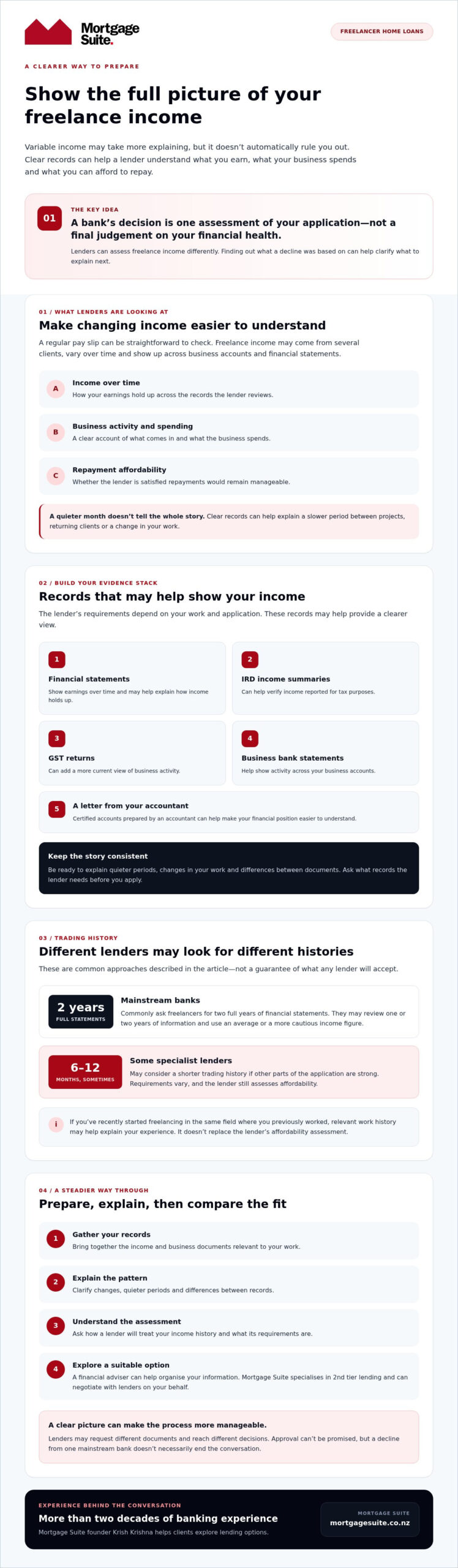
Why should a thriving business and a healthy bank balance result in a flat "no" from your bank manager? If you’re self-employed or have a non-standard income, you’ve likely felt the sting of rejection from mainstream lenders recently. It’s incredibly frustrating to feel penalised for your success, especially as strict debt-to-income (DTI) ratios, currently capped at 6 for most owner-occupiers, make traditional lending feel like an impossible hurdle. However, securing low doc home loans isn’t about settling for a "last resort" option; it’s a strategic move to help you secure property while the OCR remains at 2.25%.

We understand that your financial story is much more than a series of pay slips. You deserve a professional partner who recognises the value of your GST returns and business bank statements rather than just your annual tax assessments. This guide will show you exactly how to leverage specialised alt-doc lending to buy or refinance your home in 2026. We’ll break down the specific documents you need, explain current risk-based interest rates from non-bank lenders, and outline a clear path to transition back to mainstream banking when the time is right for your business.

Key Takeaways

  • Understand the evolution of alternative lending and how modern “alt doc” solutions meet current CCCFA requirements for non-standard borrowers.
  • Identify your eligibility for low doc home loans, whether you are an established business owner or a contractor with only six months of trading history.
  • Evaluate the financial trade-offs between 2nd tier interest rates and the potential opportunity cost of missing out on property growth while waiting for bank approval.
  • Master the documentation process by learning how to present business bank statements and GST filings to demonstrate your true serviceability.
  • Learn how to leverage professional advocacy to bridge the gap between rigid institutional criteria and your unique financial situation.

Understanding Low Doc Home Loans in the NZ Market

For many New Zealanders, the dream of property ownership shouldn’t be sidelined just because their income doesn’t fit into a tidy, PAYE-shaped box. Modern low doc home loans have evolved significantly to meet the needs of a more dynamic workforce, including entrepreneurs, contractors, and those with complex company structures. While the term "low doc" is still widely used, the reality in 2026 is a sophisticated system of "Alt Doc" (alternative documentation) lending that provides a vital bridge to finance when mainstream banks hesitate.

The landscape changed fundamentally with the tightening of the Credit Contracts and Consumer Finance Act (CCCFA). Historically, Understanding Low Doc Home Loans often meant very little oversight, but today’s version is built on the foundation of responsible lending. Lenders still have a professional obligation to ensure you can afford the mortgage; they just use different tools to verify your financial health. This shift ensures you’re protected while still allowing you to access the capital needed for residential or investment purposes. Second-tier lenders have stepped into this space, offering the flexibility that institutional banks often lack.

The Shift from Low Doc to Alt Doc

In 2026, professional lenders prefer the term "Alt Doc" because it accurately describes the process of using alternative evidence to confirm income. Instead of traditional IRD summaries or two years of audited accounts, we look at GST returns, business bank statements, or even an accountant’s declaration. Having an active NZBN (New Zealand Business Number) is a crucial part of this process, as it verifies the legitimacy and longevity of your enterprise. This method ensures serviceability without the bureaucratic red tape that often entangles self-employed borrowers.

Why Traditional Banks Often Say No

Mainstream banks are designed for predictability. They typically enforce a "two-year rule," requiring at least 24 months of consistent financial statements before they’ll even consider an application. This rigid approach often excludes profitable new businesses or those that have recently scaled. Additionally, banks often struggle to distinguish between business reinvestment and actual disposable income. If you’ve legally minimised your taxable income through business expenses, a bank’s automated credit scoring might flag you as high risk. Seasonal fluctuations also create "lumpy" income streams that don’t align with standard bank algorithms, making low doc home loans nz from 2nd tier lenders a much more logical fit for your reality.

Eligibility Criteria: Who Can Benefit from Alt-Doc Solutions?

Identifying whether you qualify for alternative finance is the first step toward property ownership. While mainstream banks often focus on a narrow set of criteria, **low doc home loans **are designed for those with more complex financial lives. The primary candidates include self-employed business owners, independent contractors, and commission-based professionals who may have high earnings but lack the two years of financial history banks demand. Property developers and investors also frequently use these structures to move quickly on opportunities without waiting for a tax year to end.

Longevity requirements are a major point of difference. Most registered banks require 24 months of trading. In contrast, many 2nd tier lenders will consider applications from businesses that have been trading for as little as six months, provided the owner has significant previous experience in the same industry. This flexibility is a game changer for many, especially considering the well-documented challenges for self-employed borrowers in the current regulatory environment. A clean credit history and active GST registration are typically essential, as they demonstrate business legitimacy and reliable financial behaviour.

Documentation You Will Actually Need

The "low doc" label doesn’t mean "no doc". It means alternative proof of income. You’ll likely need to provide 6 to 12 months of business bank statements to show consistent cash flow. An accountant-signed declaration of income is often the cornerstone of a successful application. This document confirms your financial position and ability to service the loan. If your business is newer, a "Declaration of Financial Position" can help bridge the gap, allowing you to explain your current earnings and growth trajectory to the lender. If you’re unsure how to present your figures, it’s often worth discussing your situation with a specialist who understands residential investment property loans and how to structure them for success.

Property Types and LVR Limits

The type of property you intend to buy also influences eligibility. Standard residential homes in urban centres are the easiest to finance. Lifestyle blocks or rural properties can be more complex, as lenders often view them as higher risk. This risk profile affects your Loan-to-Value Ratio (LVR). While owner-occupiers might secure up to 80% LVR, low doc applicants should generally prepare for a larger deposit, often around 20% to 30%. This equity acts as a buffer for the lender, offsetting the perceived risk of non-standard income verification. For investors, the DTI limit of 7 remains a factor, but alt-doc lenders often have more nuanced ways of calculating serviceability compared to the rigid models used by the big four banks.

Low Doc vs. Standard Mortgages: Weighing the Costs and Benefits

Choosing between a standard bank mortgage and low doc home loans nz often feels like a choice between price and possibility. While mainstream banks offer lower headline interest rates, they also demand a level of documentation that many successful entrepreneurs simply can’t provide. As of June 2026, mainstream fixed rates start around 4.65%, while non-bank lenders start from  6.35%pa and gets to as much as 9.5%pa. This gap represents the "risk premium" lenders charge for the flexibility of assessing your income through alternative means, such as GST returns rather than audited accounts.

It’s vital to look beyond the interest rate alone. Non-bank lenders often charge establishment fees ranging from 1-2%, which are significantly higher than traditional bank fees. However, the true cost of waiting two years to fit a bank’s rigid criteria can be much higher. If the property market grows while you’re sidelined, the increase in purchase price could far outweigh the extra interest paid on a specialised loan. We view these 2nd tier loans as a strategic tool rather than a permanent solution; they’re designed to get you into the market today.

Risk fees and Lenders Mortgage Insurance (LMI) are also common features in the non-bank sector. Unlike mainstream banks that might waive LMI with a 20% deposit, 2nd tier lenders often apply a risk fee regardless of your equity level. This fee compensates the lender for the intensive manual underwriting required to assess non-standard income. While it adds to the initial cost, it’s often the key that unlocks the door to a property purchase that would otherwise be impossible under current DTI restrictions.

Interest Rates and Fee Structures

Current market data shows a clear divide. While the OCR sits at 2.25%, mainstream floating rates average around 5.76%. In contrast, low doc home loans nz are priced based on your specific risk profile. A larger deposit or a pristine credit history can often help us negotiate a more favourable rate on your behalf. Beyond the rate, you’ll need to account for valuation costs and legal requirements, which can be more involved for non-standard applications. Professional negotiation is your best tool for minimising these upfront costs.

The Strategy of "Rate vs. Result"

Consider the scenario of an Auckland business owner looking to buy a $1 million property. Waiting two years to satisfy a bank might save 4% in interest, but if property values rise by even 3% annually, the buyer loses $60,000 in equity gains. By securing a loan now, you’re building wealth immediately. These loans are also incredibly effective for tax debt consolidation or funding a business expansion that will eventually make your profile "bankable" again. The Risk Premium is a temporary cost of entry into the property market.

Low Doc Home Loans NZ: The 2026 Guide for Self-Employed & Non-Standard Borrowers

Preparing Your Application: A Strategic Approach to Non-Bank Lending

Preparation is the defining factor between a swift approval and a frustrating decline. Unlike the automated "tick-box" systems at mainstream banks, 2nd tier lenders employ human underwriters who look for a coherent, professional narrative. To secure low doc home loans nz, you must present a transparent view of your financial health. Start by organising your business financials; ensure your GST filings are up to date and your business bank statements reflect consistent cash flow. Eliminating "lumpy" personal spending from your business accounts before applying can significantly enhance a lender’s perception of your serviceability.

Consulting with a specialist who understands non-bank criteria is your next move. They’ll help you assess serviceability based on actual earnings rather than just taxable profit. You’ll also need a clear "purpose statement" for the loan. Whether you’re purchasing a primary residence or using equity for business growth, the lender needs to understand the logic behind the transaction. Don’t overlook the "low-hanging fruit" on your credit file either. Small, unresolved utility bills or minor defaults can be cleared up relatively quickly, often moving your application from a "high risk" category to a much more favourable one. Finally, prepare for an independent valuation. Non-bank lenders typically require a full physical inspection of the property to accurately assess their security margin.

Organising Your "Alt-Doc" Portfolio

Your NZBN acts as a badge of business longevity. Lenders look for consistency in your trading history, so any gaps in activity should be explained upfront. Collaborating with your accountant is essential here; they need to ensure that any declarations of income align perfectly with your GST returns and bank statements. Discrepancies are a major red flag for credit managers, so a unified front is vital. Presentation matters; a well-organised portfolio suggests a well-run business, which builds the trust necessary for a successful negotiation.

Developing a Refinance Exit Strategy

A low doc loan is rarely intended to be a forever mortgage. We view these products as a strategic bridge designed to get you into the property market today while you prepare for a mainstream bank in the future. Our goal is typically to set a 12-to-24 month window to transition you back to Tier 1 rates. To achieve this, you must "season" your loan with a flawless repayment history. Every on-time payment builds a track record that mainstream banks will eventually find hard to ignore. Once your business has reached the required two years of trading history, we can leverage your equity and clean record to move you back to traditional lending. If you’re ready to start building your pathway back to traditional banking, explore our home loan solutions today and see how Mortgage Suite Ltd can assist.

How Mortgage Suite Ltd Facilitates Your Path to Property Ownership

Mortgage Suite Ltd isn’t just about finding a loan; it’s about building a bridge between your current business reality and your long-term property goals. Leveraging Krish Krishna’s 20+ years of institutional banking experience, we approach every application with the precision of a veteran insider. This deep understanding of how credit decisions are actually made allows us to act as your dedicated advocate and negotiator. We don’t just submit paperwork; we craft a narrative that recognises the strength of your enterprise, even when a mainstream bank’s automated systems cannot.

Our commitment to you extends far beyond a single transaction. We view our relationship with every client as a long-term partnership, guiding you through the complexities of non-standard lending until you’re ready to return to traditional banking. Whether you’re navigating high-DTI hurdles or managing the "lumpy" income common in self-employment, we provide the steady hand needed to secure low doc home loans nz in a fluctuating market. Mortgage Suite Ltd specialises in finding the "yes" when the big four banks have already said "no."

Beyond the Bank: Accessing Alternative Capital

Finding the right capital requires more than a simple search; it requires access to a robust network of non-bank and private lending channels across New Zealand. We specialise in structuring 2nd tier loans that don’t fit the rigid templates of mainstream institutions. This might involve using equity from an existing commercial property or leveraging business bank statements to prove serviceability for a new residential purchase. Our background in banking allows us to speak the lender’s language to secure better terms for our clients. By presenting your financial story in a way that addresses a lender’s specific risk concerns, Mortgage Suite Ltd opens doors that others often find closed.

Specialised Support for First Home Buyers and Investors

Self-employed New Zealanders often feel locked out of the property market, especially when they’re trying to secure their very first home. We provide tailored support to help you navigate this process, ensuring your business success is viewed as an asset rather than a liability. You can learn more about these specific pathways in our guide to home loans for first home buyers New Zealand.

For seasoned investors, we offer sophisticated advice on residential investment property loans using alt-doc methods. We understand how to structure debt to facilitate portfolio growth, even when your personal tax returns don’t tell the full story of your business’s success. By combining institutional knowledge with a client-first philosophy, Mortgage Suite Ltd ensures that low doc home loans nz serve as a powerful tool for your financial future. Whether you are buying, refinancing, or expanding, we are here to advocate for your success at every step.

Secure Your Future Beyond Mainstream Banking

Securing property in 2026 shouldn’t be an uphill battle just because you’ve chosen the path of self-employment. As we’ve explored, low doc home loans nz provide a sophisticated financial bridge for those who don’t fit the rigid criteria of traditional institutions. By leveraging alternative documentation like GST returns and business bank statements, you can bypass mainstream rejection and start building equity today. These specialised solutions are strategic tools designed to help you buy or refinance now while preparing your business for a future transition back to Tier 1 rates.

With over two decades of institutional banking and finance experience, we pride ourselves on being the steady hand you need in a fluctuating market. Mortgage Suite Ltd provides the seasoned expertise necessary to navigate 2nd tier and non-mainstream lending, maintaining a proven track record of securing loans when banks say no. You don’t have to navigate this complex landscape alone. Speak with a specialised lending expert at Mortgage Suite Ltd today to discover how we can advocate for your success. Your financial story deserves a partner who understands your value and is committed to your long-term growth.

Frequently Asked Questions

Can I get a low doc home loan in NZ with bad credit?

Yes, you can often secure finance even with a less than perfect credit history. Non-bank lenders are typically more interested in the circumstances surrounding your credit score than the number itself. We look for a logical explanation for past issues and focus on your current ability to service the debt. This approach provides a second chance for those the mainstream banks have simply written off.

How much deposit do I need for a low doc loan?

You will generally require a deposit of at least 20% to 30% for these types of applications. Because the lender is relying on alternative income verification, they require a higher level of equity to mitigate their risk. While some owner-occupier exceptions exist, having a larger deposit significantly improves your chances of approval and can help us negotiate a more competitive interest rate on your behalf.

Is a low doc loan the same as a non-bank loan?

These terms are related but distinct. "Low doc" describes the type of loan product and the alternative documentation used to prove your income. "Non-bank" refers to the type of lender, such as a finance company or private funder, that operates outside the traditional registered bank system. Most low doc home loans nz are provided by non-bank lenders because they have the flexibility to assess non-standard applications.

How long do I need to be self-employed before I can apply?

Many specialised lenders will consider your application once you have been trading for as little as six months. This is a significant departure from mainstream banks, which almost universally require two full years of financial statements. If you have significant previous experience in your industry, we can often use that expertise to strengthen your case, even if your current business is relatively new.

Are interest rates for low doc loans always higher?

Yes, interest rates for alternative documentation loans are typically higher than standard bank rates. This is known as a risk premium, which compensates the lender for the extra manual work and perceived risk involved in the application. However, this cost is often temporary. We view these loans as a strategic bridge to get you into a property while you build the history needed for a bank mortgage.

Can I use a low doc loan to buy an investment property?

Definitely. Using alternative documentation is a very common strategy for property investors who want to expand their portfolios. Since mainstream banks have strict DTI limits and LVR restrictions, 2nd tier lenders provide the necessary capital to move on opportunities quickly. We can structure these loans to focus on the rental yield and your business cash flow rather than just your personal taxable income.

What happens if the bank has already declined my application?

A bank decline isn’t the end of the road; it’s often where our work begins. Traditional banks use automated systems that don’t always handle the nuances of self-employment well. We take a hands-on approach, using our institutional banking background to present your application to lenders who value manual underwriting. We focus on finding the "yes" by highlighting the strengths that the bank’s software might have missed.

How do I eventually switch from a low doc loan to a standard bank mortgage?

Transitioning back to a mainstream bank usually takes between 12 and 24 months of "seasoning." During this time, it’s vital to maintain a perfect repayment history and keep your business financials organised. Once you have reached the two-year trading mark and can show consistent GST returns, we can look at refinancing your low doc home loans nz back to a Tier 1 lender with lower interest rates.

Article by

Krish Krishna

Experienced Financial Adviser with over 46 years of Banking and Mortgage broking experience and over $2.0 Billion in loan settlements.