
Auckland broker for comparing banks and non-bank lenders

A mainstream bank’s answer isn’t always the last word on your borrowing options. Mortgage Suite Ltd can present your application to multiple lenders, including banks and non-bank lenders, and help compare options for a first home, an investment property, a self-employed application or a business. A broker arranges lending rather than lending money directly, so the right match depends on your goals, finances and the lender’s criteria.

Comparing lenders can feel like another job on top of an already big decision. A low headline rate may catch your eye, but the loan structure, repayment flexibility and fit with your plans matter too.

Here, you’ll learn what a Mortgage Suite Ltd broker does, how lender comparisons work and what can shape an application. We’ll also cover the different needs involved in buying your first home, applying with self-employed income, purchasing an investment property or seeking business and commercial finance, so you can see what to prepare and what the next steps may look like.

Key Takeaways

  • Compare loan options by more than the headline rate: consider repayment flexibility and how the lending structure fits your plans.
  • For a first home or rental property, understand how your deposit, income and property choice can shape the options available.
  • Self-employed applicants can present their income using business records, including bank statements and profit-and-loss records.
  • Business and commercial lending needs can differ from a standard home loan, so the purpose of the funds and how they’ll be repaid matter.
  • Mortgage Suite can help explore home loans, residential investment property loans and business finance, including options beyond mainstream banks.

First-home buyer and property investor loans

A first-home loan and an investment loan serve different goals, so lenders assess each application in context. Compare the deposit, income evidence, property and repayment structure before choosing a direction.

First-home buyer mortgage advice

First-home mortgage advice can help you understand what lenders may consider before you make an offer. An adviser can review your deposit, income, regular commitments and the property you’re considering, then explain how these details affect possible loan structures. For example, a pre-approval can help you set a borrowing limit before attending open homes. Treat it as a guide, not a final loan offer.

In New Zealand, ask which Financial Advice Provider is responsible for the advice and how its disclosure and complaints process works. A reputable adviser should explain their role, the lenders they can approach and why a suggested option may suit your circumstances.

Auckland brokers may charge fees, while other payment arrangements can apply. The amount depends on the arrangement and your case, so ask for the fee, when it would be payable and any other payment details in writing before proceeding.

To find a suitable Auckland mortgage broker, compare how they explain lender choices, their advice process and relevant experience. Ask how they’ll present your application and what happens if a lender declines it. Clear answers help you understand the service before sharing documents or making decisions.

Using a broker also has limitations. Their lender panel may not include every available option, and a lender can still decline an application. Ask how the broker is paid and whether lender relationships affect the options they present. You remain responsible for deciding whether the proposed repayments fit your budget.

Loans for property investors

Residential investment property loans are assessed against both your financial position and the property’s role in your plans. Discuss the purchase purpose, deposit, expected rental income and how you’ll manage repayments if the property is vacant. These details help frame an application and show whether a proposed structure suits your wider financial commitments.

Compare repayment flexibility as well as the interest rate. A fixed interest rate keeps repayments stable during the agreed fixed term, while floating rates can vary with benchmarks such as swap rates. Floating rates may allow large repayments without a penalty, which can suit investors planning to reduce debt faster. Consider how each structure fits your cash flow and plans.

Before progressing, ask the adviser to explain the recommended loan structure, repayment options and lender criteria in plain language. A clear comparison should connect each option to your deposit, income and property goals, rather than focus on the interest rate alone.

Self-employed mortgage applications

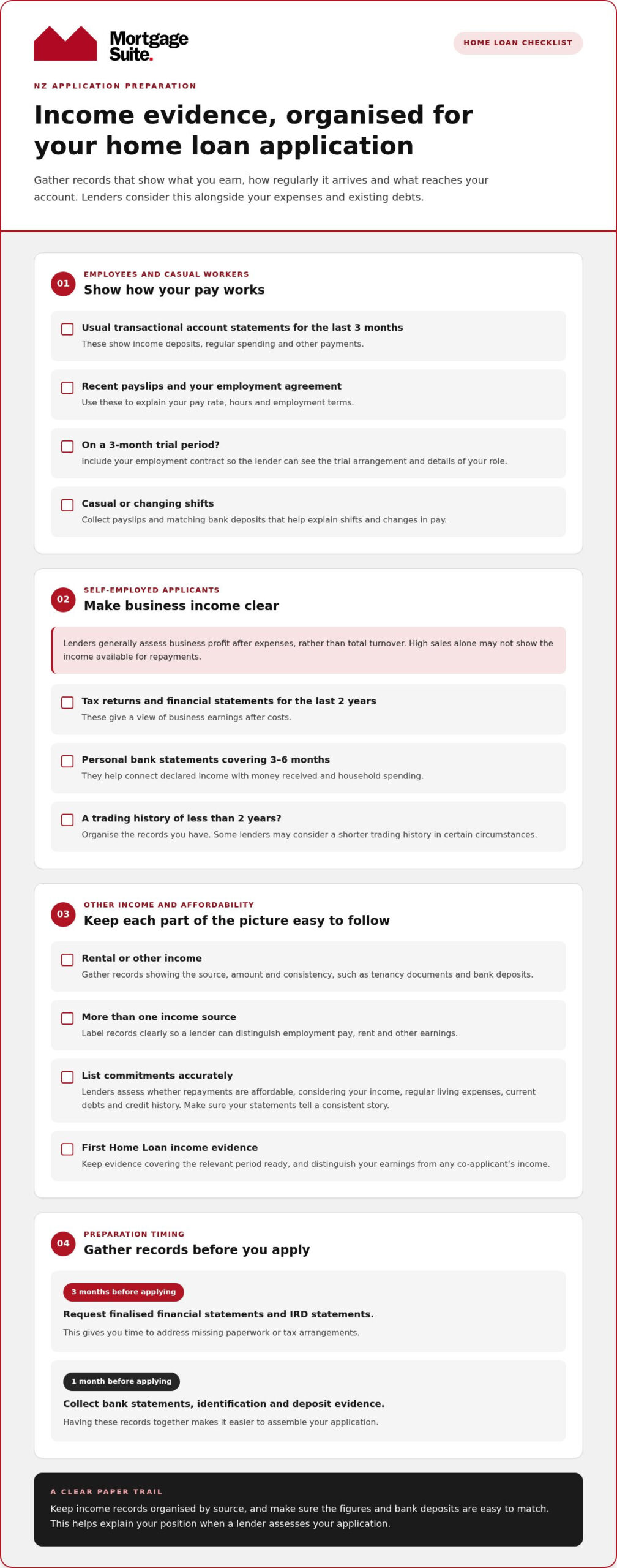
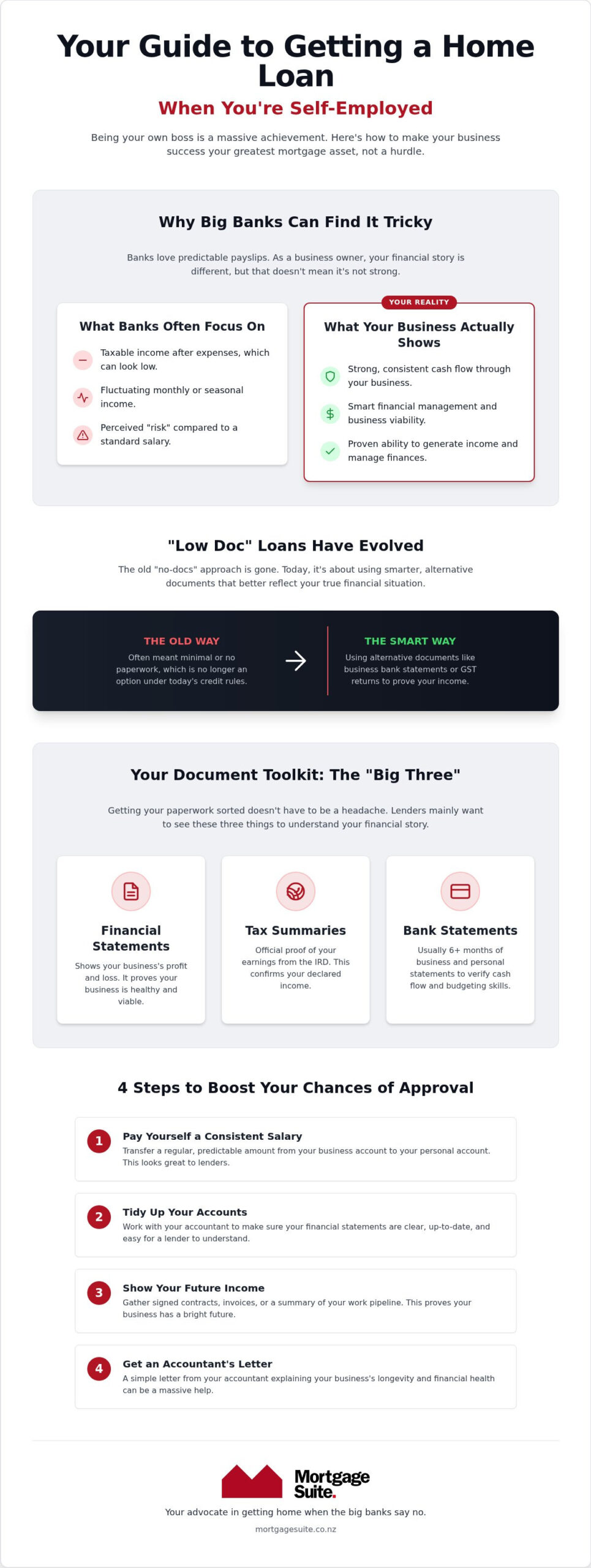
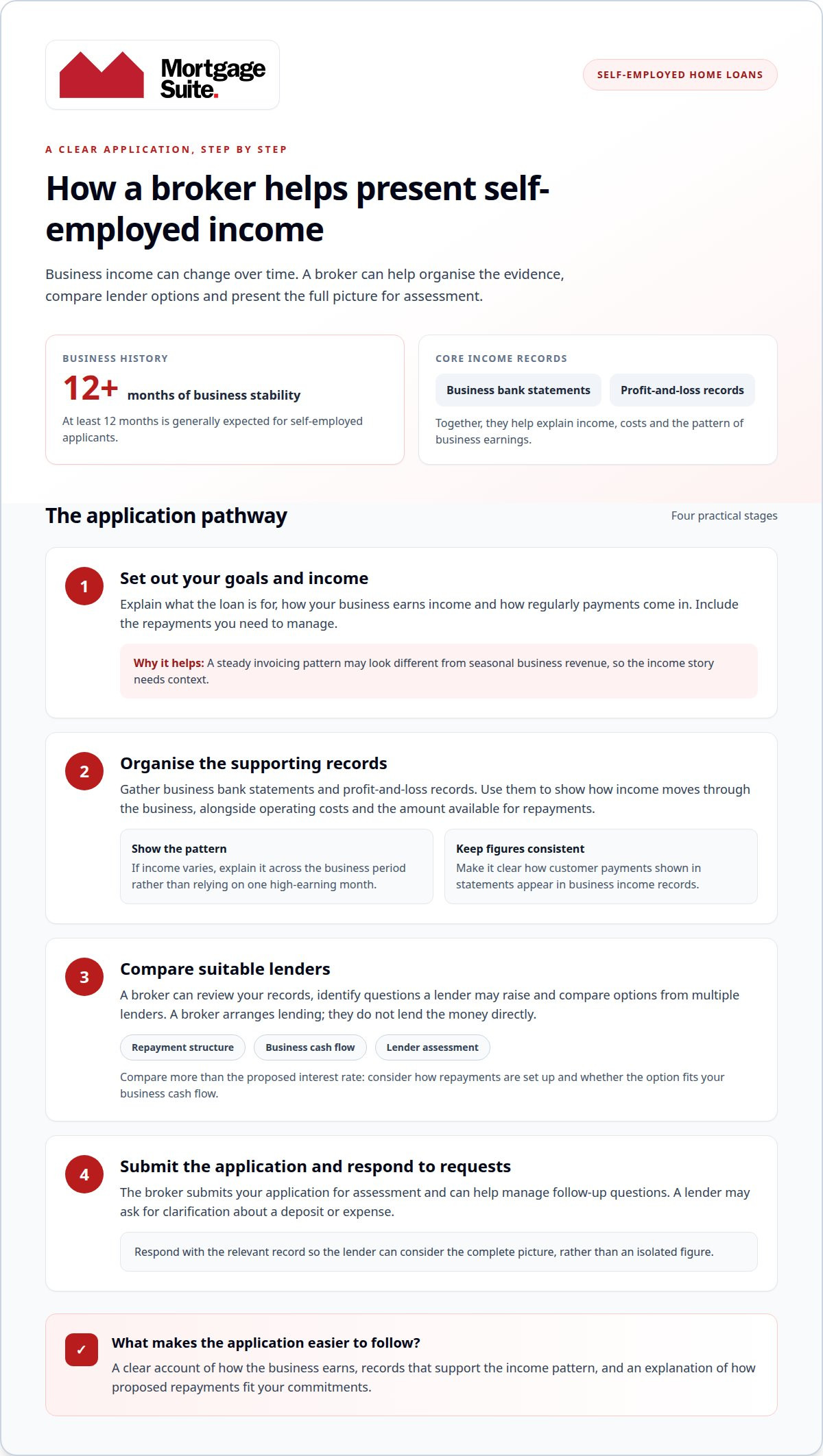
Self-employed income can be harder to present than a regular salary, especially when business earnings change between periods. In New Zealand, applicants are generally expected to show at least 12 months of business stability, and lenders can assess bank statements alongside profit-and-loss records.

Start by explaining how your business earns income and how regularly it receives payments. A contractor with steady invoices, for example, may present a different pattern from a business owner whose revenue changes seasonally. The lender considers the evidence alongside existing commitments and proposed repayments, rather than looking at one strong month alone.

Mortgage application documents

Prepare business bank statements and profit-and-loss records that show how income moves through the business. These documents help explain revenue, operating costs and the amount available to support repayments. If income varies, use the records to show the pattern across the business period, rather than relying on a single high-earning month.

Keep the figures consistent across the records you provide. For example, if a bank statement shows a customer payment, the profit-and-loss record should make its place in business income understandable. Organised documents give the lender a clearer picture of your application and reduce confusion over how you earn.

Business stability matters alongside the amount earned. A trading history of at least 12 months is generally expected for self-employed applicants, while the records help show how that business has performed. If you recently changed the way you work, explain the change and show how your current income is supported by the available evidence.

Steps to a mortgage through a broker

The steps are to discuss your goals and business income, organise supporting records, compare suitable lenders, then submit an application for assessment. A broker acts as an intermediary, presenting your application to multiple lenders rather than lending the money directly.

Start by setting out the loan purpose, the income your business generates and the repayments you need to manage. The broker can then review your bank statements and profit-and-loss records, identify questions a lender may raise, and prepare an application that explains how the figures fit together.

After comparing lender options, the broker submits the application and helps manage follow-up requests. A lender may ask for clarification if a deposit or expense needs explaining. Responding with the relevant record keeps the assessment moving and helps ensure the lender considers the complete picture, not an isolated figure.

Compare more than the proposed interest rate. Ask how repayments are structured, what the lender’s assessment focuses on and whether the option fits your business cash flow. If one mainstream bank declines the application, that decision does not automatically settle what other lenders may consider. Different lenders can assess the same income evidence under different criteria.

Before accepting an offer, make sure you understand the repayment amount, loan structure and any conditions attached to the lender’s decision. A broker can explain those details in plain language, so you can weigh the commitment against your business income and household budget.

Business and commercial loans

A business loan and a commercial property loan address different needs. A business owner seeking equipment finance has a different purpose from a company buying premises. Start by defining what the funds will pay for, how the business expects to repay them, and which assets support the request. That gives a lender a clearer basis for assessing the application.

For a business loan, explain the use of funds in practical terms. For example, a wholesaler might need working capital to pay suppliers before receiving customer payments. A lender can assess the business’s income, expenses, existing debt and repayment capacity against that purpose. A clear cash-flow picture helps show how repayments fit alongside regular operating costs.

Prepare records that make the business’s finances easy to follow. These may include business bank statements, profit-and-loss records and details of current borrowing. If income changes across the year, explain the pattern, such as higher sales during a seasonal trading period. Match the requested loan amount to a defined need, rather than presenting an unexplained figure.

Commercial property finance focuses on the property and its role in the business. A company purchasing its own premises, for instance, can explain how the site supports its operations and how repayments fit its trading income. The lender considers the property alongside the applicant’s financial position. Assess the loan against the planned use, ownership structure and repayment approach.

A term loan is provided as a lump sum with a defined repayment schedule and end date. That structure may suit a specific purchase, such as a business asset or property, where the amount and purpose are known. Compare its repayment pattern with the expected benefit of the purchase. For example, equipment should support business activity throughout the loan period.

Before an application is presented, organise the key details:

  • Purpose: describe the purchase, operating need or property transaction.
  • Repayment plan: explain which business income will meet repayments.
  • Financial records: provide statements and profit-and-loss information that support the figures.
  • Security: identify any property or business assets offered to support lending.

For a commercial property purchase, also set out the proposed use and expected contribution to the business. For example, operating from owned premises may differ from buying a property to earn rent. Those distinctions affect how the lender understands the transaction and assesses its repayment source.

If a mainstream bank declines an application, treat the decision as information about that lender’s assessment, not a verdict on the business. Another lender may consider the purpose, records or security differently. A well-organised application helps explain the business case and gives lenders the details needed to assess it.
Auckland broker for comparing banks and non-bank lenders

Comparing banks and non-bank lenders

There isn’t one best Auckland mortgage broker for every borrower. Compare how each broker explains lender choices, presents your circumstances and weighs loan structure alongside the interest rate. A useful comparison connects the lender’s criteria to your borrowing purpose, income and repayment plans.

A bank lends directly and assesses your application under its own lending criteria. A non-bank lender is also a direct lender, but its assessment approach and loan terms may differ. A broker acts as an intermediary and can present your application to multiple lenders. That can help you see alternatives if one lender’s criteria don’t fit your circumstances.

Compare the whole loan, not just its advertised rate. Check the repayment structure, any conditions, flexibility for extra repayments and how long a fixed interest rate applies. For example, a lower rate may not suit a borrower who values repayment flexibility more. Ask the broker to explain the trade-offs in plain language, using your own goals.

Non-bank lending can be relevant when an application doesn’t fit a mainstream bank’s usual criteria. Second-tier loans are options for borrowers who don’t fit mainstream banks. The lender still assesses the application, including its purpose, income, repayments and supporting information. A different lender may offer another path, but the terms and assessment can differ.

Use these points to compare a broker’s approach:

  • Lender range: ask whether the broker can present your application to banks and non-bank lenders.
  • Reasoning: expect a clear explanation of why a lender may suit your income and loan purpose.
  • Loan structure: compare repayment options and conditions, not only the headline rate.
  • Communication: find out how the broker will explain lender feedback and any next steps.

For example, a self-employed borrower may need an application that explains variable business income clearly. One lender may assess that evidence differently from another. A good comparison shows how the records support the application and why each proposed lender is worth considering. It doesn’t treat a bank’s decline as a final judgement on the borrower.

Before choosing a broker, ask how they’re paid and whether lender relationships affect the options presented. Request a written comparison that outlines the proposed lender, repayment structure, conditions and relevant trade-offs. This gives you a clearer basis for deciding, rather than relying on a broad claim that one lender is always best.

The right Auckland broker is one whose lender access and explanation fit your needs. Compare their approach using the same questions and your actual borrowing goals. A careful discussion should leave you understanding why a bank or non-bank option is being considered, and what the lender will assess.

The best fit is a broker whose lender range matches your circumstances and who clearly explains lender choices, loan structure, conditions and trade-offs. Compare how each broker handles your income and loan purpose, communicates lender feedback, and explains how they’re paid and whether lender relationships affect the options they present.

What types of brokers operate in Auckland, New Zealand?

An Auckland broker may focus on home lending, specialist applications or business finance. A mortgage broker acts as an intermediary, rather than lending money directly, and can present your application to multiple lenders. The useful distinction is the type of borrowing they handle and whether that matches your plans.

A residential mortgage broker works with home-loan applications. That can include a first-home purchase, a move to another home or borrowing for a rental property. For example, a first-home buyer may need help understanding how their deposit and income shape lender choices. An investor may need a discussion centred on the property’s purpose and planned repayments.

Some brokers focus on applications with less straightforward income or circumstances. A self-employed applicant, for instance, may need their business income explained through bank statements and profit-and-loss records. A broker familiar with those applications can help present the records clearly and approach lenders whose criteria may suit the case. The broker arranges the application; the lender makes its own assessment.

Business and commercial finance brokers work with funding for business purposes or commercial property. A business seeking funds for equipment has a different borrowing purpose from a company purchasing premises. Describe the planned use of funds and repayment source, then identify a broker whose work includes that kind of application.

Bank lending staff have a different role from brokers. They discuss lending offered by their own bank, while a broker can take an application to multiple lenders. That distinction matters if you want to compare a bank’s proposal with options from other lenders. Ask which lenders the broker can approach and how they’ll explain the differences.

To work out which type fits, match the broker’s focus to your application:

  • Buying your first home: look for experience with residential home-loan applications and pre-approval.
  • Applying with business income: ask how the broker presents self-employed earnings.
  • Buying a rental property: discuss residential investment lending and repayment plans.
  • Funding a business or premises: choose a broker whose work includes business or commercial finance.

Before sharing documents, explain your goal in one clear sentence, such as buying a first home or funding business premises. Then ask how the broker will handle that specific application, which lenders they can approach and how they’ll outline each option. Those answers help you understand whether their focus fits your borrowing needs.

Mortgage Suite

Mortgage Suite Ltd helps you compare lending options around your goals, income and borrowing needs. If you’re buying your first home, investing in residential property or seeking finance for a business or property development, the team can help present your application to suitable lenders and explain the differences in plain English.

A mainstream bank’s decline doesn’t necessarily end your options. Mortgage Suite Ltd can also consider second-tier lending for applications that don’t fit mainstream bank criteria, while explaining the terms and trade-offs involved. The focus is on helping you make an informed choice, not promising a particular outcome.

If you’d like to talk through your borrowing plans and possible next steps, contact Mortgage Suite Ltd for a free, no-obligation conversation.

Take the next step with a clear borrowing plan

Before moving ahead, decide what a useful lending outcome needs to do for you. You might want confidence about your first home purchase, room to grow a business, or a structure that supports a property purchase over time. Being clear about that priority gives an Auckland broker a practical starting point for discussing suitable options.

Mortgage Suite offers Home Loans to First Home Buyers, Residential Investment property loans and Business Loans. The next step is a conversation about your goal, your circumstances and the questions you want answered. From there, you can understand which lending options may fit and what information an application needs.

You don’t need to have every detail sorted before starting. Bring the outline of your plans, including what you’re hoping to finance and what feels uncertain. Mortgage Suite can help you talk through the lending path and possible next steps, with no obligation to decide on the spot.

Contact Mortgage Suite about your loan and take the next step with a clearer sense of direction.

Frequently Asked Questions

What documents do Auckland brokers need to assess a loan application?

Prepare documents that show your income, commitments and the purpose of the loan. For a self-employed application, this can include business bank statements and profit-and-loss records. A first-home buyer might also prepare information about their deposit, regular expenses and the property they’re considering. For example, someone buying with another person should be ready to explain how each applicant contributes to repayments and manages shared commitments.

How do Auckland mortgage rates and lending criteria compare across banks?

Rates and lending criteria can differ between banks, so compare offers using the same borrowing details. Look beyond the advertised rate: consider repayment structure, conditions, flexibility and how long any fixed rate applies. For example, ask how each bank would assess the same income and deposit, then compare its written offer and requirements. This makes differences easier to understand without assuming the lowest headline rate is automatically the best fit.

What should first-home buyers in Auckland ask a mortgage broker?

Ask which lenders they can approach, how they’ll compare suitable loan structures and what a pre-approval does and doesn’t cover. You could also ask what may change between pre-approval and a final offer, and which conditions you’ll need to meet. If you’re buying with another person, discuss how the application reflects both incomes and shared repayments. Clear answers help you understand the decision before you make an offer.

How are mortgage brokers in New Zealand regulated and checked?

Ask which Financial Advice Provider is responsible for the advice and how its disclosure and complaints process works. You can also compare the broker’s explanation of lender choices, advice process and relevant experience.

Do Auckland mortgage brokers charge fees, and how much?

Auckland brokers may charge fees, but the amount depends on the arrangement and your case. Ask for the fee, when it is payable and any other payment details in writing before proceeding.

Article by

Krish Krishna

Experienced Financial Adviser with over 46 years of Banking and Mortgage broking experience and over $2.0 Billion in loan settlements.

Calculating Home Loan Costs, Interest and Total Repayments

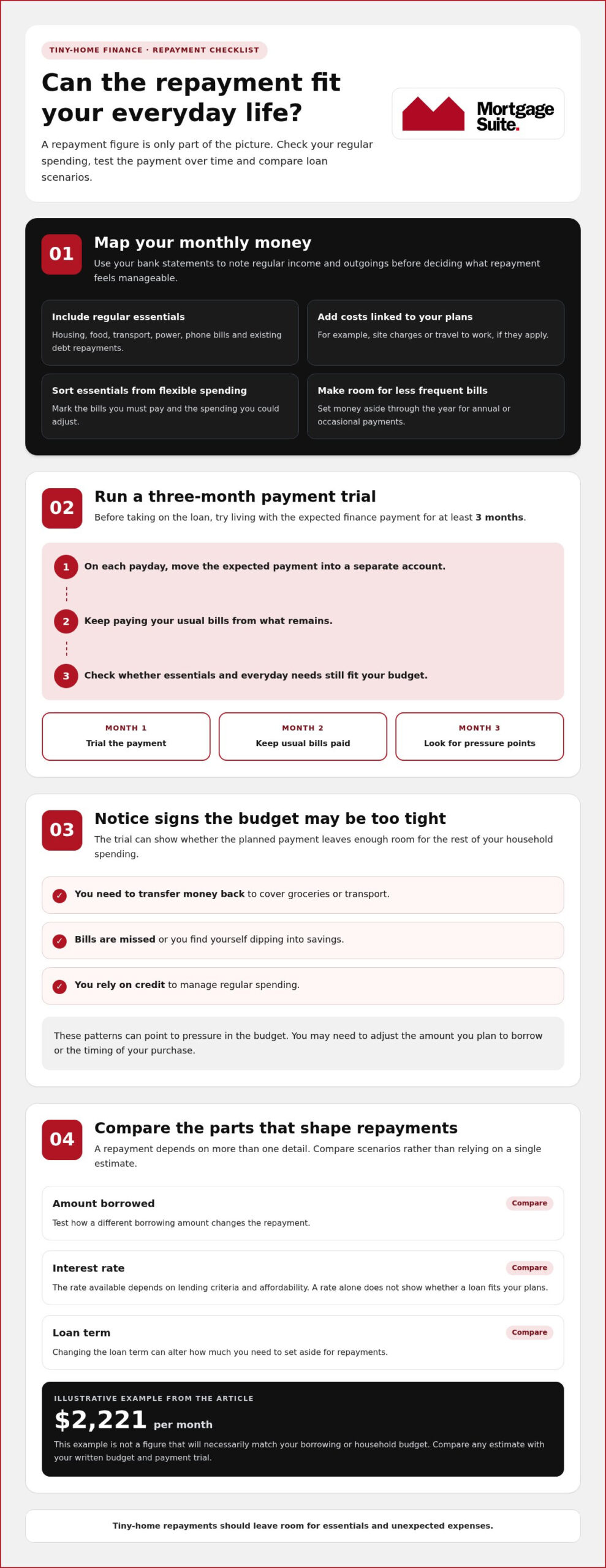
Your repayment depends on more than the amount you borrow. When calculating a home loan, the loan term, repayment frequency, interest rate and repayment structure all affect your regular payments and the total interest you may pay.

It’s natural to want a clear figure before making a major decision, but an estimate is only useful when you understand its assumptions. Changing the repayment frequency or choosing an interest-only period can affect both your regular payments and how quickly you reduce the amount borrowed.

This guide explains how to estimate home loan repayments in New Zealand and what to compare when reviewing mortgage options. Learn how loan size and repayment frequency affect the calculation, how principal-and-interest repayments differ from interest-only payments, and why the lowest regular repayment may not mean the lowest total interest. Understanding these factors helps you build a more realistic picture of borrowing.

Key Takeaways

  • Compare repayment frequencies using the same loan details so you can see how payment timing changes your regular repayments.
  • Look beyond the interest rate: the loan structure and its flexibility can affect how well repayments fit your plans.
  • Use the amount you expect to borrow, rather than the property’s full price, to make your repayment estimate more relevant.
  • Separate regular repayments from total interest to understand the longer-term effect of your loan settings.
  • An interest-only period can reduce repayments for a time, but it doesn’t reduce the amount borrowed during that period.

Choosing repayment frequency

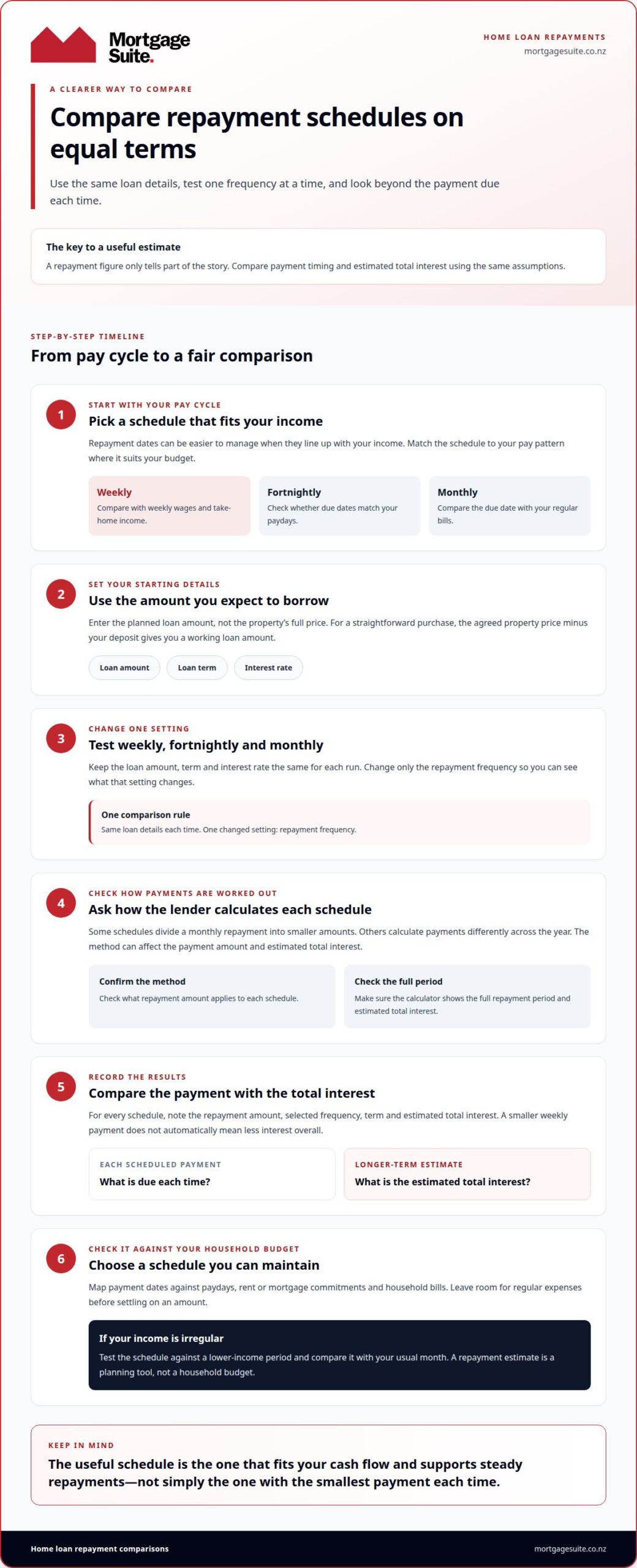
Start with your pay cycle and household budget. Repayment dates are easier to manage when they align with your income. Weekly repayments may suit weekly wages, fortnightly repayments may fit income paid every two weeks, and monthly repayments may suit a monthly salary. Frequency changes the amount due each time and may affect total interest, depending on how the lender calculates repayments. Compare schedules using the same loan amount, interest rate and term so you can see the effect of frequency alone.

Check how the lender calculates more frequent payments. Some schedules divide a monthly repayment into smaller amounts, while others calculate payments differently across the year. Ask what repayment amount applies to each schedule, and check that the calculator shows the full repayment period and estimated total interest. When calculating a home loan, the payment amount alone can be misleading: a smaller weekly payment does not automatically mean less interest overall. Compare the total paid and payment timing using the same loan assumptions.

  • Weekly: compare the payment against weekly take-home income.
  • Fortnightly: check whether payment dates match your paydays.
  • Monthly: compare the due date with regular bills.

For a practical comparison, use the same inputs each time. Enter the loan amount, term and interest rate first. Select weekly, fortnightly or monthly repayments. Record each payment and estimated total interest. A home loan repayment calculator can help you compare those settings. Change only one setting at a time. That makes it easier to identify the effect of frequency. If the figures vary, review the repayment method and assumptions. Keep notes beside each result, including the selected frequency and term.

Your deposit and finance preparation also shape your buying range. In New Zealand, most lenders require first-home buyers to have a deposit of at least 20 % of the amount they are borrowing. Conditional pre-approved finance can help you understand the price range you can buy in. Arrange it with your chosen lender before looking for a property. These steps help you work with a realistic loan amount before comparing repayment schedules. They also connect the estimate to your buying plans, rather than an arbitrary figure.

Finally, choose a frequency you can maintain through changing weeks. Map payment dates against paydays, rent or mortgage commitments, and household bills. Leave room for regular expenses before settling on an amount. If your income arrives irregularly, test the schedule against a lower-income period. Compare that result with your usual month. A repayment estimate is a planning tool, not a household budget. The right frequency is the one that fits your cash flow and supports steady repayments without relying on optimistic assumptions.

Comparing mortgage options

In New Zealand, a fixed interest rate stays unchanged for its agreed period. A floating rate can change when the lender adjusts it, which may affect your repayments or the interest charged. Compare both options using the same loan amount and term.

The rate type affects predictability and flexibility. A fixed rate stays steady during the agreed period, making scheduled repayments easier to plan. When that period ends, a new rate arrangement may change your estimate. A floating rate can move during the loan, so repayments may rise or fall. Check whether the lender changes the repayment amount or keeps it level and adjusts the loan term.

Compare more than the first repayment figure. Use the same loan amount, repayment frequency and term for each option, then note the interest rate, repayment amount and estimated total interest. Update the estimate if the rate changes. This shows how the result responds without treating today’s figure as permanent.

  • Fixed: consider how steady repayments fit your budget.
  • Floating: consider how a changing rate could affect payments.
  • Split: compare each portion separately, then review the combined repayment.

A split loan divides borrowing across different arrangements. For example, one portion could have a fixed rate and another a floating rate. This affects how much of the loan responds to rate changes, and means you need to track separate balances and repayment settings. Enter each portion separately if the calculator allows it, then add the results to estimate your total scheduled repayment. If it cannot model a split, compare each portion separately using consistent assumptions.

An offset account can also affect your comparison. Its balance reduces the loan balance used to calculate interest. For example, while money remains in a linked account, interest may be calculated on a lower balance. The effect depends on the balance and account terms. Compare the same loan with and without the offset, keeping the repayment amount and rate assumptions unchanged, to see how it may affect interest over time.

Use a home loan calculator to test different loan settings. Record each result beside its rate type and repayment assumptions. A lower first repayment doesn’t tell the whole story. Compare payment stability, flexibility and estimated interest together. Then consider which structure suits your income pattern and plans. That gives you a clearer basis for discussing options and choosing a repayment estimate that reflects the loan structure, not just the headline rate.

Entering a loan amount

Most lenders in New Zealand require first home buyers to have a deposit of at least 20 % of the amount they are borrowing. For a repayment estimate, enter the amount you plan to borrow, not the property’s full price.

For a straightforward purchase, start with the agreed property price and subtract your deposit. The result gives you a working loan amount. For example, if your deposit covers part of the purchase, the remaining amount is the starting figure for your estimate. Use the same amount across each calculator comparison. Changing it alongside the interest rate makes it harder to tell which input changed the repayment.

Keep the property value, deposit and borrowing amount distinct in your notes. They represent different parts of the purchase. A calculator’s loan amount field usually asks for the sum you plan to borrow, so check the label before entering a figure. Entering the purchase price instead could make the estimate assume you are borrowing more than intended.

Use this simple sequence before calculating:

  1. Enter the property price you are working with.
  2. Subtract the deposit you expect to contribute.
  3. Enter the remaining borrowing amount in the loan field.
  4. Check the figure and currency shown by the calculator.

Consider what your estimate includes. If you plan to borrow more than the purchase price, include those amounts in the loan figure. Don’t add an item simply because it appears in your wider budget. Include it only if you intend to borrow it, so the repayment estimate reflects your loan assumptions rather than unrelated household spending.

Use New Zealand dollars when entering the amount. A calculator may display a currency symbol or a separate currency label. Check that you have entered the full amount, with no missing digits or misplaced decimal point. Then compare the displayed loan amount with your notes. A quick check can catch a typing error before it changes the repayment estimate.

Try a second estimate with a different loan amount, keeping the rate, term and repayment frequency unchanged. This shows how borrowing size affects the scheduled payment. Record each amount beside its result. If you are still planning your purchase, treat the figures as scenarios, not as a final borrowing decision.

A home loan calculator can help you test these inputs. Start with one clear loan amount, then change one setting at a time. The resulting comparison is easier to understand when each estimate uses a consistent set of assumptions.

Calculating Home Loan Costs, Interest and Total Repayments

Interest and total repayment estimates

A repayment estimate shows a scheduled payment. The total repayment estimate adds those payments across the loan term, while the interest estimate shows the interest within that total. These figures depend on the loan amount, rate, term and repayment frequency. Enter each assumption carefully, then compare the payment, total repaid and estimated interest together.

Use a calculator to estimate repayments from your loan details. Select the repayment frequency, enter the interest rate and set the loan term, then review the payment shown. A home loan calculator can help you test these inputs. Note each setting, and record a new result whenever you change the rate or term so the comparisons are easy to follow.

Keep scheduled loan repayments separate from other financial commitments. Don’t add unrelated expenses to the loan amount unless you intend to borrow them. Use a separate budget for the rest of your home-buying costs.

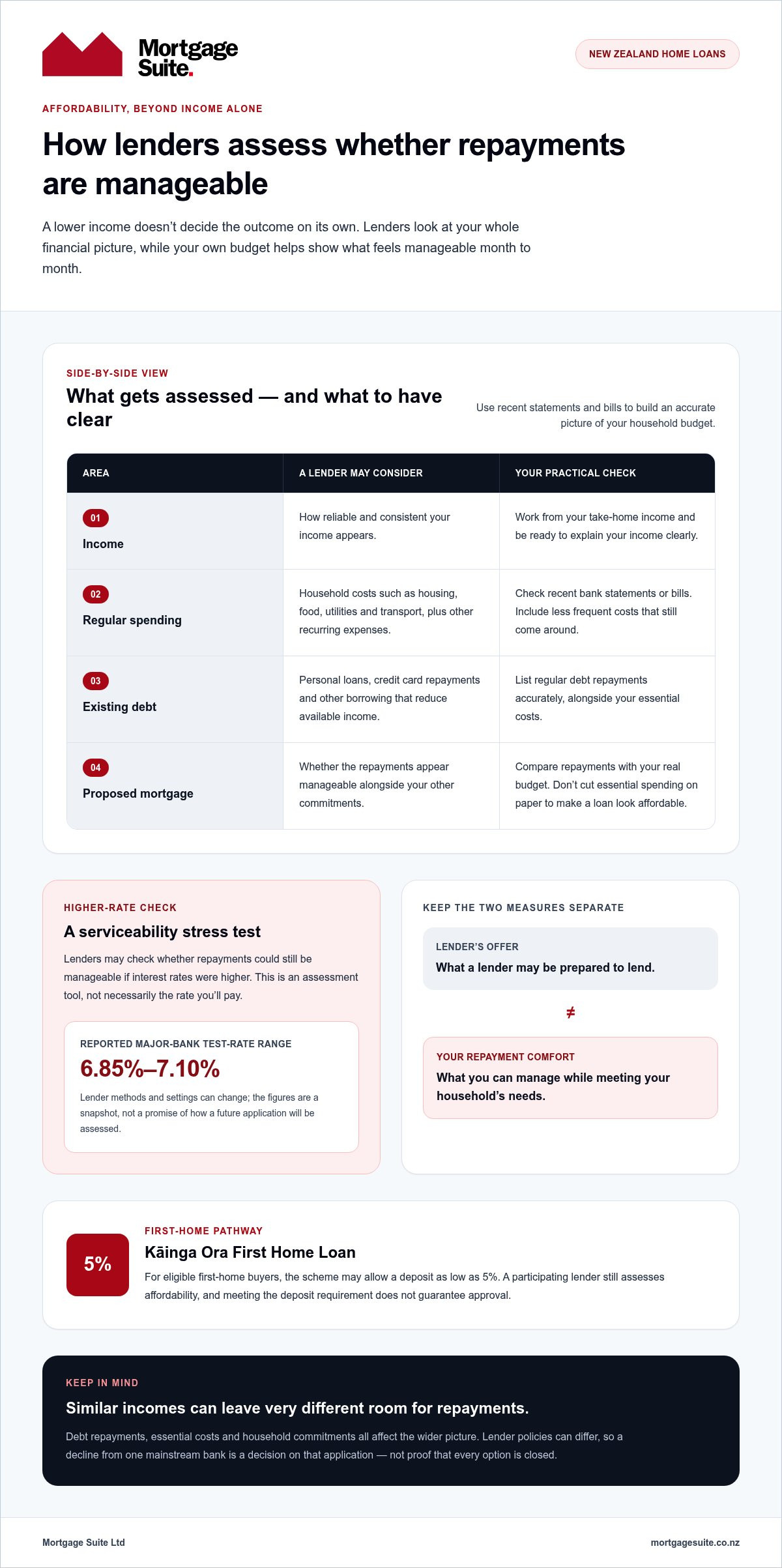
In New Zealand, banks assess affordability by reviewing income, regular expenses, existing debt and proposed repayments. They may also use a serviceability stress test to check whether repayments remain manageable at a higher interest rate. Your estimate helps with planning, while a bank’s assessment considers your wider financial position.

Extra repayments can reduce the balance sooner and may lower interest over time. A shorter loan term usually increases each scheduled repayment but reduces the time interest can accrue. Compare these changes using the same loan amount and rate, and check your loan’s repayment conditions before planning extra payments.

If interest rates rise, repayments on a floating-rate loan may increase. A fixed rate stays unchanged for its agreed period, so scheduled repayments generally remain steady during that time. When the fixed period ends, a new rate may change the repayment. Test a higher-rate assumption to see how your budget responds.

Compare scenarios instead of relying on one figure. Start with your current assumptions, then test a higher rate, a shorter term and an extra repayment, changing one setting at a time. Record the new payment and estimated total interest for each scenario. This shows which changes affect cash flow most and which may reduce interest most. A lower regular repayment may mean paying for longer; a higher repayment may reduce the balance faster if it fits your budget.

Keep the estimate separate from your household budget. List your income and existing commitments alongside the proposed repayment, including regular bills and debt payments. Check whether the payment leaves room for those commitments. This helps you assess whether the estimate is workable before a full lending assessment.

Interest-only periods

With interest-only repayments, your payments cover interest rather than the loan balance. The principal, meaning the amount borrowed, stays unchanged during that period. So, interest-only payments on a home loan do not reduce the amount you owe.

Interest-only payments may be lower than principal-and-interest repayments on the same balance, rate and term. But that does not mean the loan costs less overall. Interest continues to accrue, and the original balance remains due. Compare the payment with the balance after each repayment to see whether your debt is actually reducing.

To estimate an interest-only repayment, use the outstanding balance and interest rate. A higher balance or rate means more interest to pay. Repayment frequency also affects how often you make payments. When comparing interest-only with principal-and-interest scenarios, use the same balance, rate and frequency.

Pay close attention to what happens when the interest-only period ends. If the loan then switches to principal-and-interest repayments, the remaining balance must be repaid over the remaining loan term, which may increase scheduled payments. The amount depends on the balance, rate and remaining term. Model both stages instead of looking only at the initial payment.

  • During the period: track the balance and interest payments.
  • At the changeover: note the remaining balance and term.
  • Afterward: compare the new repayment with your budget.

For a clear comparison, record the interest-only payment, then estimate principal-and-interest repayments using the same loan amount, rate and repayment frequency. Keep the term assumptions clear, especially for the period after interest-only payments end. A calculator that models only one stage will not show the full repayment path. Estimate each stage separately, then consider their combined effect across the loan.

Interest-only repayments may suit a particular short-term cash-flow need, but they do not reduce the principal. Consider the purpose of the arrangement and what may change later. If your income is expected to change, for example, compare the later repayment with your expected budget. If the balance remains unchanged, plan how you will manage the move to repayments that reduce the debt.

Use a home loan calculator to compare repayment structures and test different rates. Change one input at a time, and save each estimate with its assumptions, including the balance, rate, frequency and remaining term. This makes the differences easier to explain and discuss. If you are weighing interest-only repayments against reducing the principal, compare the scenarios before choosing a structure.

Mortgage Suite Ltd: Home Loans to First Home Buyers

Mortgage Suite Ltd helps first-home buyers explore home loan options and understand how loan structure affects repayments. If your estimates raise questions about borrowing amount, repayment type or lender fit, a conversation can help put those figures into context.

Mortgage Suite Ltd offers Home Loans to First Home Buyers and Residential Investment property loans. It also offers Business Loans and Property Development Loans. If a mainstream bank’s lending criteria don’t fit your circumstances, 2nd Tier Loans may provide another path to consider. That doesn’t mean every application will suit every lender, so it helps to discuss your goals and financial position openly.

Bring your repayment estimates and the assumptions behind them, such as the loan amount, term and repayment frequency. Mortgage Suite Ltd can help you consider suitable lending options and negotiate with lenders on your behalf. To discuss your next step, contact Mortgage Suite Ltd or visit mortgagesuite.co.nz.

Make your next borrowing decision with confidence

A repayment estimate is more useful when it reflects the plans you are working towards. Before deciding what feels manageable, consider how your borrowing needs could change if your household or work circumstances shift. That wider view can help you choose a direction that supports your priorities, not just today’s budget.

Calculating a home loan gives you a starting point for that decision. The next step is matching your plans with the type of lending you need. Home Loans to First Home Buyers, Residential Investment property loans and Business Loans support different borrowing goals. A clear sense of your priorities can make your next conversation more focused.

Ready to take that step? Discuss your options. You can talk through what matters to you and move forward at a pace that feels right.

Frequently Asked Questions

What formula calculates mortgage repayments using the loan amount, interest rate, and term?

For a standard principal-and-interest loan, the periodic repayment formula is M = P × i(1 + i)n ÷ ((1 + i)n − 1). Here, P is the amount borrowed, i is the interest rate per repayment period, and n is the total number of repayments. Convert the annual rate to the relevant period and match n to your chosen schedule.

How do you calculate total interest and total cost over a home loan term?

Add the scheduled repayments across the loan term to estimate the total amount repaid. Subtract the original amount borrowed to estimate the interest, assuming the rate and repayment schedule stay unchanged. For example, if a calculator shows total repayments and the starting loan amount, subtract the loan amount from the total. If repayments or rates change, add the payments for each period instead.

What New Zealand mortgage calculators can estimate repayments and borrowing power?

A home loan repayment calculator can compare repayments using the loan amount, rate, term and repayment frequency. Conditional pre-approved finance from your chosen lender can help you understand your buying range before looking for a property.

Article by

Krish Krishna

Experienced Financial Adviser with over 46 years of Banking and Mortgage broking experience and over $2.0 Billion in loan settlements.

Mortgage refixing strategy NZ: Compare rates and loan types

A mortgage refixing strategy in NZ starts with reviewing your loan six to twelve months before a key fixed term expires. Compare more than the headline rate: consider the loan structure, flexibility and how repayments fit your plans. Staggering fixed-term dates can also help avoid having all your lending refix at once.

It’s understandable to feel unsure when rates and your circumstances can change. A lower rate may look appealing, but the right choice also depends on how much certainty or flexibility you need and when you might need access to funds.

This guide explains how to compare banks and non-bank lenders, weigh fixed, floating and split options, and prepare for a review before your term expires. You’ll also learn how staggered expiry dates can spread decisions over time, helping you plan your mortgage with care.

Key Takeaways

  • Compare lenders on structure and flexibility as well as the interest rate, so the loan fits your plans.
  • Choose between fixed, floating or split lending by weighing repayment certainty against access to flexibility.
  • Start reviewing your mortgage six to twelve months before a key fixed term expires to give yourself time to consider your options.
  • Staggering fixed-term dates can prevent all your lending from needing to refix at once.
  • Compare current rates by lender and fixed term, then consider how each option affects your repayments and future plans.

1. Comparing banks and non-bank lenders

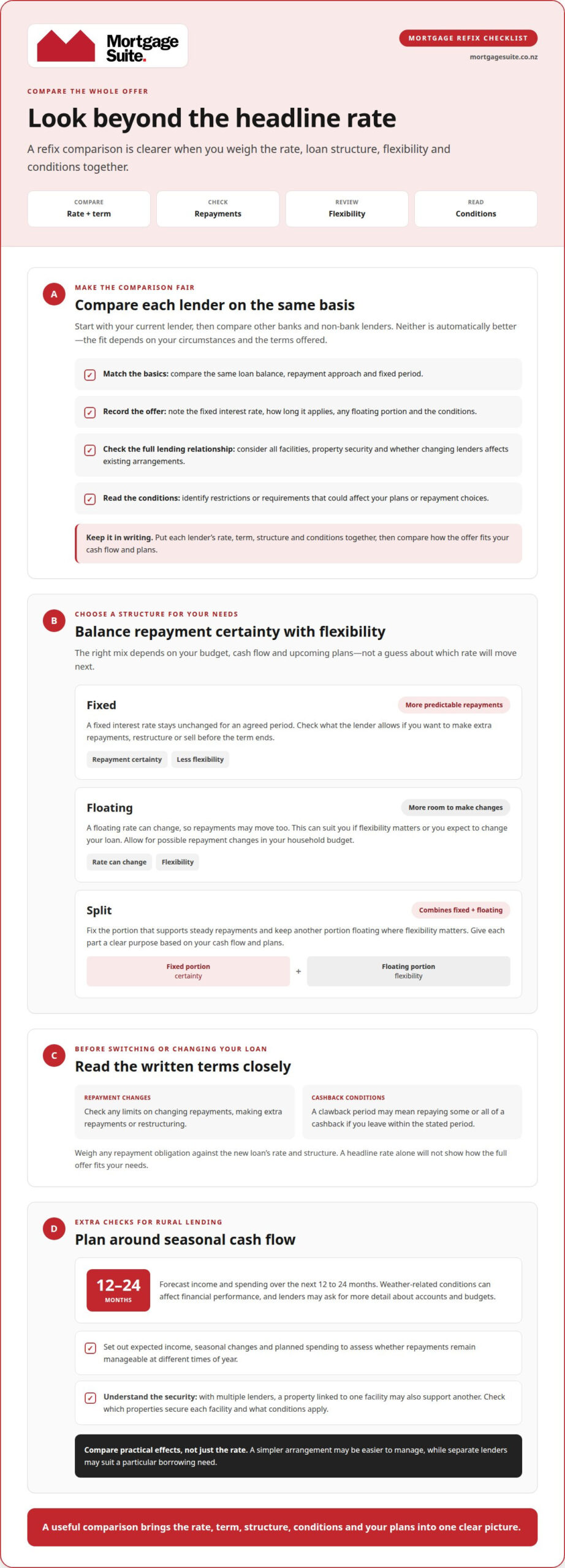
Compare your bank’s refix offer with alternatives by looking beyond the advertised rate. Assess the rate, fixed period, repayment options and conditions together. A lower rate may not suit you if the structure limits flexibility you need. Use the same loan balance and repayment approach when comparing offers, so you can make a like-for-like assessment.

Start with your current lender’s offer, then compare other banks and non-bank lenders. Ask how each option would affect your repayments and loan structure. A non-bank lender may be worth considering when mainstream bank criteria don’t fit your circumstances. Neither type of lender is automatically better: the right comparison depends on your income, security, plans and the terms available.

Use the same checklist for each lender. Record the fixed interest rate, how long it applies, any floating portion and conditions that affect how you manage the loan. Consider whether changing lenders would affect your existing lending arrangements. A headline rate won’t show the full picture if the offer changes your flexibility or requires a different security setup.

  • Compare like with like: Match the loan balance, repayment approach and fixed period across offers.
  • Read the conditions: Note restrictions or requirements that could affect your plans.
  • Review the structure: Check whether fixed and floating portions suit your need for certainty and access.
  • Consider the whole lending relationship: Look at how each lender treats all facilities and property security.

Rural borrowers have extra cash-flow factors to weigh. Forecast income and spending over the next 12 to 24 months before choosing a refix. Weather-related conditions can affect financial performance, and lenders may request more detail about accounts and budgets. Prepare a clear view of expected income, seasonal changes and planned spending. This helps you assess whether repayments remain manageable through different parts of the year.

Using multiple lenders for rural lending can also create complex security arrangements, including cross-collateralisation. This means a property linked to one facility may also support another. Before splitting lending across lenders, understand which properties secure each facility and what conditions apply. A simpler arrangement may be easier to manage, while separate lenders may suit a particular borrowing need. Compare the practical effects, not just the rate.

Keep your comparison in writing. Set out each lender’s rate, term, structure and conditions in one place, then identify the option that best fits your cash flow and plans. For rural lending, include the 12 to 24-month forecast. This turns a stressful choice into a clearer decision based on your actual circumstances.

2. Fixed, floating and split mortgage structures

Compare fixed mortgage rates and fees by matching the loan balance, fixed period and repayment type. Read each written offer for rate conditions, fee details and any limits on changing repayments. A headline rate is useful only when the surrounding terms also suit your needs.

A fixed interest rate stays unchanged for an agreed period, making repayments more predictable during that term. That certainty can help if your household budget has little room for unexpected changes. The trade-off is less flexibility: check what the lender allows if you want to make extra repayments, restructure or sell before the term ends.

A floating rate can change, so repayments may move when the lender changes its rate. This option can suit borrowers who value flexibility or expect to make changes to their loan. Factor the possibility of changing repayments into your household budget rather than assuming the current amount will stay the same.

A split structure combines fixed and floating portions. For example, you could fix the part of your loan that supports steady repayments and keep another portion floating for flexibility. Base the split on your cash flow and upcoming plans, not a guess about which rate will move next.

For rural borrowers, a split mortgage can combine a fixed portion of core term debt, a floating portion for flexibility and seasonal facilities for short-term cash-flow swings. This links different parts of the lending to different needs. Consider when income arrives, when expenses fall due and which funds need to remain accessible.

What mortgage refixing strategy suits changing interest rates and household budgets in New Zealand? Choose a fixed portion for repayment certainty and a floating portion where flexibility matters. The balance depends on your cash-flow needs and how much change your budget can absorb.

Cashbacks can affect a decision to refinance, but compare the offer with its conditions. A clawback period may require you to repay some or all of a cashback if you leave within the stated period. Read the written terms before switching, and weigh any repayment obligation against the new loan’s structure and rate.

Keep the comparison practical. Write down each portion’s purpose, rate type, repayment conditions and any relevant fee or cashback terms. Then assess the structure against your budget and plans. A suitable split gives each part of the loan a clear purpose, rather than dividing lending without a reason.

A rural mortgage refix in New Zealand can involve renegotiating the rate and loan structure with your current lender or splitting lending across multiple lenders. In either case, compare how each arrangement serves your cash-flow needs and preserves the flexibility your plans require.

3. Reviewing a mortgage before the fixed term expires

Yes, you can ask your bank to review the rate it offers for your next fixed term. Make a specific request, such as asking whether it can improve the rate or adjust the loan structure. Have your current loan details and preferred terms ready. A clear request gives the bank something practical to respond to.

Before speaking with your lender, prepare a concise snapshot of your mortgage. Include each loan portion, its balance, repayment type and current conditions. Note what you want to change, such as the repayment frequency or the amount you’d like to keep flexible. This helps keep the discussion focused on your needs.

Break fees are charges for ending or changing a fixed loan before its agreed term expires. Early repayment costs may also apply if you repay more than the loan terms allow. Read your loan documents and ask the lender for a written breakdown before making an early change. The terms and calculation determine the amount.

Use the review to check whether your current setup still reflects your circumstances. For example, a change in household income could affect what repayment amount feels manageable. List any planned property or borrowing changes, then consider how they might affect your loan structure. This gives you a practical basis for discussing options with your lender.

You can switch lenders when your fixed term expires. Compare the new lender’s written terms with your existing arrangement, including the steps needed to transfer the loan. Switching can involve charges or other costs, depending on the lending and transfer requirements. Ask for a clear breakdown before deciding, and compare the overall implications rather than focusing only on the rate.

Keep your review notes together. Record the lender’s offer, when it was provided, any conditions and questions that still need answers. If you discuss changes by phone, check the written terms afterwards. This makes it easier to compare what was discussed with the offer you’re being asked to accept.

Before agreeing to a new term, check how the proposed repayments fit your current budget. Consider whether you need the option to make extra repayments or change the structure later. A useful review ends with a clear record of the agreed rate, term, repayment arrangement and applicable conditions.

For rural borrowers in New Zealand, begin reviewing your mortgage six to twelve months before key fixed terms expire. Use that time to gather your loan details, preferred terms and planned changes, then identify what you need the lender to clarify. Setting out these points early can keep the review focused on the choices that matter to your household.

As expiry approaches, revisit the written offer alongside your notes. Check the rate, term, repayment arrangement, conditions and any costs tied to a change or transfer. If anything remains unclear, ask for an explanation in writing before deciding. Keep your decision grounded in what your budget can manage and whether the arrangement provides the flexibility you want.

Mortgage refixing strategy NZ: Compare rates and loan types

4. Staggering fixed-term expiry dates

Staggering means arranging fixed loan portions so they expire at different times. Instead of facing a single decision for the whole mortgage, you review each portion as its term ends. This can reduce the impact of a rate rise by preventing all your lending from refixing at once.

The main benefit is spreading rate changes across separate review points. If rates rise before one portion expires, that portion may refix at a higher rate while the others remain on their agreed terms. If rates fall, later expiry dates give you opportunities to consider the rates available then. Staggering spreads exposure; it doesn’t predict or prevent rate movements.

Decide how much of your mortgage to put in each portion by considering your budget and tolerance for repayment changes. A larger portion expiring at once can cause a more noticeable change to repayments. Smaller portions can spread that effect, but mean managing more individual dates and decisions. The right balance is personal, not a standard formula.

Before changing your schedule, map your existing loan portions and their expiry dates. Mark the portion that expires first, then consider whether the next expiry coincides with a planned change in household finances. For instance, if you expect a change in regular income, consider how a refix decision around that time could affect your available budget.

Staggering also has practical trade-offs. Each portion has its own rate, term and review point, so you’ll need to keep clear records. Maintain a loan schedule showing each portion, its expiry date, repayment arrangement and lender terms. A calendar reminder for each review can help you keep decisions distinct and avoid treating the mortgage as one undivided loan.

When a portion approaches expiry, assess it on its own merits. Consider the rate and terms available then, how its repayments fit your budget and whether the remaining portions still have the right schedule. A decision about one portion doesn’t have to dictate the next. Review the whole plan when circumstances change, but tie each refix choice to the portion reaching expiry.

Staggered dates are most useful when you can manage the extra administration and want to avoid concentrating every refix decision at one point. They won’t guarantee a lower rate or smoother repayments in every market. The practical aim is to make each decision manageable and keep future expiry dates visible, so you can approach them with a clear view of your mortgage.

5. What are current NZ mortgage refix rates by bank and fixed term?

Mortgage rates change, so a useful comparison needs the lender’s current offer and the fixed term you’re considering. Rather than relying on a single rate figure, compare the terms available for your loan and confirm how each offer applies to your circumstances. The rate alone won’t show whether the structure suits your budget.

Start with your bank’s current refix offer. Record the rate, fixed period, repayment conditions and date the offer applies. Then compare it with other available offers for the same loan balance and repayment approach. This keeps the comparison fair and helps you spot differences beyond the headline rate.

Fixed terms can have different rates at the same lender. Compare the options side by side using the same loan details. For example, look at the shorter and longer fixed periods available, then consider how each fits your expected budget and plans. Don’t assume a rate for one term applies to another.

A bank’s advertised rate may not be the final offer for every borrower. Your loan details and the lender’s terms affect what you’re offered. Ask for the rate and conditions that apply to your mortgage in writing. Note the date of each offer, so an older figure doesn’t distort your comparison.

Use a simple comparison record with these details:

  • Lender: Record which bank or lender made the offer.
  • Fixed period: Note the term linked to that rate.
  • Loan structure: Include any fixed and floating portions.
  • Conditions: Record repayment limits and any relevant offer terms.
  • Offer date: Write down when the lender provided the information.

For a clear decision, compare the same fixed period across lenders first, then compare other terms separately. If one offer has a lower rate but tighter repayment conditions, consider whether those limits fit your plans. A household expecting an income change may value flexibility differently from one seeking steady repayments.

Check whether your comparison includes any cashback terms or conditions associated with changing lenders. Read how long those conditions apply and what could happen if you move the loan again. Keep these details separate from the interest rate, so an upfront offer doesn’t distract from the ongoing loan terms.

Before accepting a refix, confirm that the rate, term and conditions match the lender’s written offer. If your current bank’s offer doesn’t meet your needs, use comparable written terms to discuss alternatives. A careful, dated comparison gives you a practical basis for choosing a mortgage structure that fits your budget.

Mortgage Suite: Home Loans to First Home Buyers

Mortgage Suite Ltd offers Home Loans to First Home Buyers, helping you consider your borrowing needs and mortgage structure. If reviewing your finances has raised questions about buying your first home, or you’re weighing a new loan against your household budget, this can be a useful next step.

Bring together your income, regular spending, existing lending and property plans before discussing your options. A clear picture of your finances can help you explore a loan structure suited to your circumstances, rather than focusing only on a headline rate. If a mainstream bank’s decision has left you unsure what to do next, you can explore alternative lending options.

Contact Mortgage Suite Ltd to discuss your home loan needs and possible next steps.

Make your next mortgage decision with confidence

Your next mortgage decision is a chance to make your borrowing fit the priorities ahead. A mortgage refixing strategy in NZ should reflect what you need from your loan and the changes you expect in your household plans. Take a moment to identify what matters most before deciding on your next step.

If you’d value a conversation about your options, discuss your situation and prepare for the decisions ahead. A clear discussion can help you frame the questions that matter and consider a path forward.

Talk through your mortgage options. A thoughtful next step can help you feel more prepared and in control.

Frequently Asked Questions

How does mortgage refixing work in New Zealand?

Refixing means agreeing a new fixed rate and term as your existing fixed term ends. Your lender presents the available options, and you choose a rate period and loan arrangement for the next term. For example, if your home loan has separate portions, you can decide on each as its term comes up. Check the new repayment amount and terms before accepting.

When should I refix my NZ mortgage before the fixed term expires?

Begin reviewing your mortgage six to twelve months before a key fixed term expires. Use that time to gather current loan details, note any changes to income or spending, and consider what repayment amount your budget can manage. For a rural household, include a cash-flow forecast for the next 12 to 24 months. This preparation gives you time to compare options before deciding.

Should I choose a short or long fixed term for a NZ home loan?

Choose a term based on how long you want repayment certainty and whether your plans may change. A longer term keeps the agreed rate in place for longer, while a shorter one brings the next review sooner. For example, if you expect a change in household income or property plans, consider how either term affects your flexibility and budget before choosing.

How do floating, fixed, and split mortgage strategies compare in NZ?

A fixed rate keeps the agreed rate in place for its term; a floating rate can change. A split arrangement combines both, so different loan portions serve different needs. For example, a household seeking predictable repayments could fix most of its lending while keeping a smaller portion flexible for planned changes. Compare repayment conditions and your capacity to manage changing payments before settling on a structure.

Article by

Krish Krishna

Experienced Financial Adviser with over 46 years of Banking and Mortgage broking experience and over $2.0 Billion in loan settlements.

Home loan pre-approval declined? What to do next

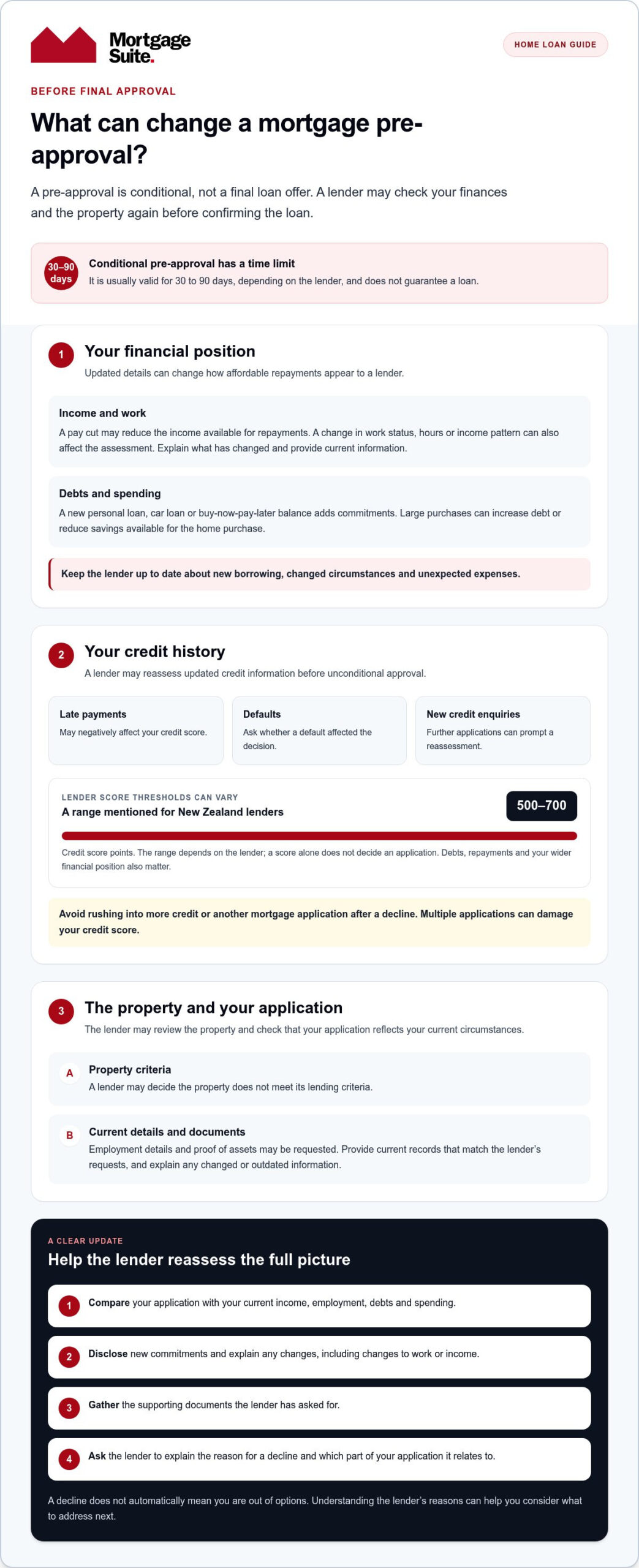
A pre-approval isn’t a final yes: a lender can still decline your home loan after reviewing your finances and the property. Conditional pre-approvals are usually valid for 30 to 90 days, depending on the lender, and don’t guarantee a loan. If your mortgage pre-approval is rejected, it doesn’t automatically mean you’re out of options.

It’s understandable to feel unsettled, especially if you thought the main hurdle was behind you. A lender may reassess your income, spending, debts or credit history, or decide the property doesn’t meet its lending criteria. This article explains why mortgage pre-approval can be rejected, what financial changes may affect your application, and how a mortgage broker may help you understand the decision and consider a suitable next step.

Key Takeaways

  • Pre-approval is conditional, not a final loan offer. A lender may reassess your finances and the property before confirming the loan.
  • Changes to your income, employment, debts or spending can affect how affordable the repayments appear to a lender.
  • Late payments and new credit applications may affect your credit history, so avoid taking on extra debt while your application is being assessed.
  • Ask the lender to explain the reason for a decline. The issue may relate to your finances, the property, or information in your application.
  • A mortgage broker can help you understand the lender’s decision and consider whether a different loan approach may suit your circumstances.

Changes in income, employment, debt and spending

Pre-approval reflects the information assessed when you applied, not every change that follows. Before final approval, updated income, employment or spending details can affect how a lender views your ability to repay.

Income and debt changes

Income and debt changes are shifts in what you earn or owe after applying for a home loan. For example, a pay cut can reduce the income available for repayments, while a new personal loan adds another commitment. These changes can alter the picture the lender assessed at pre-approval, so tell the lender if your circumstances change instead of relying on figures that are no longer accurate.

Changes don’t always mean your application has to stop. A pay rise, reduced debt or change in regular work hours can affect the assessment differently, depending on the full picture. Give the lender current details and explain what changed. If your income varies, describe the pattern clearly. Leaving out a recent change can create a mismatch between your application and your current finances.

New debt matters because repayments reduce the money left for a mortgage. A car loan, personal loan or buy-now-pay-later balance can change your regular commitments, even if you’ve kept up with payments. Before taking on new debt during the home-loan process, consider how its repayments could affect your application. Tell the lender about any new borrowing instead of assuming it won’t appear in the assessment.

Employment details and supporting documents

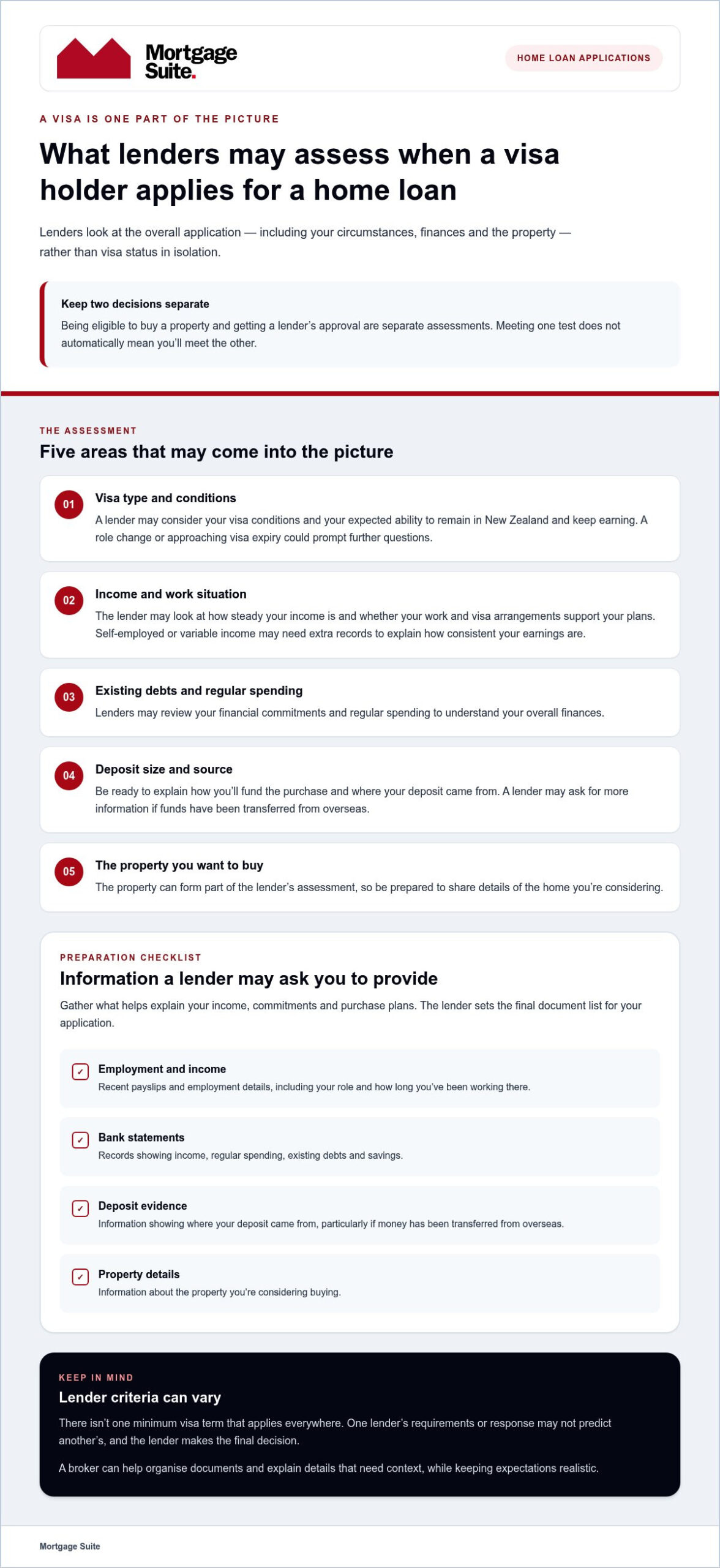
Employment details describe your current work and income arrangements, while supporting documents show the financial information behind your application. A lender may require employment details and proof of assets for pre-approval. If you move from salaried work to contracting, for example, update your work status and provide the information requested to support the new arrangement.

Keep relevant records together, including documents that show your current income, employment and assets. The lender’s requests depend on your circumstances, so match each document to the information they ask for. If a record is out of date or a detail has changed, explain that clearly when you submit updated information. This helps avoid confusion between your original application and your current position.

Spending changes can also affect the lender’s view of affordability. A large purchase, such as new furniture bought on credit, can increase debt or reduce savings available for the home purchase. Avoid taking on more debt or making large purchases while seeking final approval. If an unexpected expense changes your finances, record what happened and update the lender with accurate details.

Before sending an update, compare your application with your current income, employment, debts and spending. Correct outdated details, disclose new commitments and gather the requested supporting documents. For example, if your work arrangement changed and you also opened a credit account, explain both changes together. A complete, up-to-date account gives the lender a clearer basis for reassessing your application.

Credit score changes and new credit applications

Your credit score can change between pre-approval and final assessment. Late payments, defaults and new credit enquiries may negatively affect your score before unconditional approval. That matters because a lender may reassess your application using updated credit information. If your score has changed since applying, ask what part of your credit history affected the decision and what information the lender considered.

There’s no single credit-score threshold for every New Zealand home loan. The minimum scores used by lenders can range from 500 to 700 credit score points, depending on the lender. A score within that range doesn’t decide the application by itself. The lender also considers your wider financial position, including debts and repayments, so a higher score alone may not resolve other concerns.

New credit applications can add uncertainty while a lender assesses your mortgage. For example, applying for a credit card and a car loan after receiving pre-approval may prompt the lender to reassess your commitments. Opening more lines of credit can also affect your application. Avoid rushing into another mortgage application after a decline: multiple applications can damage your credit score.

If a lender declines your application, first ask for a clear explanation. Find out whether the concern involved late payments, a default, a recent credit enquiry or another part of your application. Then review your credit records and compare them with your own payment history. If an entry appears incorrect, gather the relevant account information before discussing it with the organisation that recorded it.

For a New Zealand home loan, deposit requirements and Loan-to-Value restrictions depend on the lender’s criteria and property assessment. The Loan-to-Value ratio compares the loan with the property’s value, so a larger deposit means borrowing a smaller proportion of that value. Deposit size is one part of the assessment, alongside credit history, income and existing debts.

Before applying again, pause and make a clear record of any credit applications, repayments or missed payments since pre-approval. Avoid taking on new credit while the lender reviews your position. If you’ve recently applied for finance, explain why and whether the application led to a new debt. Accurate details help the lender assess your current commitments rather than an incomplete picture.

A decline doesn’t tell you which change mattered most unless you get the lender’s reasons. For example, a recent enquiry may be less significant than an unpaid default, depending on the lender’s assessment. Use the explanation to decide what to address first, then discuss another application once you understand how your credit history and deposit affect the overall picture.

Can I be denied after a pre-approval?

Yes. A lender can decline after pre-approval if updated financial checks or the specific property change its assessment. Ask for the lender’s reasons before deciding what to do next.

Reasons for decline after pre-approval

A decline after pre-approval means the lender’s final assessment no longer supports the loan. The lender may reassess your finances and the property, including its valuation. If the valuation is below the purchase price, the lender may decide the security does not support the requested amount. Changed credit information, incorrect application details or a property that fails a condition can also affect the decision.

The property itself can be the issue. A lender may view a flood-zone property, a home in a mining town or a property needing substantial renovation as higher risk. A rise in interest rates or a change to lending policy may also prompt reassessment. These factors mean pre-approval is not final approval for every home you might choose.

Steps after a loan decline

Start by asking the lender to explain the decline clearly. Identify whether the main concern was your finances, an application error, a property condition or its valuation. Then compare that explanation with your documents and purchase details. This gives you a specific issue to address, rather than guessing or sending another application with the same problem.

If the property is the obstacle, consider whether another property may meet the lender’s criteria. If a valuation came in below the purchase price, discuss how that figure affected the requested loan. If details were missing or incorrect, prepare accurate information before reapplying. Keep the lender’s explanation and supporting documents together so the next assessment addresses the actual concern.

Applying to another lender

You can consider another New Zealand lender after a decline, but first understand why the original application failed. There is no set waiting period in the available guidance. The practical next step is to address the reason before applying again. Rushing into several mortgage applications can damage your credit score, so avoid sending multiple applications at once.

A different lender may assess your circumstances or the property differently, but the same unresolved issue can still matter. For example, a lower valuation remains relevant if you apply for the same property and loan amount. Before approaching another lender, gather the decline explanation, update any incorrect details and decide whether the property or requested borrowing needs to change.

Use the lender’s decision as a guide to what needs attention. If your mortgage pre-approval is rejected because of a property condition, changing your finances alone may not solve it. If the concern relates to your application information, correct that first. A clear reason helps you decide whether to revisit the property, update your application or seek another assessment.

Home loan pre-approval declined? What to do next

Conditional approval and approval in principle

Conditional approval, also called approval in principle, is an early indication that a lender may lend if its conditions are met. In New Zealand, it’s provisional, not a final loan offer, so the lender can still review your finances and the property before confirming the loan.

Pre-approval letters commonly include conditions that need to be satisfied before the lender proceeds. These may relate to information the lender still needs or to the property you intend to buy. For example, the lender may need to assess a specific home after you make an offer. Approval in principle therefore gives you an early guide, not confirmation that every property will qualify.

Check the letter carefully when it arrives. Note the date, the stated expiry and each condition that applies to your application. Home-loan pre-approvals are usually valid for 30 to 90 days, depending on the lender. If your search takes longer, the approval may expire, and the lender may need to reassess your circumstances before you rely on it.

That reassessment can matter if your finances change during the approval period. New debt, a change in employment or a credit-history change could affect the lender’s view of your application. Keep the information you provided accurate and current. If something changes, tell the lender rather than treating the original pre-approval as an unchanged decision.

The property is another part of the final assessment. A lender may assess the specific home and obtain a valuation before issuing unconditional approval. For example, if the valuation comes in below the agreed purchase price, the lender may reconsider the loan amount. Pre-approval for your finances does not mean the lender has accepted every property you might choose.

Unconditional approval is formal approval issued after all conditions are met and both you and the specific property have been assessed. Until then, don’t treat a conditional letter as confirmation that settlement funding is ready. Read the conditions, respond to requests for information and track the approval period. These steps help you understand what remains outstanding.

If a conditional approval expires or the lender changes its assessment, ask which condition remains unmet and what information is needed. For instance, clarify whether the issue concerns an updated financial detail or the property’s valuation. A precise explanation helps you decide whether to provide further information, revisit the property choice or discuss a revised application.

Approval in principle can help you understand your borrowing position while you look for a home, but it has limits. Treat the lender’s conditions and expiry date as part of your planning. Before making commitments based on the letter, understand that final approval depends on the lender completing its assessment of your finances and the particular property.

Using a mortgage broker

A mortgage adviser can review the lender’s reasons, help prepare a request for reconsideration and discuss other lending options. Their value lies in turning a decline into a clearer plan, not simply sending the same application again.

Broker support after rejection

A broker’s support after rejection means reviewing the decision and helping you present relevant information clearly. This matters when, for example, the lender misunderstood a change in income or overlooked a document. Share the decline explanation and application details so the adviser can identify the concern and help shape a focused response.

If the lender may reconsider, a broker can help organise supporting documents and explain how they address the issue. For example, an updated employment record may clarify a recent work change. If the property valuation is the concern, the response needs to address the property assessment, not rely only on documents about your income.

A broker can also discuss whether another lender’s criteria may better fit your circumstances. Start that comparison with the reason for the decline, not a fresh application sent everywhere. If the issue is an incorrect detail, correct it first. If the property is the obstacle, consider whether another property could change the assessment.

Working with a mortgage broker

Working with a mortgage broker means sharing your financial picture so they can help assess suitable lending options. Provide accurate information about income, existing debts, deposit and the property you’re considering. For instance, if you’re self-employed, explain how your income is recorded and supply the documents requested for assessment.

Use the lender’s decline explanation as the starting point for a practical discussion. Ask the broker to clarify which parts of your application need attention and what evidence could address them. A clear account of the issue helps avoid repeating an application without meaningful changes.

A broker can help communicate with lenders and present your circumstances in context. For example, if a mainstream bank’s criteria don’t suit your situation, discuss whether another lending approach may fit. The lender still assesses the application, so focus on a realistic plan, clear documents and loan terms that match your goals.

Before proceeding, agree on what the next application needs to show. That could mean correcting information, documenting a change or reconsidering the property. A mortgage adviser can help you weigh those options and prepare for the next conversation with a lender, rather than treating a decline as a final judgement on your borrowing plans.

Mortgage Suite: Home Loans to First Home Buyers

Mortgage Suite Ltd provides home loans to first home buyers, helping you consider your next move after a lender’s decision. If your pre-approval was declined, bring the lender’s explanation and your updated financial details to discuss possible lending options. Understanding whether the concern relates to your circumstances or the property can help shape a more suitable application.

Mortgage Suite Ltd also provides residential investment property loans, business loans and property development loans. For a first-home buyer, the focus is understanding your goals and borrowing situation, then considering a path that fits. A decline can be discouraging, but it isn’t a judgement on you as a borrower. Contact Mortgage Suite Ltd to talk through your circumstances and possible next steps.

Choose your next move with confidence

If your mortgage pre-approval has been rejected, take time to understand the lender’s reasons before deciding what to do next. You don’t need to treat the decline as a judgement on your plans. Focus on what you want to achieve, what needs to change and what information will help a lender assess your situation fairly.

A useful conversation can turn uncertainty into a practical direction. Mortgage Suite can talk through your circumstances and help you consider the next step, whether that means revisiting your application or exploring another lending path. You don’t need to have every answer ready before you start. A clear account of what happened is a helpful beginning.

Contact Mortgage Suite to discuss your next step. With a considered plan and the right support, you can keep moving towards your property goals.

Frequently Asked Questions

What is home loan pre-approval?

It’s an early indication of how much a lender may be willing to lend, based on the details you’ve supplied. Use it as a planning guide, not a spending target: consider whether the repayments and other homeownership commitments fit your budget. Before making an offer, read the lender’s letter closely and note what it says about the amount, property and any remaining conditions.

Why might a mortgage pre-approval be rejected in New Zealand?

A lender may decline if its assessment finds a concern it can’t accept or needs more evidence to resolve. Ask whether the decision reflects a lending policy, missing information or a specific part of your application. That distinction helps you work out whether to provide further documents, correct a detail or reconsider your plans, instead of making another application without knowing what needs to change.

What credit score and credit history issues can prevent mortgage pre-approval in NZ?

Review your credit history for accounts you don’t recognise, incorrect balances or payment entries that don’t match your records. If something looks wrong, gather statements or other relevant records and raise the specific entry with the organisation that recorded it. A lender can also explain whether its concern relates to your overall credit profile or a particular item, helping you focus on the right issue.

How do income, expenses, debt, and affordability affect NZ mortgage pre-approval?

Prepare a realistic household budget that captures regular bills as well as less frequent expenses, such as vehicle maintenance or annual charges. Compare that spending with the income you can reliably count on, then account for your existing financial commitments. This gives you a clearer view of what repayment level may fit your day-to-day life and helps you discuss your budget with the lender using specific figures from your own records.

Can a bank reject pre-approval because of the property, its valuation, or its location?

Yes. To clarify a property-related concern, keep the purchase documents and any available property reports together. Ask the lender which feature affected its assessment and whether the concern relates to value, condition or suitability. For example, if the issue is the valuation, ask how the lender’s assessed value affects the proposed loan, rather than assuming the purchase price will determine the amount it is prepared to lend.

What should I do after my NZ mortgage pre-approval is declined?

Keep the lender’s decision and related correspondence together, then ask what evidence could change the assessment. Find out whether the lender would reconsider the existing application with further information or expects a new application. If you’re working with a mortgage adviser, share the decision and your supporting records so they can help you consider the next approach without sending an application that leaves the original concern unanswered.

Does a rejected mortgage pre-approval affect my credit score in New Zealand?

The declined decision and a credit enquiry are different things. A lender’s enquiry may be recorded when it assesses an application, and new enquiries can negatively affect your score. Check your credit history for enquiries you don’t recognise, and keep track of applications you’ve made. If you’re unsure which enquiry relates to the declined application, ask the lender or the organisation holding your credit information for clarification.

What documents do NZ lenders require to assess a mortgage pre-approval?

New Zealand lenders may require employment details and proof of assets. They may also request supporting documents showing your current income and financial position.

Article by

Krish Krishna

Experienced Financial Adviser with over 46 years of Banking and Mortgage broking experience and over $2.0 Billion in loan settlements.

Home loan application in NZ: evidence for income and deposit

A practical home loan application checklist NZ borrowers can start with includes income records, proof of deposit, property details and identification showing residency status. For a First Home Loan, you must be a New Zealand citizen, permanent resident or resident visa holder ordinarily resident in New Zealand, and a first-home buyer or previous homeowner in a similar financial position. Lenders also assess whether repayments are affordable.

Gathering paperwork can feel like a hurdle, especially when your income is irregular or your circumstances do not fit a straightforward first-home-buyer profile. Organising your documents can help you explain your position and show lenders what they need to assess your application.

This guide covers the income and deposit evidence to gather, the property and residency details that matter, and the additional criteria for First Home Loan applicants. It also explains how pre-approval fits into the process and how a mortgage broker can help you prepare your application.

Key Takeaways

  • Gather recent bank statements and employment records so a lender can understand your income and regular spending.
  • Keep a clear record of where your deposit comes from, including any gifted funds.
  • Pre-approval can help you understand your borrowing position before house hunting, with final approval considered once you have a property in mind.
  • Collect property and building documents early, especially if you’re buying a home that needs work or planning a build.
  • Check residency and first-home-buyer eligibility alongside your income and deposit, as these details can affect which application pathway fits.

Income evidence for employees and casual workers

Start with records showing what you earn, how regularly you receive it and what reaches your account. Lenders consider this evidence alongside your expenses and existing debts when assessing affordability. A home loan application checklist NZ borrowers can use should make every income source easy to identify.

  • Gather your usual transactional account statements for the last three months. They help show income deposits, regular spending and other payments.
  • Collect recent payslips and your employment agreement. These help explain your pay rate, hours and employment terms.
  • If you’re on a three month trial period, include your employment contract. It gives the lender information about the trial arrangement and your role.
  • For casual work, organise records that show your shifts and changing pay. A clear run of payslips and matching bank deposits can help explain fluctuations.

How do NZ banks assess living expenses, debts, credit history, and affordability? Lenders consider your ability to repay, current debts and credit history, as well as your income and regular living expenses. They must assess affordability and suitability, so list your commitments accurately and ensure your statements tell a consistent story.

Self-employed income needs a different paper trail. Self-employed applicants may be asked to provide tax returns, financial statements and personal bank statements. They generally assess business profit after expenses, not total turnover, so high sales alone may not show the income available for repayments.

  • Prepare tax returns and financial statements for the last two years. These give a view of business earnings after costs.
  • Gather personal bank statements covering three to six months. They help connect declared income with money received and household spending.
  • If your trading history is under two years, organise the records you do have. Some lenders may consider a shorter trading history in certain circumstances.
  • Request finalised financial statements and IRD statements three months before applying. This gives you time to address missing paperwork or tax arrangements.
  • Collect bank statements, identification and deposit evidence one month before applying. Having these records together makes it easier to assemble your application.

For rental or other income, gather records showing the source, amount and consistency, such as tenancy documents and bank deposits. If you have multiple income sources, label each record clearly so the lender can distinguish employment pay, rent and other earnings.

First Home Loan income thresholds also matter. Keep evidence covering the relevant period ready for your application. A home loan application checklist NZ first-home buyers prepare should distinguish personal earnings from any co-applicant’s income.

Deposit sources and gifted funds

Loan-to-Value restrictions compare the loan amount with the property’s value, while deposit requirements depend on the lending pathway. A First Home Loan requires a minimum deposit of 5% of the purchase price; other applications are assessed against the lender’s criteria.

Your deposit evidence should show both how much you have and where it came from. Gather account statements and records for savings, transfers or a relative’s gift. A clear paper trail links the amount you declare to the money available for settlement.

  • List each deposit source. Separate personal savings, eligible withdrawals and gifted funds so each amount has a clear origin.
  • Save statements showing your savings balance. Keep the relevant account records together, including entries that show regular deposits or a transfer into your deposit account.
  • Keep evidence of large transfers. Match the incoming payment to a transfer record or written explanation, so it is clear whether the funds are your savings or a gift.
  • Record the gift’s source and amount. First Home Loan applicants may use a relative’s gift as their deposit, so keep a clear record of the relative and the gifted funds.
  • Check that your available deposit matches your purchase plans. Compare the funds you can access with the purchase price and the minimum deposit required for your chosen pathway.

For example, if a relative transfers gifted funds into your everyday account, keep the statement showing the deposit and a record explaining the transfer. If you move savings between accounts, keep statements for both. This makes the movement of funds easier to follow and helps prevent unexplained gaps in your deposit history.

A First Home Loan has a specific minimum deposit: 5% of the purchase price. That figure is the programme’s deposit requirement, not a universal deposit rule for every home loan. Loan-to-Value restrictions relate the borrowing to the property’s value, so the required deposit and lending assessment depend on the loan type and lender criteria.

Before applying, organise your evidence in one place. Make a simple record of each deposit source, its amount, the account holding it and the supporting document. For gifted funds, include the transfer record and gift details. For savings, include statements showing the balance and transfers between accounts.

A tidy deposit record helps you explain your position clearly, whether your funds come from long-term savings, a relative’s gift or a mix of sources. Keep original statements and transfer records together so you can give a consistent account of your deposit during the application process.

Mortgage pre-approval and broker assistance

Pre-approval can help you understand your borrowing position before house hunting. A New Zealand First Home Loan applicant may seek pre-approval before finding a property, then return to the lender for final approval after choosing one. Treat pre-approval as an early step, not confirmation that every property or offer will be accepted. Have your income, deposit and purchase details ready for assessment.

Use pre-approval to set a practical search range and identify any information the lender still needs. If your income varies between pay periods, for example, explain the pattern rather than relying on one unusually strong week. Keep your evidence consistent with your application. A clear account of your income, commitments and deposit helps the lender understand your circumstances.

  • Gather your financial details before applying. Include income, debts, regular expenses and deposit information, so the assessment reflects your whole position.
  • State your likely purchase plans. Share the type of property you’re considering and your expected price range, because the chosen property is reviewed later.
  • Keep a record of pre-approval conditions. Note any documents or changes the lender needs before final approval.
  • Update the lender if your circumstances change. A new debt, job change or altered deposit can affect the application between pre-approval and purchase.

Once you find a home, provide the lender with its details for final approval. The lender then assesses the specific property alongside your application. A pre-approved amount should guide your search, not replace the final review. Keep purchase information and any new financial details organised for this step.

A mortgage broker can help you present your application clearly and understand how lender criteria may differ. They can review your circumstances, identify relevant questions and help organise information for a lender. If you have casual work, self-employed income or several income sources, a broker can help explain how the details fit together. The lender makes the final decision.

Lenders in New Zealand may apply different credit criteria, so a decline from one lender does not necessarily mean another will decline your application. A broker can help identify whether another lender’s criteria may better fit your circumstances and support a clear application. This can be useful if a standard application does not capture the full picture of your income or deposit.

If you’re self-employed, consider seeking pre-approval before house hunting. It gives you an early opportunity to discuss how your trading history and income records will be assessed. Use the time to fill gaps in your paperwork and understand the next steps before making an offer. Keep your financial information current as you move from pre-approval to a chosen property.

Home loan application in NZ: evidence for income and deposit

Property purchase and construction documents

Property documents connect your borrowing request with the home or project you plan to fund. Start a separate folder for each property, then add purchase records, property details and, where relevant, construction paperwork. Clear files make it easier to explain what you’re buying and how the proposed loan relates to it.

  • Keep a copy of the sale and purchase agreement. It records the agreed transaction details, including the property and purchase terms.
  • Note the property address and type. Record whether it’s a house, apartment, section or another property type, so your application identifies the security clearly.
  • Save any property information supplied during your purchase. For example, keep the listing details and documents describing the land, dwelling or included fixtures.
  • Organise any valuation or building report you receive. These documents provide information about the property’s value or condition.
  • Keep relevant council records together. Plans, consents and correspondence can help explain the property’s status or planned work.

For a First Home Loan, the property must be less than 1 hectare, and you must use it as your primary place of residence. Keep property records that show what you’re buying and where you intend to live. If the purchase involves a section or a home with substantial work planned, separate existing property documents from proposed building documents.

Planning a build or renovation? Gather documents describing the work, expected stages and how the project will be funded. The lender needs to understand the property and proposed project together, so make that connection clear in your folder.

  • File the building plans and specifications. These describe the intended layout, materials and scope of the work.
  • Keep the builder’s contract and project schedule. These explain who is completing the work and how the project is organised.
  • Save the project budget and payment schedule. They show how the expected spending relates to the work stages.
  • Include relevant council documents. For example, keep consent records or correspondence alongside the plans they relate to.
  • Record any siteworks separately. Note ground preparation or access work as distinct project items, so the costs and tasks are easy to identify.

Use a simple document list showing the file name, date and purpose of each item. If a plan changes, keep the updated version and label it clearly instead of mixing several drafts together. For example, label a revised building plan with its issue date and match it to the relevant project schedule. This creates a tidy record for the move from purchase details to final property assessment.

Residency and first-home-buyer criteria

For a First Home Loan, check residency and buyer eligibility before preparing your application. These criteria are separate from proof of income or deposit and can determine which application pathway suits your circumstances.

How do home loan application requirements differ between banks and non-bank lenders in NZ? Lenders may apply different credit criteria, so their documents and assessment approaches can vary. A decline from one bank does not necessarily mean another lender will decline your application.

  • Confirm your residency category. First Home Loan applicants must be New Zealand citizens, permanent residents, or resident visa holders ordinarily resident in New Zealand.
  • Gather documents that show your status. Put the relevant citizenship, permanent residency or resident visa records with your application, so your residency details are clear.
  • Check whether you meet the first-home-buyer test. You must be a first-home buyer or a previous homeowner in a similar financial position to a first-home buyer.
  • Explain previous home ownership accurately. If you’ve owned a home before, prepare a clear account of your present financial position and circumstances for the eligibility assessment.
  • Confirm your intended use of the home. A First Home Loan property must be your primary place of residence, not a home you plan to use solely as a rental.
  • Check the age requirement. Check whether any age requirements apply to your application, and include accurate identification details.

What bank statements and expense records should NZ home loan applicants provide? Keep statements from your usual transactional account for the last three months, alongside a clear record of regular household spending and debt repayments. These help present your living costs and financial commitments consistently.

If you’re buying with others, explain every buyer’s residency and ownership history. One buyer may be purchasing for the first time while another has previously owned a home, for example. Set out each person’s circumstances separately, then show how you are applying together. This helps clarify the relevant eligibility pathway.

What common mistakes or delays should NZ home loan applicants avoid? Avoid gaps in residency or ownership details, inconsistencies across forms and overlooking the primary-residence requirement. Match names and dates across identification and application records, and explain any previous ownership clearly.

Before applying, use a simple eligibility checklist: confirm your residency category, buyer status, intended home use and identification details. Then organise the supporting records under those headings. If you’re unsure how the criteria fit your circumstances, explore practical mortgage guidance before lodging your application.

Mortgage Suite: Home Loans to First Home Buyers

Mortgage Suite Ltd provides Home Loans to First Home Buyers, helping you consider how your income, deposit and eligibility fit together in an application. If your circumstances are complex, or a mainstream bank has declined your application, a different lender’s criteria may offer another pathway to explore.

Bring your organised documents and questions about pre-approval, the property you’re considering and your next steps. Mortgage Suite Ltd can help you understand the options and prepare a lending application that reflects your circumstances, without promising an approval outcome.

If you’re ready to discuss buying your first home, visit mortgagesuite.co.nz to get in touch with Mortgage Suite Ltd.

Take your next step with a clear plan

Turn your home loan application checklist for New Zealand into a working plan: organise your documents, note any outstanding details and prepare to explain your circumstances clearly. Then match that information to a lending approach suited to your goals, rather than focusing only on whether one application pathway fits.

Mortgage Suite Ltd offers Home Loans to First Home Buyers, residential investment property loans and Business Loans. If you’re buying your first home, growing a property portfolio or financing a business, a conversation can help clarify which lending questions to tackle first. The lender makes the final decision based on its assessment of your application.

Contact Mortgage Suite Ltd to discuss your lending plans. A considered next step can help you move forward with greater clarity and confidence.

Frequently Asked Questions

What documents do NZ banks require for a home loan application?

Prepare identification, income and deposit records, along with documents for the property you intend to buy. Keep files current and easy to match to your application. Use clear filenames and group documents by applicant and type, for example. If a transfer or change in your circumstances needs explaining, keep a note with the relevant record rather than relying on memory later.

What proof of income is needed for PAYE employees and self-employed applicants in New Zealand?

PAYE employees can use payslips and employment records to show their pay and work arrangements. Self-employed applicants can organise business accounts and tax records so lenders can distinguish business turnover from personal income. If your own company pays you a regular wage, show how it is paid and recorded. Make sure the amounts in your application match the supporting documents.

What deposit and proof of funds do New Zealand lenders require?

For a First Home Loan, the minimum deposit is 5% of the purchase price. Keep evidence that makes the source of each part clear. If a relative contributes a gift, retain the transfer record and a written explanation of the funds. If you have moved savings between accounts, keep records that show the movement, rather than presenting only the final balance.

What extra home loan application requirements apply to first-home buyers?

First Home Loan applicants must be over 18 and meet the programme’s residency and buyer criteria. The home must be intended as your primary residence, and two or more applicants complete a participating lender’s application form. If you previously owned a home, explain how your current financial position is similar to that of a first-home buyer. These details help the lender assess the correct application pathway.

What are New Zealand’s current LVR rules and deposit requirements for home loans?

Loan-to-Value restrictions compare the loan amount with the property’s value. A First Home Loan requires a minimum deposit of 5% of the purchase price; other applications are assessed against the lender’s criteria.

Article by

Krish Krishna

Experienced Financial Adviser with over 46 years of Banking and Mortgage broking experience and over $2.0 Billion in loan settlements.

Mortgage for a New Build in NZ: Compare Your Options and Plan Your Next Steps

What if the right mortgage for new build NZ buyers depends as much on how they buy as on the home itself? Buying a completed new home, choosing a house-and-land package and building from scratch can each involve different finance steps. Staged payments and changing build timelines can add to the uncertainty.

This guide explains the main purchase pathways, how finance may work for each and what to organise before discussing your plans. Mortgage Suite Ltd works with banks, private lenders and non-bank lenders, and negotiates on your behalf to find a lending option suited to your circumstances. Its advice is free of charge with no obligation.

Key Takeaways

  • Identify whether you’re buying a completed new home, a house-and-land package or building from scratch. Each pathway can shape your finance options.
  • Understand the drawdown process and how build milestones, payment timing and loan arrangements fit together before you commit.
  • Prepare a clear picture of your income, existing commitments, deposit position and preferred purchase pathway before discussing finance.
  • Compare mortgage for new build nz options against your plans and circumstances, rather than assuming one loan structure suits every buyer.
  • Mortgage Suite works across banks, private lenders and non-bank lenders, negotiating on your behalf as you consider a suitable way forward.

Mortgage for a New Build in NZ: Start by Identifying Your Buying Path

A “new build” might be a completed home ready to buy or a property that’s still under construction. That difference matters when arranging finance. If construction is complete, you’re generally seeking a loan to purchase the home. If you’re buying land and funding a build, the finance may also need to account for construction. Start by clarifying which pathway applies to you.

Buying a completed new home versus building from scratch

With a completed new home, the property is built and your loan is arranged for the purchase. If you’re building from scratch, you may need finance for the land and the building work, with funds released as the project progresses. The payment schedule and timing can affect how you plan your borrowing.

A house-and-land package combines the section and the home to be built. The land purchase and construction arrangements need to be considered together, but the details depend on how the package is structured and the lender’s assessment.

For example, one buyer might purchase a finished new home and arrange a home loan for settlement. Another might buy a section with a build contract, where construction finance could be relevant because the home is not yet complete. Both homes are new, but the finance discussion differs.

What a mortgage for a new build is designed to do

A home loan provides finance towards buying a property, with the property used as security for the lending. A home loan is commonly arranged to fund a purchase, while construction finance may be considered when building work and payments happen in stages. The right option depends on the purchase arrangement, project details and your finances.

Construction finance may involve a drawdown process, where loan funds are released in stages under agreed arrangements as the build progresses. Check how the funding schedule relates to the work and payments before settling on a loan structure. This overview of mortgage loan structures explains how security, interest and repayments can fit together. Your own lending terms depend on the lender’s assessment.

As you compare options, focus on what you’re buying, whether construction is part of the purchase and when funds may be needed. Mortgage Suite can help you consider these details across banks, private lenders and non-bank lenders, and negotiate on your behalf. A clear picture of your plans gives the lending discussion a practical starting point.

How New-Build Mortgages Work: Understand Stages, Drawdowns and Timing

When you’re building, finance may need to keep pace with the work rather than arrive in one lump sum. Before committing, understand how the project schedule, payment requests and lender’s funding arrangements fit together. This can help you plan ahead and spot potential timing issues.

The drawdown process is the staged release of construction-loan funds under the agreed lending arrangements. The process depends on the loan and project, including what progress information the lender needs before releasing each portion. Ask for the funding steps to be explained in plain English, including what needs to happen before each release.

How staged construction-loan funding works

In a staged build, work begins, reaches agreed points and continues towards completion. Funding may be released as those stages are reached rather than all at once. The loan arrangements set out how this works and what supporting information is needed for each release. Stage names, documents and timing can vary, so use the requirements for your own project rather than relying on another buyer’s experience.

Keep the build schedule and funding requirements side by side. If a payment is due before the lender has received the required progress update or other information, the timing may not work as planned. Check who is responsible for supplying each document and when it’s needed. This can help you plan cash flow and connect the finance steps to the build.

Why build timelines matter to your mortgage plans

A longer build can extend the time between arranging finance and reaching completion. Your income, commitments or other financial circumstances may change during that period, and a lender may need to reassess your application if relevant details change. An earlier lending discussion isn’t a promise that the same outcome will apply later.

Discuss timing early. Share the expected project schedule, when you anticipate needing funds and what you know about the build. If the schedule changes, update your finance plan rather than waiting until a payment is due. This won’t prevent every delay, but it can help you identify where a change in progress may affect the funding arrangements.

Keep a simple record of key dates, payment milestones, lender requirements and changes to the build plan. This gives you a useful reference when discussing the project and helps you see what needs attention next. When weighing up a mortgage for new build nz, consider how funding stages fit with your circumstances, not just the loan structure.

Mortgage Suite can help you compare construction lending pathways and negotiate with banks, private lenders and non-bank lenders on your behalf. The Mortgage School guides offer more plain-English information as you plan.

Compare New-Build Mortgage Options for Your Purchase Scenario

The finance pathway depends on what you’re buying and when the property or build will be ready. Use this comparison as a starting point, not a promise of eligibility. A lender will assess your circumstances alongside the property and the purchase or construction arrangements.

Purchase scenario Finance pathway to discuss What to consider
Completed new home A standard home loan may be relevant for purchasing a finished property. Consider the purchase and settlement details, your deposit position and the lender’s assessment of your application.
House-and-land package A standard home loan or construction finance may be relevant, depending on how the land and build are arranged. Clarify how the land purchase connects to the building agreement, when funding is needed and how progress payments are handled.
Build from scratch Construction finance may be relevant if funding is required as building work progresses. Consider the project plan, payment arrangements and information the lender needs as the build advances.

Standard home loan or construction finance?

A standard home loan generally funds the purchase of a completed property. Construction finance may be considered when the project is unfinished and funds are needed in stages. This distinction can shape how you plan payments and coordinate lending with the build. Neither option is automatically cheaper, quicker or easier to obtain. The fit depends on your application and project details.

If you’re building as an owner-builder, discuss your role, project plan and how the work will be managed with a mortgage adviser. The lender’s assessment may depend on those details, your financial position and the property being used as security.

Compare more than the headline rate

A lower advertised rate may catch your eye, but it doesn’t show whether the loan suits your plans. Compare the overall structure, when funds are available, how repayments are arranged and what flexibility you may need if the build schedule changes. Ask how the lending works during construction and what happens when the home is complete.

A fixed interest rate stays unchanged for an agreed period. Consider whether that arrangement suits your plans and how it fits with the timing and structure of the lending. Compare the full arrangement, not just the initial rate.

Read the Mortgage Rates NZ guide alongside this comparison for more on rates. If you’re considering a mortgage for new build nz, Mortgage Suite can compare pathways across banks, private lenders and non-bank lenders, then negotiate on your behalf. The aim is to find an option that suits your circumstances, while recognising that lenders may assess the project differently.

Mortgage for a New Build in NZ: Compare Your Options and Plan Your Next Steps

Prepare for a New-Build Mortgage: A Practical Buyer Checklist

Preparing a few key details can make a lending conversation more manageable. You don’t need every project detail finalised, but bringing together what you know helps an adviser understand your plans and discuss possible pathways. For a mortgage for new build nz buyers, explain the type of purchase and how far the project has progressed, as well as your financial position.

Information to organise before discussing your application

Pull together a snapshot of your household finances and the build. Include your income and regular income sources, existing loan or credit commitments, and your deposit position. Note your borrowing goal too: are you buying a completed home, purchasing land with a build, or constructing from scratch?

Gather any project information already available. Depending on your pathway, this may include a building contract, plans, project timeline, land purchase details and updates on the construction stage. Start with what you have. The aim is to give your adviser a practical picture, not to create a perfect file before asking questions.

  • Income: Record your income sources and any details that explain how you’re paid.
  • Commitments: List existing debts and regular financial obligations.
  • Deposit: Set out your current deposit position and where the funds are coming from.
  • Purchase pathway: Describe whether you’re buying a finished home, choosing a house-and-land package or building from scratch.
  • Project details: Collect available plans, contracts, timelines and updates on the build stage.

Questions to resolve before committing to the build

Map the expected payment stages against your household budget. Consider when funds may be needed, what other payments you’ll need to manage and how much room you have if the schedule changes. Drawdown arrangements and supporting information can vary, so discuss them alongside the construction plan rather than treating finance and building as separate issues.

Talk through what a timeline change could mean for your application. If the project takes longer or your circumstances change, a lender may reassess the application. An adviser can help you understand how the timing and your finances fit together, without assuming an earlier discussion guarantees a later lending decision.

For an initial view of repayments, Mortgage Suite’s mortgage calculator can help you explore affordability. Treat the result as a guide for planning, not a lending decision.

Bring your questions, even if some details are still taking shape. Mortgage Suite’s advice is free of charge with no obligation, and the team can help you compare options and negotiate with lenders. Explore your new-build finance options with Mortgage Suite.

Find a New-Build Mortgage Pathway That Fits Your Situation

Choosing finance for a new build involves more than the property or interest rate. Your purchase pathway, the timing of staged funding, the project details and your finances all help shape which options are worth considering. A mortgage for new build nz buyers can look different from one person to the next, so compare the choices against your own plans.

When a lender comparison may help

Lenders may assess the same borrower or project differently. Comparing banks, private lenders and non-bank lenders can show which lending channels may better fit your circumstances. Mortgage Suite can help with that comparison and negotiate on your behalf. You can also read Mortgage Suite client reviews to hear about other people’s experiences, while keeping in mind that every application is assessed on its own details.

Look beyond whether a lender is willing to consider the application. Think about how the proposed finance fits the property, build arrangements and your plans over time. If a mainstream bank has declined your application, it can feel disheartening, but it isn’t necessarily the end of your options. Other lending channels may be worth discussing, though no lender can be assumed to approve an application.

What happens when you ask Mortgage Suite for help

The first conversation is a chance to explain what you hope to buy or build, where the project stands and what matters to you financially. Talk through the documents you’ve gathered and any uncertainties about the finance or build timeline. This helps Mortgage Suite understand your goals and circumstances before comparing possible pathways.

Mortgage Suite works across banks, private lenders and non-bank lenders, acting as your advocate as lending options are considered. The team works to negotiate a suitable deal based on your situation and the project. This is support through the decision-making process, not a promise of approval. Your application remains subject to the lender’s assessment.

The advice is free of charge with no obligation, so you can discuss your plans and understand possible next steps without pressure. Bring your questions, even if the project details are still developing. A clear conversation can help you weigh the purchase pathway, funding arrangements and timing together before deciding how to proceed.

To compare a pathway that may suit your circumstances, discuss your new-build mortgage options with Mortgage Suite.

Take the Next Step With a Clear Plan

You don’t need every detail settled before exploring your options. Start with the question that feels most pressing, whether it’s how to structure your borrowing or how the project timing fits your plans. A focused conversation can help you decide what to clarify next as you consider a mortgage for new build nz.

Mortgage Suite was founded by Krish Krishna in 2000. The team can help you work through your new-build plans and consider a way forward that reflects your circumstances, without pressure to decide before you’re ready.

Talk with Mortgage Suite about your build plans and take the next step when you’re ready.

Frequently Asked Questions

Do I need pre-approval before choosing a new-build property?

Pre-approval can help you understand your borrowing position before committing, but it isn’t final loan approval. If you’re weighing up a completed home against a section with a build planned, discuss both possibilities early so the finance conversation reflects the purchase you’re considering. If the property, project or your circumstances change, the lender may reassess the application. Keep your adviser informed as your plans take shape.

Can I get a mortgage for a house-and-land package in New Zealand?

A house-and-land package may be financed, but the right pathway depends on how the land purchase and build are arranged. If you’re considering a mortgage for new build NZ, clarify whether the home is finished or still to be built, and how the agreement handles each part of the purchase. This gives your adviser useful context for the lending discussion. The lender will assess your circumstances and the project details.

How do lenders assess a mortgage application for a new build?

Lenders assess your financial position alongside the property and construction details. The information they consider can depend on the loan structure and how far the build has progressed. For example, someone discussing a home still at the planning stage may need to provide different project details from a buyer purchasing a completed home. Prepare an overview of your income, regular commitments and project information, then discuss what’s relevant to your situation.

What happens to a new-build mortgage if construction is delayed?

A construction delay may affect when you need funds and whether the finance plan still fits the project. The impact depends on your lending arrangements, the reason for the change and your circumstances. If the expected completion date moves, tell your lending adviser and lender promptly rather than assuming the original plan remains unchanged. They can explain whether the new timing affects your application or funding arrangements.

Can self-employed buyers apply for a mortgage for a new build?

Self-employed buyers can discuss a new-build mortgage, and each application is considered on its own information. Be ready to explain how you earn your income and how it supports your borrowing plans. If your income varies through the year, describing that pattern gives your adviser useful context alongside the project details. Lender requirements differ, so an adviser can help you explore options without promising approval.

Can I explore other lending options if a bank declines my new-build mortgage?

Yes. A bank’s decision doesn’t automatically mean there are no other pathways to discuss. Mortgage Suite works across banks, private lenders and non-bank lenders, whose assessments may differ depending on the lender and your application. Share the reason for the decline, any feedback you received and what has changed since you applied. An adviser can help you consider possible next steps, although each lender makes its own decision and approval isn’t guaranteed.

Article by

Krish Krishna

Experienced Financial Adviser with over 46 years of Banking and Mortgage broking experience and over $2.0 Billion in loan settlements.

Mortgage for a Tiny Home NZ: Costs, Rates and Land Rules

Owning land isn’t always essential to borrowing, but a movable tiny home can be harder to use as mortgage security. A mortgage for a tiny home in NZ may depend on whether you own land, have other assets to support the loan and can comfortably manage the repayments.

It’s understandable to feel unsure when a tiny home doesn’t fit the usual home-loan picture. The home’s design, where it will sit and what security you can offer all affect which finance options may suit.

This guide explains how land ownership and other assets may affect an application, how to set a repayment budget and where specialist finance may fit. You’ll get a clearer picture of what lenders assess and the practical details to prepare before deciding what to do next.

Key Takeaways

  • Land ownership isn’t the only factor in borrowing; the lender will also consider what security you can offer and how the tiny home is set up.
  • Build a repayment budget around your regular income and expenses, and test how it feels alongside your usual spending before committing.
  • Compare interest rates alongside repayment terms and loan structure, as specialist finance can work differently from a standard home loan.
  • Clarify who owns the land and how the tiny home will be placed there, as these details can affect the finance assessment.
  • If mainstream lending doesn’t suit your situation, specialist finance may be another avenue to explore.

Do I need to own land or other assets?

Owning the section beneath a tiny home can strengthen a borrowing application, but it isn’t the only possible security. A lender may also consider other property you own and how the home is attached to its site.

Using land or property as security

Security is property a lender can rely on if a borrower can’t repay a loan. For a tiny-home application, land or another property may provide stronger security than the home alone, particularly if the home can be moved.

Consider a house-and-land valuation of NZ$800,000. In this example, banks might lend 80% or even 90% of the combined valuation, depending on the application. That example concerns land and a house together, not a promise that a tiny home will be assessed the same way.

If you own a section, the lender can assess its value alongside the proposed home and your ability to make repayments. If you don’t own land, another property may be relevant security. The key question is what property supports the loan, not whether the tiny home looks like a conventional house.

Before applying, list what you own and how it relates to your tiny-home plans. For example, distinguish land you own from a site where you have permission to place the home. This helps show what security is available and clarifies the arrangement behind the application.

Assessing fixed and movable tiny homes

A tiny home fixed to land may be assessed together with the land, while a movable home may be considered separately. This matters because a home that can be moved may be harder for a lender to rely on as security.

A tiny home on wheels doesn’t automatically qualify for a standard home loan as a house secured by land. A lender may instead assess land or another property offered as security, alongside your ability to make repayments.

For a fixed home, explain how it is attached to the site and what land supports the application. For a movable home, describe where it will be kept and whether you own that land. These details help clarify what the lender could assess if you can’t repay.

Consider the whole arrangement, not just the build. A home on wheels placed on a section you own presents a different security picture from one parked on land you don’t own. If a bank mortgage isn’t suited to the movable home itself, other property may still be relevant to the lending discussion.

Land ownership can help, but it isn’t the only factor. A lender weighs the security available, whether the tiny home is fixed or movable, and whether the repayments fit your finances.

Budgeting for loan repayments

A repayment figure tells only part of the story. Your budget also needs to cover regular household spending, tiny-home upkeep and the income left after bills. Mapping out your monthly finances helps you judge whether a loan fits daily life, not just a lender’s assessment.

There’s no single repayment amount that suits every tiny-home loan. Repayments depend on the amount borrowed, the interest rate and the loan term. Changing any of these can alter what you need to set aside, so compare scenarios rather than relying on one estimate.

Start with your bank statements and record your regular income and outgoings. Include housing, food, transport, power, phone bills and existing debt repayments. Then add expenses linked to your plans, such as site charges or travel to work, if they apply.

  • Separate essentials from flexible spending: Identify bills you must pay and spending you could adjust.
  • Include irregular bills: Set money aside throughout the year for annual or occasional payments.
  • Allow for changes: Consider how your budget would cope if household income fell or another bill increased.
  • Compare scenarios: Test how a different borrowing amount or loan term changes the repayment.

Next, try living with the expected finance payment for at least 3 months before taking on the loan. Move that amount into a separate account on each payday, as though repayments have already started. Keep paying your usual bills from what remains. This practical test shows whether the planned payment leaves room for essentials and everyday needs.

If you need to transfer money back to cover groceries or transport, your repayment plan may be too tight. If you test a budget over time, look for missed bills, dipping into savings or relying on credit. These patterns can reveal pressure points. You may need to adjust the amount you plan to borrow or the timing of your purchase.

A repayment calculator can help you compare scenarios using different borrowing amounts, rates and terms. The mortgage calculator can help show how changing the amount borrowed affects repayments. Compare any result with your written budget and the three-month payment trial before deciding what feels manageable for your household.

An example tiny home finance repayment in New Zealand is $2,221 per month. Treat it as an illustration, not a figure that will necessarily match your borrowing or household budget. Your own estimate should reflect the amount you need, the available loan terms and your regular costs. Check that the repayment leaves enough room for essentials and unexpected expenses, and revisit your budget if your income or spending changes.

What are the interest rates?

Specialist tiny-home finance in New Zealand may have interest rates from 9.99% p.a. Lending criteria and affordability affect the rate available, so treat that figure as a starting point, not a universal offer. A rate alone doesn’t show whether a loan fits your plans. The repayment amount, loan term and conditions also shape the overall commitment.

Compare the loan structure as well as the headline rate. A fixed interest rate stays unchanged for an agreed period, making repayments more predictable during that time. Other structures work differently. Ask how the rate applies, when it can change and how the repayment schedule would affect your budget.

For a fair comparison, line up offers using the same borrowing amount and repayment period. Then check:

  • Interest rate: Note whether the quoted rate is fixed or can change.
  • Repayment schedule: Understand how often payments are due and how long they continue.
  • Loan conditions: Read the terms alongside the rate, including any requirements attached to the finance.
  • Affordability: Compare the proposed payment with your household budget, not just another lender’s rate.

A lower rate can look appealing, but it may not suit you if the loan structure doesn’t match your plans. For example, consider whether repayments remain manageable alongside your regular bills and tiny-home expenses. Comparing the rate, term and repayments together gives you a more useful basis for deciding.

Approval timing depends on the lender receiving the information needed to assess the application. Tiny-home finance approvals in New Zealand are often available within 24 hours after the lender has all the information. That timeframe begins once the application details are complete; preparing clear information about your income, existing commitments, the home and its intended location helps the assessment proceed.

Keep your application details consistent. If your purchase or build plans change, update the information provided, as the lender assesses the application presented. A prompt decision is useful, but speed shouldn’t replace a careful review of repayments and loan terms.

Before accepting an offer, write down the rate, how long it applies, the repayment schedule and the conditions. Compare these details with your budget and the home’s intended use. This helps you assess the whole borrowing arrangement rather than choosing on the interest rate alone.

Mortgage for a Tiny Home NZ: Costs, Rates and Land Rules

Land ownership requirements

Owning the land isn’t automatically a requirement for every tiny-home finance application. In New Zealand, the land arrangement still matters because it shows where the home will sit and what property may support the borrowing.

Separate three parts of your plan: owning a section, having an arrangement to place a home there, and offering land as loan security. These are distinct. You might own the tiny home but not the site, or own both the home and section. Each arrangement gives a lender different information to assess.

If you own the land, gather details showing who owns it and how the tiny home will be placed. If someone else owns the site, explain the arrangement and how long you expect to use it. A lender needs to understand whether the home’s location is stable and how the land relates to the borrowing. Details about site access, services and planned use can also help explain the setup.

Prepare these details before discussing finance:

  • Land ownership: Record whether the section is yours, jointly owned or owned by someone else.
  • Placement arrangement: Explain where the tiny home will sit and what agreement supports that plan.
  • Home setup: Describe whether it will be fixed in place or remain movable.
  • Security: Identify whether the land or another property is being offered to support the loan.

For example, you might own a section and plan to place a movable tiny home there. That doesn’t make the home and land the same asset. Explain each separately, including who owns them and how they’re connected. If the home will sit on a family member’s land, describe that arrangement clearly rather than presenting the site as your own property.

Land ownership can affect what a lender considers as security. A section you own may be assessed differently from land you can use but don’t own. The lender considers the available property, the tiny home’s placement and your ability to repay. Clear information helps distinguish the home’s location from property that can support the borrowing.

Before committing, compare the land arrangement with the loan structure you’re considering. If you’re buying land and a tiny home together, explain both parts of the purchase. If you already own a section, outline how the proposed home will fit the site. Clear details about ownership, placement and security help frame the application around your actual plans.

Specialist tiny home finance

Specialist finance can be another option when a tiny home doesn’t fit a standard mortgage. The loan type, security and repayment plan still need to suit your circumstances.

Lender eligibility criteria

Eligibility criteria are the lender’s requirements for deciding whether an application and its security fit a loan. Specialist lenders in New Zealand may consider tiny-home finance, but their criteria vary. There isn’t one lender list or rule that applies to every borrower.

Lenders assess factors such as income, existing commitments, repayment capacity, the home’s value and whether it can be moved. These factors shape possible loan terms, but they don’t determine an automatic approval amount or term.

A strong application explains the full arrangement: who owns the home, where it will sit, what security is available and how repayments fit your budget. If a mainstream bank declines, that doesn’t settle whether another lender’s criteria may suit your circumstances.

Mortgage eligibility for tiny homes

A mortgage may be possible, but the lender’s assessment depends on the tiny home, the land arrangement, available security and your ability to repay. A home on wheels may be treated differently from one fixed to land, so describe its setup clearly.

Planning and building requirements depend on the site and proposed home. Before committing, identify the relevant local council and ask how its planning rules, building consent process and site requirements apply to your proposal. Don’t assume a tiny home has the same requirements on every section.

There isn’t one total cost for every tiny-home project. Your overall budget depends on the home, land, site preparation and connections such as power or water. List each part separately, then compare the project budget with the borrowing you can manage.

Lenders may also consider whether the home can be valued as security and how readily it could be resold. A movable home’s location, condition and saleability can affect its usefulness as security. Include clear details about the home and site in your finance information.

Application steps and documents

An application brings together your financial position and tiny-home plans, helping a lender assess your repayment ability and available security. Prepare proof of income, a record of regular commitments, details of the home and a clear account of where it will be placed.

Include purchase or build information, the proposed site, land ownership details and any documents describing the placement arrangement. If you own other property, note whether it may support the borrowing. Keep the figures and project details consistent across your budget and application.

Before applying, organise these records and identify any missing project details. Then compare the lender’s proposed amount, term, repayments and conditions against your budget. For help exploring a finance path that fits your circumstances, discuss tiny-home finance options.

Mortgage Suite: Home Loans to First Home Buyers

Mortgage Suite can help you explore home-loan options, including Home Loans to First Home Buyers, when a tiny-home purchase forms part of your first-home plans. If a mainstream bank’s criteria don’t fit your circumstances, its 2nd Tier Loans may offer another lending pathway to discuss.

Bring together your income details, regular commitments, tiny-home plans and information about the land or other security. Mortgage Suite can help you consider how these factors fit together and discuss a suitable next step, without treating one lender’s decision as the final word.

If you’re a first-home buyer considering a tiny home, contact Mortgage Suite to discuss your borrowing situation and possible options.

Take the next step with a clear borrowing plan

Your tiny-home plans don’t have to follow a standard property path. Shape the finance conversation around your goals, how you’ll use the home and what you can comfortably repay. This gives you a clearer basis for deciding whether a mortgage for a tiny home in NZ suits your wider plans.

Mortgage Suite can help you talk through your circumstances and consider which lending pathway may fit. If a mainstream bank’s criteria don’t suit your situation, that doesn’t necessarily end the conversation. The next step is to look at your plans and finances together.

Before getting in touch, bring together an outline of your plans, income and regular commitments. You don’t need every detail sorted to start a useful conversation. A clear starting point can help you work out what to explore next.

Contact Mortgage Suite about your options and take a confident next step towards your tiny-home plans.

Frequently Asked Questions

How much can I get?

There’s no single borrowing amount for a mortgage for a tiny home in NZ. The amount a lender may offer depends on your income, existing commitments, repayment capacity and available security. Separate your borrowing goal from the full project budget, then work out how you’d fund any gap.

What financing options are out there?

For a mortgage for a tiny home in NZ, options may include a home loan supported by land or other property, or specialist finance for tiny homes. The suitable path depends on whether the home is fixed or movable, what security you can offer and how you plan to repay. Buying a tiny home and land together creates a different borrowing structure from purchasing a wheeled home without owning the site.

Can first-home support help fund a tiny home in NZ?

First-home support has its own eligibility rules, and whether it can contribute depends on the buyer and property arrangement. A wheeled tiny home, a home fixed to land and a land-and-home purchase may be treated differently. Keep your borrowing plan workable without relying on support until you know it applies to your purchase. Include any eligible assistance separately in your deposit plan, not as guaranteed funding.

What insurance, valuation, and resale risks affect tiny-home finance in NZ?

A movable tiny home can be harder for a lender to rely on as security and may be assessed separately from the land. The lender may assess the land or another property as security, alongside your ability to repay.

Article by

Krish Krishna

Experienced Financial Adviser with over 46 years of Banking and Mortgage broking experience and over $2.0 Billion in loan settlements.

How to Get a Mortgage on a Low Income in NZ in 2026

What if a lower income doesn’t automatically rule out a home loan? Working out how to get a mortgage with low income nz can feel daunting, especially if you’re worried that regular bills, existing debt or a small deposit will affect your application.

Lenders look at your full financial picture: your income, regular spending, debts and whether repayments appear affordable if interest rates rise. Their lending policies can differ, so a decline from one mainstream bank doesn’t necessarily mean you’re out of options. For eligible first-home buyers, the Kāinga Ora First Home Loan may allow a deposit as low as 5%, but meeting the deposit requirement doesn’t guarantee approval.

This guide explains how lenders assess affordability, which financial records to prepare and what pathways may be worth exploring. You’ll also learn how a mortgage adviser can organise your application and negotiate with lenders, including discussing alternative options where suitable. The aim is to help you understand your next steps and get sorted with a clearer picture, without assuming any lender will approve your application.

Key Takeaways

  • See how to get a mortgage with low income nz by looking at your full financial picture, not income alone.
  • Map your regular income, essential spending and debt to see what room your household budget may have for repayments.
  • Prepare clear, consistent financial records to help lenders assess your application.
  • Compare lending pathways by affordability, repayment structure and flexibility, and consider how each fits your longer-term plans.
  • A mortgage adviser can help organise your application and negotiate with lenders, but no pathway guarantees approval.

Can you get a mortgage on a low income in NZ? Start with affordability

Borrowing can feel stressful when income is tight. You might be wondering whether there’s room for a mortgage after rent, food, transport and other regular bills. A lower income can affect how much you may be able to borrow, but it doesn’t decide the outcome on its own.

Affordability is about whether the proposed repayments appear manageable alongside your household’s other commitments. A lender considers the overall picture, including how reliable your income is, what you spend, any existing debt and the repayments for the home loan you’re seeking. The aim is to assess your application as a whole, rather than judge you by one number.

A rough income rule can offer a starting point, but only an individual lender assessment can consider how your income, spending and commitments fit together. That’s why an online estimate or a simple percentage of income shouldn’t be treated as a borrowing limit or a sign of approval.

What does a lender look at beyond your income?

Income matters, but so does the amount left after regular household costs and debt repayments. A lender may consider whether your income is consistent, what you pay towards existing borrowing, and how a proposed mortgage repayment would sit alongside essentials such as food, utilities and transport.

Two people with similar incomes can have very different budgets. One might have few debts and modest regular commitments; the other might have personal loan repayments or be supporting dependants. Those differences can affect how much room each household appears to have for a mortgage. Be ready to explain your regular costs accurately, rather than relying on a calculator result or a general rule.

Why a lower income does not tell the whole story

Lenders assess the proposed loan against your wider repayment picture, and their policies can differ. That doesn’t mean one lender will necessarily approve an application another declines. It means lender fit may be worth exploring, with affordability and the loan’s terms kept firmly in view. If a mainstream bank says no, treat that as a decision on that application, not a judgement on you or proof that every option is closed.

If you’re exploring how to get a mortgage with low income nz, focus on presenting a clear, accurate account of your finances and understanding what may affect your application. General explanations of a mortgage loan can help clarify common terms, but they don’t describe how a New Zealand lender will assess your application. If you’re buying your first home, Home Loans for First Home Buyers in New Zealand is also a useful next read about the first-home buyer pathway. A careful look at your circumstances can help you work out what to prepare next, without assuming approval is guaranteed.

How NZ lenders assess whether your mortgage repayments are manageable

A salary can look sufficient on paper but leave little breathing room once household costs are included. Lenders look beyond gross income to estimate what could realistically remain for mortgage repayments after regular expenses and existing commitments. Your own budget matters too: a lender’s maximum offer isn’t automatically an amount that will feel comfortable month to month.

A lender’s offer shows what it may be prepared to lend; repayment comfort is about what you can manage while still meeting your household’s needs. Keep that difference in mind when weighing a possible loan amount against your real-life budget.

How income, expenses and existing debt fit together

Start with your take-home income, then list regular costs using recent bank statements or bills to keep your estimates grounded. Include essentials such as housing, food, utilities and transport, along with less frequent expenses that still recur. Don’t trim essential spending on paper just to make a mortgage look affordable. Give an accurate account of your financial commitments.

Existing personal loans, credit card repayments and other borrowing can reduce the income available for a home loan. For example, two households with similar take-home pay may have different repayment room if one has regular debt repayments or higher essential costs. The point isn’t to judge those choices. It’s to give the lender an accurate picture of what your budget can carry.

Why a lender may test repayments at a higher rate

A serviceability stress test checks whether repayments might still be manageable if interest rates were higher. It’s an assessment tool, not necessarily the interest rate you’ll pay. As reported by interest.co.nz and NZ Adviser in October 2026, major banks were using test rates ranging from 6.85% to 7.10%. Lender methods and settings can change, so those figures are a snapshot, not a promise of how a future application will be assessed.

This higher-rate check can affect how much a lender considers affordable, even if the actual rate offered is lower. If you’re looking at a low-deposit first-home option, the Kāinga Ora First Home Loan scheme still involves an affordability assessment by a participating lender. A small deposit doesn’t remove the need to show that repayments fit your circumstances.

To explore how a fixed interest rate or a different loan structure could affect repayments over time, see the Mortgage Rates NZ guide. Compare more than the headline rate: consider the repayment pattern, flexibility and how each option fits your plans. If you’re unsure how a lender may assess your budget, talk through your home-loan options with an adviser who can help organise your financial picture and discuss lender fit.

Which mortgage pathways may suit a lower-income borrower?

There isn’t one lending route that suits every household. Mainstream banks and alternative lenders may assess applications differently, while a first-home loan option has its own eligibility requirements and still depends on a participating lender’s assessment. The useful question isn’t simply which pathway may lend more. It’s which one could fit your budget and plans without leaving repayments uncomfortably tight.

For eligible first-home buyers, the Kāinga Ora First Home Loan may allow a deposit as low as 5%. That deposit level isn’t a promise of approval. You still need to meet current scheme criteria, and the participating lender assesses whether the loan is affordable for you. Check the current requirements before relying on scheme details, as criteria can change.

Pathway What to consider
Mainstream lender How its assessment fits your income, commitments, deposit and property plans.
Alternative lender Whether its different assessment approach suits your circumstances, and whether the repayments and terms remain manageable.
Kāinga Ora First Home Loan Whether you meet the current scheme criteria, and whether a participating lender considers the loan affordable.

When a mainstream lender may not be the only route

A decline from one bank is a decision on that application, not necessarily a final answer from every lender. Policies and assessment approaches differ, so another lending channel may view your circumstances differently. That doesn’t mean it will approve the application or that it will be the right fit.

An adviser can help organise your information, understand your goals and present your circumstances to suitable lending channels. If you’re weighing up a second-tier option, the 2nd Tier Lender New Zealand guide can give you more context about this type of lending. Treat alternative lending as a pathway to assess carefully, not a shortcut around affordability.

How to weigh flexibility against repayment comfort

Compare the whole loan, not just the headline interest rate. Consider how repayments are structured, what flexibility is available if your circumstances change, and whether the loan supports your longer-term plans. A feature that looks helpful may matter less than repayments that reliably fit your household budget.

To make the comparison practical, write down what matters most: predictable repayments, room in your budget for changing expenses, or flexibility to adjust the loan later. Then consider each pathway against those priorities. The right fit is personal, and an option that works for one borrower may not suit another.

If you’re weighing up how to get a mortgage with low income nz, focus on matching the lender and loan structure to your circumstances, rather than chasing the largest possible offer. A careful comparison can help you explore a fair go while keeping repayment comfort front and centre.

How to Get a Mortgage on a Low Income in NZ in 2026

How to prepare a stronger mortgage application on a lower income

A well-organised application helps show a lender how your finances work in practice. You don’t need to make your budget look perfect. Give a clear, consistent account of your income, spending and commitments, then explore lending options that fit your circumstances.

Build a clear picture of your household budget

Start with a simple household budget. List your take-home income, essential spending, regular commitments and what remains for possible mortgage repayments. Include costs that don’t happen every week or month, so your estimate reflects normal life rather than an unusually quiet period.

Next, consider whether a possible repayment would leave enough room for everyday needs and unexpected changes. If the budget only works when nothing goes wrong, that’s useful to know before applying. A realistic figure gives you a better starting point for discussing a loan size and structure that may suit you.

You can use the Mortgage Suite mortgage calculator to explore how changing the loan amount, repayment frequency or term affects estimated repayments. Treat the result as an initial guide, not an approval or a substitute for a lender’s assessment. Try a few scenarios and compare them with the budget you’ve written down.

Get your application details organised before applying

Gather clear records of your income, employment and existing financial commitments. Lenders may ask for different information, so check the current requirements for the pathway being considered before you apply. Keeping your details together can make it easier to answer questions accurately and avoid gaps in your application.

If your income has changed or varies over time, explain that plainly. Note what changed and how your current income is earned, then make sure the information you provide is consistent across your application. Don’t leave an unusual item unexplained or omit a commitment to make the figures look better. Clear context helps a lender understand the financial picture you’re presenting.

Use your preparation to discuss suitable lending pathways

Once your budget and financial details are organised, you can have a more focused discussion about which lending channels may fit. Share what matters to you, such as keeping repayments manageable or having room in your budget if circumstances change. A mortgage adviser can organise the information and present your circumstances to lenders, while explaining that an application still needs to meet the lender’s criteria.

Preparing this way can make the next steps in how to get a mortgage with low income nz feel more manageable. It also helps you compare a possible offer with your own budget, rather than relying on the largest amount a lender might consider. Talk through your home loan options with Mortgage Suite and use your figures to guide a conversation about suitable pathways.

How Mortgage Suite can help you explore a mortgage on a low income

A home loan decision involves more than working out a possible borrowing amount. An adviser can first understand what you want to achieve, how your income is earned and which commitments shape your household budget. From there, Mortgage Suite can help you consider mainstream or alternative lending channels, including second-tier lending for borrowers who don’t fit mainstream bank criteria, and identify questions to resolve before taking the next step.

Mortgage Suite helps organise your application and represent your circumstances clearly when discussing options with lenders. The focus is on finding a suitable fit for your goals and budget, not pushing you towards a particular loan. Each lender makes its own assessment, so no outcome can be promised.

What to expect from an initial conversation

You can talk through your income, regular commitments, plans for a home and what you hope a mortgage will make possible. If you’ve already spoken with a lender, share what you learned and what remains unclear. This gives the adviser a practical starting point for identifying questions, organising relevant details and considering possible pathways, without treating the conversation as a promise of approval.

Mortgage Suite founder Krish Krishna brings more than two decades of banking experience to this work. That background informs the firm’s approach to understanding borrowers’ circumstances and discussing lender fit.

Take the next step without feeling pressured

You don’t need to arrive with a perfect application or a definite borrowing target. Bring the information you have and use the discussion to clarify what you can prepare next. It’s also a chance to talk about what feels manageable for your household and which questions matter most before making a decision.

If you’re considering how to get a mortgage with low income nz, a calm, informed conversation can help turn uncertainty into a practical next step. Talk with Mortgage Suite about your home-loan options when you’re ready to explore what may fit.

Take your next step with a clear plan

A home-buying plan doesn’t have to start with a final borrowing figure. Start by deciding what repayment would leave your household feeling steady, then use that as a guide when considering properties and loan options. If your income or commitments change, revisit the plan before making a major decision.

Working out how to get a mortgage with low income nz is less about finding a one-size-fits-all rule and more about understanding the options for your circumstances. A conversation can help you identify what to clarify, which questions to ask and what a sensible next step might look like. You don’t need to have everything perfectly sorted before you begin.

Mortgage Suite can help you consider your goals and discuss possible lending pathways without treating approval as a given. Talk through your home loan options with Mortgage Suite and take the next step at a pace that feels right for you. With a clearer plan, you can move forward with more confidence and give your home-buying goals a fair go.

Frequently Asked Questions

Can I get a mortgage in NZ if I earn close to the minimum wage?

Possibly, but your pay alone can’t show whether a mortgage will fit your circumstances. Before approaching a lender, work out what your household regularly spends and what remains after essentials and existing commitments. There isn’t a set income threshold that guarantees an outcome. This practical budget can help you discuss how to get a mortgage with low income nz without assuming a particular borrowing amount is within reach.

Can I apply for a mortgage if my income changes from week to week?

You can discuss an application, but be ready to explain how your income varies and how you earn it. Keep a clear record over time so the pattern is easy to understand, including quieter and busier periods if that reflects your work. Lenders may assess changing income in different ways, and no single history or rule applies to every case. Share accurate details before settling on a lending pathway.

Can a partner or family member apply for a mortgage with me?

Yes, you can explore applying together. A lender will consider each applicant’s income, commitments and circumstances, so discuss everyone’s finances openly before starting. Shared borrowing also brings shared responsibility: joint and several liability means each borrower may be responsible for the whole shared debt, not only an agreed personal share. Make sure you understand how repayments will be handled and what you’d do if one person’s circumstances changed.

Does a low income mean I will have to pay a higher interest rate?

Not automatically. Income alone doesn’t determine the interest rate a lender may offer. Its decision can reflect your overall application and the loan structure being considered. As you compare options, look at the repayment pattern and any flexibility alongside the rate, then consider whether the arrangement supports your longer-term plans. A rate that looks appealing on its own may not be the best fit if the wider loan terms don’t suit your needs.

Will a mortgage calculator tell me whether a lender will approve me?

No. A calculator can’t weigh lender-specific criteria, the property being considered or all the details of your application. Use the Mortgage Suite Mortgage Calculator to explore possible repayments, then check that the figures you enter reflect the loan scenario you’re considering. The result can help you prepare questions for a lender or adviser, but it can’t confirm that a particular loan will be approved.

Does a declined mortgage application mean I cannot borrow from another lender?

Not necessarily. Before taking another step, ask the lender to explain the main reasons for its decision and whether any information was unclear or missing. Check that you understand what would need to change before another application is considered. This can help you decide whether to update your information, wait or discuss your circumstances with an adviser. Avoid applying again until you have a clearer plan, as another lender will make its own assessment.

Article by

Krish Krishna

Experienced Financial Adviser with over 46 years of Banking and Mortgage broking experience and over $2.0 Billion in loan settlements.

Home loan for visa holders in NZ: your 2026 guide

Can your visa allow you to buy a home in New Zealand but still leave a lender unsure about your application? That can happen because eligibility to purchase and mortgage approval are separate decisions. If you’re looking at a home loan for visa holders nz, understanding that difference is a useful first step.

It’s understandable to feel uncertain. Property rules can affect whether you’re allowed to buy, while lenders may assess visa type, income, deposit and supporting documents in different ways. A decline from a mainstream bank isn’t necessarily the end of the road, but no lending pathway can promise approval.

This guide explains how the two decisions fit together, what lenders may look at, how mainstream and alternative lending pathways can differ, and which documents may help explain your circumstances. Mortgage Suite helps borrowers understand their options and present their situation to lenders, so you can have a clearer conversation about possible next steps.

Key Takeaways

  • Check your right to buy a property separately from a lender’s decision to approve a mortgage. They’re different assessments.
  • For a home loan for visa holders nz, be ready to explain your visa conditions, income, debts, deposit source and the property you’re considering.
  • Compare mainstream and alternative lending pathways against your circumstances, as lender criteria and flexibility can vary.
  • Organise your key documents before discussing an application, while allowing for lenders to request different information.
  • A broker can help present your circumstances clearly and negotiate with lenders, but approval depends on the details of your application.

Home loan for visa holders in NZ: separate property eligibility from loan approval

It can be hard to tell whether your visa lets you buy a home and whether a lender will support the purchase. Treat them as two separate questions. First, establish whether you’re eligible to buy the property. Then consider how a lender may assess your finances and circumstances for a home loan for visa holders nz.

Property-purchase eligibility is your legal ability to buy a particular property in New Zealand; loan approval is a lender’s decision about whether your finances can support the borrowing. Meeting one test doesn’t automatically mean you’ll meet the other.

Can visa holders buy residential property in New Zealand?

There isn’t one answer for every visa holder. Eligibility can depend on your visa category, residence history, citizenship, who you’re buying with and the property involved. New Zealand’s overseas investment rules restrict some purchases of residential land. The Overseas Investment Amendment Act 2018 provides background on changes to those rules, but your own circumstances matter.

For example, a residence class visa holder may need consent from the Overseas Investment Office (OIO), the government body that considers certain property purchases, if they haven’t yet met the “ordinarily resident” test. This generally means holding a residence class visa, living in New Zealand for the previous 12 months and being physically present here for at least 183 days during that period. OIO consent is official permission to buy or build a home in cases where the rules require it.

Temporary visa holders are generally restricted from buying a home to live in on their own, but some situations, including buying jointly with an eligible partner, can be treated differently. Australian and Singaporean citizens also have specific exemptions. Check current OIO guidance before making decisions, as eligibility depends on your circumstances.

Why property eligibility does not guarantee a home loan

Even if you’re allowed to buy, a lender makes a separate assessment of whether the loan appears affordable and suitable. It may consider your income and how steady it is, your existing debts, the size and source of your deposit, and the property you plan to buy. Your visa conditions may also affect how a lender views your circumstances. Policies differ, so one lender’s response may not predict another’s.

Keeping the two decisions separate can make the process feel more manageable. A lender’s decision isn’t a verdict on your future, and a decline from one mainstream bank doesn’t necessarily close every pathway. Review what the lender has assessed, identify any details that need explaining, and consider whether another lender’s criteria may fit your circumstances. Property eligibility and borrowing are connected, but each needs its own clear assessment.

What lenders may assess when a visa holder applies for a home loan

Your visa is one part of the picture, not the whole application. A lender assesses the overall application, not visa status in isolation. It may consider your visa type and conditions alongside your income, work situation, debts, deposit and the property you want to buy. Each lender sets its own criteria, so a requirement applied by one lender shouldn’t be treated as a universal rule.

This is why an application for a home loan for visa holders nz may need a clear explanation of your circumstances. A lender may want to understand how steady your income is and whether your work and visa arrangements support your plans. Questions are part of assessing the application as a whole and don’t automatically mean there’s a problem.

How visa type and remaining visa term may affect an application

Lenders may look at your visa conditions and expected ability to remain in New Zealand and keep earning. Work conditions, a role change or an approaching expiry could prompt further questions, but lender policies differ. Don’t assume there’s one minimum visa term that applies everywhere. The relevant lender’s current criteria determine what it will consider in your situation.

The same applies to named loan pathways. Kāinga Ora’s First Home Loan scheme has its own eligibility criteria, so check the current details rather than assuming a visa alone determines whether you qualify.

Income, deposit and financial records lenders may review

A lender needs a clear view of the money coming in, the commitments going out and how you’ll fund the purchase. Depending on your circumstances and the lender, you may be asked for records such as:

  • Recent payslips and details of your employment, including your role and how long you’ve been working there.
  • Bank statements showing income, regular spending, existing debts and savings.
  • Evidence showing where your deposit came from, particularly if funds have been transferred from overseas.
  • Details of the property you’re considering, as the property can form part of the lender’s assessment.

If you’re self-employed or your income varies, the lender may need extra records to understand how consistent your earnings are. Gather the documents that show your income and commitments clearly, but expect the lender to set the final list for your application. You can also explore plain-English mortgage guidance as you get your information together.

Clear information can make it easier for a lender to assess your application on its merits. A broker can help organise the documents and explain details that need context, while keeping expectations realistic: the lender makes the final decision.

Mainstream and alternative home loans for visa holders: how to compare pathways

There isn’t one lender pathway that suits every visa holder. Mainstream and alternative lenders may assess applications differently, and policies can vary within each group. When comparing a home loan for visa holders nz, look at how the lender’s criteria fit your circumstances, as well as the loan’s repayment structure and flexibility. A headline interest rate alone won’t show whether the overall arrangement suits your plans.

The 2nd tier and non-bank home loans guide explains more about alternative lending. This can be a pathway to explore if your circumstances don’t fit a mainstream lender’s criteria, though suitability depends on your application and the terms available.

What to compare Mainstream lender Alternative lender
Criteria and assessment May apply defined policies to visa status, income, deposit and property details. May consider applications that sit outside some mainstream criteria, with its own assessment requirements.
Flexibility Depends on the individual lender’s rules and how your application fits them. May offer a different way to assess some circumstances, but flexibility isn’t the same across all lenders.
Loan fit Compare repayments, structure and conditions against your needs and plans. Review the full loan terms and repayment commitments, not just the initial rate.

When a mainstream lender may be worth considering

A mainstream lender may be worth exploring if your visa, income, deposit and property plans fit its current criteria. That doesn’t guarantee acceptance. Find out how the lender treats your specific visa circumstances, what evidence it needs and whether the repayment arrangement fits your budget over time. Each lender sets its own requirements, so don’t assume one bank’s policy applies to all.

When an alternative lender may be another pathway

If a mainstream lender can’t assess your application under its usual criteria, an alternative lender may be another option to consider. It won’t suit everyone or guarantee approval, so weigh its assessment approach and loan conditions carefully. Mortgage Suite helps explain possible pathways and present more complex circumstances clearly to lenders. If you’d like support comparing options, talk with Mortgage Suite about your goals and situation.

Home loan for visa holders in NZ: your 2026 guide

How to prepare a home loan application as a visa holder

A little preparation can make a home loan conversation clearer and less stressful. Before comparing lenders, bring together the details that explain your visa, finances and property plans. This gives you a practical starting point for a home loan for visa holders nz, while allowing for lenders to request documents specific to your application.

Build a clear picture of your visa and financial position

Start by checking your property-purchase eligibility for your circumstances. Then organise your information so you can explain your situation consistently. A simple summary of your income, regular commitments, deposit source and intended property can help you spot gaps before you apply.

Depending on the lender and application, useful documents may include:

  • Current visa documents and relevant visa conditions.
  • Recent payslips, employment details or other evidence of income.
  • Bank statements showing regular income, expenses, debts and savings.
  • Information or records showing where your deposit funds came from.
  • Details of the property you’re considering, if you’ve chosen one.

If you’re self-employed or your income changes from month to month, gather records that help explain how you earn and how your income varies. Keep names, dates and other personal details consistent across forms and supporting documents. The lender may ask for more or different information, so use this as a starting checklist rather than a fixed list.

Prepare questions and compare lender fit

Use these steps to get sorted before discussing an application:

  • Clarify purchase eligibility. Understand whether your visa and circumstances allow you to buy the property you have in mind.
  • Map your finances. Note your income, work history, regular expenses, existing debts and deposit source.
  • Organise your records. Bring together relevant visa, employment, income and bank documents.
  • Discuss lender options. Ask how a lender may assess your visa and income circumstances, and what information it needs to consider your application.
  • Compare the whole loan. Look at eligibility, repayment structure, flexibility and communication, as well as the interest rate.

Useful questions can help you understand whether a lender may be a fit: Which parts of my visa or income history need explaining? What documents would help clarify them? How do the repayments and conditions match my plans? For plain-English explanations as you prepare, visit Mortgage Suite’s mortgage education resources.

Mortgage Suite can help you organise your information and discuss lender options without treating one lender’s response as the final word. Talk through your home loan options with a team that can present your circumstances clearly and negotiate with lenders.

How Mortgage Suite can help visa holders explore home loan options

Working out which lender may suit your visa and financial circumstances can feel like a lot to manage alone. Mortgage Suite takes a personal approach: we learn about your goals, understand the details of your situation and consider how your application may fit different lender criteria. This gives you a clearer view of possible next steps without treating a particular loan outcome as certain.

A personal advocate when lending criteria feel hard to navigate

Lender feedback can be difficult to interpret, especially if a decision focuses on one part of your application. A broker can help explain what the feedback means, identify information that may need more context and discuss whether another lending pathway could be worth exploring. A decline from one lender isn’t necessarily a final judgement, but it also doesn’t mean another lender will approve your application.

Mortgage Suite’s founder, Krish Krishna, brings more than two decades of banking experience to conversations about borrowing. That experience supports a practical understanding of how lenders assess applications and how a borrower’s circumstances can be presented clearly. It’s guidance and advocacy, not a promise of approval. You can read more about Mortgage Suite’s team and experience.

What to expect from an initial lending conversation

An initial conversation is a chance to explain what you’re hoping to do and get a clearer picture of the information lenders may need. You can talk through your visa conditions, income, deposit, existing commitments and property plans. If some details are still uncertain, say so. A clear, honest picture helps shape a useful discussion about lender options and what may need attention before an application is presented.

Mortgage Suite can help organise the key details, match your circumstances to potential lender criteria and present your application clearly. Where appropriate, the broker can also negotiate with lenders on your behalf. For a home loan for visa holders nz, this support can help you compare possible pathways and understand what each lender is asking for, while leaving the decision with the lender.

You don’t need to have every answer before starting a conversation. If you’d like to talk through your goals and possible next steps, discuss your home loan options with Mortgage Suite. There’s no pressure to have everything sorted first.

Take your next step with a clearer plan

Buying a home with a visa involves two separate questions: whether you’re eligible to purchase, and whether a lender is prepared to approve your borrowing. Once you understand that distinction, you can focus on the details that shape a home loan for visa holders nz, including your visa conditions, income, deposit and the lender’s own criteria.

Mainstream and alternative lending pathways may suit different circumstances, but neither guarantees approval. Preparing clear information and comparing the full loan structure can help you have a more informed conversation about your options.

Mortgage Suite supports borrowers through mainstream and alternative lending applications, with personal advocacy and lender negotiation. Founder Krish Krishna brings over two decades of banking experience to that work, helping you understand lender feedback and present your circumstances clearly.

Talk through your home loan options with Mortgage Suite and explore possible next steps at your pace. Getting started doesn’t have to be daunting.

Frequently Asked Questions

Can I get a home loan in New Zealand on a work visa?

You may be able to apply, but a lender’s decision depends on your circumstances and its current criteria. A work visa doesn’t automatically mean you can buy a home independently, so check purchase eligibility separately before making plans. Lenders may consider your visa conditions, income, employment history, deposit and other commitments. For a home loan for visa holders nz, both property rules and borrowing requirements need to be considered.

Can temporary visa holders buy a house in New Zealand?

Temporary visa holders are generally restricted from buying a home to live in on their own, but individual circumstances can affect the rules. For example, a temporary visa holder may be able to buy jointly with an eligible New Zealand partner if the property is treated as shared under relationship-property rules. This means it falls within the property-sharing rules for couples. Check current Overseas Investment Office guidance before entering a purchase agreement or assuming an exception applies.

Does a residence-class visa guarantee home loan approval?

No. A residence-class visa may affect whether you’re eligible to purchase, but it doesn’t require a lender to approve a mortgage. The lender will separately assess your income, debts, deposit, ability to manage repayments and the property. Some residence visa holders may also need Overseas Investment Office consent, depending on their circumstances. Confirm purchase eligibility and borrowing requirements as separate steps before committing to a property.

What documents might a visa holder need for a home loan application?

Possible documents include current visa details, payslips, employment information, bank statements and evidence showing where your deposit came from. If you’re self-employed or your income varies, a lender may ask for additional records to understand your earnings. You may also need to provide details of the property you’re considering. The exact documents depend on the lender and your application, so treat this as a starting list, not a universal requirement.

Do all New Zealand lenders assess visa holders in the same way?

No. Lenders set their own criteria, and they may differ in how they consider visa conditions, income, employment history, deposit and property details. One lender’s decision doesn’t necessarily tell you how another will assess your application. Compare more than the interest rate: consider eligibility, repayment structure, flexibility and the information each lender needs. A broker can help explain lender feedback and present your circumstances clearly.

Can I apply for a home loan if a bank has declined my application?

Yes, a decline from one bank doesn’t automatically rule out every other lending option. First, understand the reasons for the decision and whether anything in your application needs clarification or improvement. Lenders assess applications differently, and an alternative lender may consider circumstances outside some mainstream criteria. That isn’t a promise of approval or a suitable route for everyone, but a tailored review can help you understand possible next steps.

Article by

Krish Krishna

Experienced Financial Adviser with over 46 years of Banking and Mortgage broking experience and over $2.0 Billion in loan settlements.

Mortgage for Self Employed NZ: How to Get Your Home Loan Sorted in 2026

Your business success should be your greatest mortgage asset, not the reason a bank says no. It’s a common frustration for New Zealand entrepreneurs who feel penalised for their drive and independence. You’ve likely heard that traditional low doc home loans nz are harder to find now that the Financial Markets Authority has taken over credit regulation, but that doesn’t mean your home ownership dreams are over. We understand that your business bank statements often tell a much more accurate story than a standard tax return ever could.

You deserve a clear path to approval that doesn’t involve a mountain of confusing paperwork or endless anxiety. In this guide, we’ll show you exactly how to handle the 2026 lending market to get your home loan sorted. We will explore the rise of alternative documentation options, explain how second-tier lenders operate, and provide a step-by-step strategy to move from a bank decline to a front door key in your hand.

Key Takeaways

  • Being self-employed is a major achievement, and we will show you how to use your business success as an asset rather than a hurdle when applying for a mortgage.
  • Learn how traditional low doc home loans nz have evolved into flexible alternative documentation options from safe, regulated lenders who actually understand your business story.
  • Discover the specific, simple paperwork you need to show your true income without the stress of overwhelming accounting jargon or complex bank requirements.
  • Get practical tips on how to tidy up your accounts and why paying yourself a consistent salary can significantly boost your chances of loan approval.
  • Find out how to partner with a veteran advocate who knows the non-bank market inside out and will fight to get you into a home when the big banks say no.

What does it mean to get a mortgage for self-employed NZ borrowers?

At its heart, a self-employed mortgage is just a standard home loan. It’s helpful to understand what is a mortgage in the broadest sense: a way to secure property using the equity you build over time. For you, the only real difference is how you prove you can afford the repayments. Banks often see your business as a risk, but we see it as a massive achievement. Whether you’re a tradie on the tools or a freelancer working from a home office, your drive shouldn’t be a hurdle to getting your own place.

Many Kiwis feel like they’re being penalised for their entrepreneurial spirit. If a mainstream bank has already said no, you might think you’re out of options. The market for low doc home loans nz has evolved significantly. While the big banks are often stuck in a cycle of strict criteria, other lenders are more interested in your actual business story and your ability to manage money. We help everyone from company directors and contractors to sole traders find a path forward.

Why the big banks treat you differently

Banks love predictability. They want to see a payslip that looks exactly the same every fortnight. When you run your own show, your income might go up and down depending on the season or when a big contract finishes. Mainstream lenders also tend to focus purely on your taxable income. Because you likely work with an accountant to legally minimise your tax, your “on paper” profit might look much lower than the actual cash you have available to pay a mortgage. In 2026, banks are using test rates around 7% to see if you can handle repayments. For a business owner with fluctuating income, meeting that hurdle while staying under the debt-to-income (DTI) cap of 6 can feel impossible without an expert in your corner.

The different types of self-employed income

Not all self-employment is the same. A full-time contractor might have a steady stream of work from one source, while a small business owner manages staff and overheads. Sometimes, a one-off business expense, like a new piece of machinery or a vehicle, can confuse a bank’s computer system and make it look like your business is struggling. If you’re just starting out on this journey, our First Home Buyer Guide is a great place to see how the basics apply to you. Specialised low doc home loans nz or alternative documentation options can bridge this gap by looking at your GST returns or bank statements instead of just a standard tax summary.

The paperwork you will need to get sorted

Gathering a mountain of files can feel like a full-time job. It’s often the point where many entrepreneurs give up before they’ve even started. You might worry that your accounts aren’t perfect or that a single quiet month will ruin your chances. In 2026, the concept of low doc home loans nz has shifted. It no longer means “no documents” at all. Instead, it refers to alternative documentation that fits your life better than a standard payslip. We act as your mentor through this process, helping you pick out the right files to show your financial strength.

The Big Three documents

Lenders typically focus on three core areas to understand your situation. First, your financial statements tell the story of your business profit and loss. We keep this simple. It’s about showing that your business is a viable, living entity. Second, you’ll need tax summaries from the IRD to prove your official earnings. Finally, personal bank statements are vital. Under current regulations managed by the Financial Markets Authority, lenders often look for at least six months of business bank statements to verify your cash flow. These personal records show how you handle your household budget and prove you can manage the commitment of a home loan.

Proving your future income

Banks are naturally cautious, so showing them a bright future is just as important as showing a solid past. If you have a stack of signed contracts or a healthy pipeline of work for the coming year, these are massive assets for your approval. A simple letter from your accountant can also go a long way. They can explain the longevity of your business and why certain one-off expenses shouldn’t count against you. Essentially, income verification is just the process of proving you have the actual cash on hand to cover your repayments without struggle.

If you’re feeling overwhelmed by the requirements, it’s often helpful to see what others in your position have achieved. You can read through our client reviews to see how we’ve helped other self-employed Kiwis get their paperwork sorted and their loans approved.

When the bank says no: Exploring 2nd tier and alternative lenders

Hearing a “no” from a mainstream bank can feel like a punch in the gut. You’ve worked hard to build your business, and being told you aren’t “predictable” enough is discouraging. It’s important to remember that a bank’s rejection isn’t a reflection of your business success. It’s simply a sign that you don’t fit their very narrow, rigid box. This is where 2nd tier lenders come in. These are professional, safe, and fully regulated finance companies that operate without the big bank branding. They specialise in low doc home loans nz because they have the freedom to look at the person and the business story, not just a standard spreadsheet.

Using a non-bank lender isn’t a last resort. It’s a strategic move used by many of New Zealand’s most successful entrepreneurs. These lenders are solution-based. They understand that a business owner’s wealth is often tied up in growth and assets rather than a static salary. For a deeper dive into how these finance companies can help you, check out our 2nd Tier Lender Guide.

Mainstream Banks vs. 2nd Tier Lenders

The differences between these two worlds are significant. Mainstream banks offer lower interest rates, but their rules are incredibly strict and their processes are often slow. If you don’t have two years of perfect, steady tax returns, they’ll likely struggle to say yes. In contrast, 2nd tier lenders offer more flexible rules. As of mid-2026, while mainstream rates for one-year fixed terms sit around 4.8%, non-bank rates for alternative documentation loans typically start from about 6.35%.

A 2nd tier loan is often used as a vital stepping stone. You can secure your home now, build equity for 12 to 24 months, and then refinance with a mainstream bank once your accounts have settled into a pattern the banks recognise. This proactive approach gets you into the property market years sooner than waiting for a bank’s approval.

The benefit of a specialised negotiator

Because the non-bank world is diverse, having a veteran mentor on your side is vital. We don’t just pass on your paperwork. We act as your advocate, carefully presenting your business to the right lender to ensure they see your success rather than a risk. Krish Krishna’s 20 years of industry experience means he knows exactly which lenders are currently looking for businesses like yours. We know how to tell your story in a way that opens doors that might otherwise stay shut. Our goal is to remove the stress and provide a clear, confident path to your new home.

Mortgage for Self Employed NZ: How to Get Your Home Loan Sorted in 2026

Steps to improve your chances of approval

Preparing for a mortgage when you’re your own boss is all about presentation. Think of it like dressing your business up for an interview. One of the most effective things you can do is keep your personal and business expenses completely separate. When your accounts are clean, it’s much easier for a lender to see that your business is thriving and that you have the cash flow to handle a home loan. This clarity is especially important when we’re looking at low doc home loans nz, as it allows the lender to trust the alternative documents we provide.

Another great move is to pay yourself a consistent salary. Even if you own 100% of the company, regular transfers into your personal account look fantastic to a lender. It mimics the predictability of a standard job, which banks find very reassuring. You should also look at managing your existing debt. Clearing a car loan or closing an unused credit card can significantly boost how much you’re allowed to borrow. Before you get too far down the track, it’s a smart idea to use our mortgage calculator to see what a realistic repayment looks like for your budget.

Clean up your personal bank statements

In the three months before you apply, try to avoid any unusual spending spikes. Lenders look closely at your day-to-day habits to see how you’ll handle a mortgage. This is also the time to pause any “buy now, pay later” schemes. While they’re handy for small purchases, lenders often view them as a line of credit that reduces your overall borrowing power. Being squeaky clean with your bill payments and regular outgoings shows that you’re disciplined and reliable.

Timing your application

Timing can be everything. If you’ve just made a massive business investment, like buying new machinery or a fleet of vehicles, your cash reserves might look a bit low. It’s often better to wait until those investments start showing a return. The sweet spot for many self-employed Kiwis is right after the end of the financial year on March 31st. This is when your latest figures are fresh and your accountant can provide the most up-to-date proof of your success. Loan readiness is about showing you are a safe pair of hands. If you’re ready to see what’s possible for your business, get in touch with us today to start the conversation.

How Mortgage Suite helps self-employed Kiwis get home

At Mortgage Suite Ltd, we don’t believe your business success should be a barrier to buying a home. We take an advocacy-led approach to every application. This means we don’t just bundle up your paperwork and hope for the best. We actively fight your corner with lenders to make sure they see the full value of what you’ve built. Because we are a business ourselves, we understand the long hours and the dedication it takes to be your own boss. We aren’t a cold corporate office; we are your partners in this process. Whether you’re looking for a property in the far north or the deep south, our national reach means we can help you secure a home anywhere in New Zealand.

If you’re curious about how this works in practice, we encourage you to read our client reviews. You’ll see stories from other Kiwis who thought their dream was over after a bank decline, only to find a path forward with us. We know that every business has a unique story, and we make it our mission to ensure that story is heard by the right people.

A personal approach from an industry veteran

Krish Krishna brings over two decades of banking and finance experience to the table. He uses this deep institutional knowledge to navigate the often complex world of low doc home loans nz and alternative lending. The Mortgage Suite Ltd way is about removing the weight from your shoulders. We aim to make a process that usually feels overwhelming into something that is sorted and stress-free. You can learn more about us and our philosophy of partnership. We believe in building long-term relationships, not just processing one-off transactions.

Your next steps to home ownership

Taking the next step doesn’t have to be scary. Our first conversation is simply about understanding your goals and where you want to go. There is absolutely no pressure and definitely no confusing jargon. We’ll look at your current situation and build a clear, actionable plan together. Our goal is to move you from a “declined” status to a firm approval. You’ve already done the hard work of building a successful business. Now, let’s work together to build your future in a home you actually own. Getting your low doc home loans nz sorted is much easier when you have a veteran mentor who knows exactly which levers to pull.

Take the lead on your home ownership journey

Building a business is a major achievement that proves you have the drive to succeed. While big banks might focus on rigid boxes, you now know that alternative documentation and second-tier lenders offer a professional, regulated path to your new home. Securing low doc home loans nz is about finding the right lender who understands your unique story and sees your success as an asset. By tidying your accounts and paying yourself a consistent salary, you’re already halfway there.

With over 20 years of banking expertise, our team at Mortgage Suite acts as your dedicated negotiator. We specialise in non-bank and second-tier lending, and we know exactly how to open doors that mainstream lenders often keep shut. We’ll handle the complex paperwork so you can focus on what you do best: running your business. Ready to get your mortgage sorted? Book a chat with the Mortgage Suite team today. Your entrepreneurial spirit has built your business, now let’s use it to build your future in a home of your own. You’ve got this.

Frequently Asked Questions

Can I get a mortgage if I’ve only been self-employed for one year?

Yes, you certainly can. While major banks typically look for two years of accounts, many second tier lenders only require six to twelve months of trading history. We focus on showing the strength of your business through GST returns and bank statements. If your industry experience is solid and your current cash flow is healthy, we can often find a solution that gets you into a home much sooner than a bank would allow.

Do I need a bigger deposit if I’m self-employed in NZ?

Not always, but it helps to be prepared. If you fit a bank’s standard criteria, a 20% deposit is the norm. For those using low doc home loans nz or alternative documentation, lenders might ask for 20% to 30%. This larger deposit acts as a safety net for the lender. However, we have seen cases where a smaller deposit is possible depending on the strength of your business story and the specific property you are buying.

What is a low doc loan and is it right for me?

In 2026, these are often called “alt doc” loans. They are designed for business owners who have a solid income but don’t have standard tax returns ready yet. Instead of IRD summaries, the lender looks at your bank statements or GST filings. It’s a great fit if you’ve recently invested back into your business or have a complex income structure that a standard bank computer doesn’t understand or recognise as stable.

Will I have to pay a higher interest rate because I work for myself?

Not necessarily. If you qualify for a standard bank loan, your rate will be the same as any other borrower. However, if you need the flexibility of a non-bank lender, you should expect to pay a bit more. As of mid-2026, non-bank rates for low doc home loans nz often start around 6.35%. Many of our clients see this as a temporary cost to get into the market before refinancing later on.

Can I use my business profit to help with my mortgage application?

Absolutely. Lenders focus on your net profit before tax. We also work with your accountant to identify “add-backs.” These are one-off business expenses, like a new vehicle purchase or depreciation, that shouldn’t count against your ability to pay a mortgage. By adding these back into your profit, we can often show a much stronger income than what appears on your final tax bill, which helps with your borrowing power.

What happens if my business had a bad year recently?

A single quiet year isn’t an automatic decline. We look at the reason behind the numbers. If you had a dip because of a strategic investment or a one-off event, we can explain that story to a lender. Many second tier lenders are happy to look at your most recent six months of trading to see that your business has recovered and is currently performing well. It’s about showing your current financial health.

How do I prove my income if I’m a contractor?

Proving income as a contractor is all about showing your track record. Lenders will want to see your current signed contracts, your GST returns, and at least six months of business bank statements. They look for a pattern of regular payments and a healthy pipeline of future work. If you’ve been in the same industry for a long time, that experience counts for a lot even if you are relatively new to contracting.

Why should I use a broker instead of going straight to my bank?

Your bank only has one set of rules and one list of products. If you don’t fit their box, they simply say no. A broker has access to dozens of lenders, including specialised second tier companies that don’t deal with the public directly. We act as your advocate, using over twenty years of experience to tell your business story to the right person. We find the “yes” that your bank might have missed.

Article by

Krish Krishna

Experienced Financial Adviser with over 46 years of Banking and Mortgage broking experience and over $2.0 Billion in loan settlements.