
Mortgage Broker for First Home Buyers NZ: 2026 Guide

What if the bank you have used since you were a child is actually the biggest hurdle standing between you and your first set of keys? It’s a frustrating reality for many Kiwis who find that mainstream lenders can be surprisingly rigid when it comes to first home loans. If you’re feeling overwhelmed by talk of debt-to-income ratios or worried your deposit isn’t quite large enough, you aren’t alone. Partnering with a specialist mortgage broker for first home buyers NZ can change the entire experience from a stressful chore into a clear, manageable plan.

We understand that the rules have shifted, with the First Home Grant now gone and new 2026 interest rates to consider. This guide explains how to navigate the current market with a seasoned mentor like Krish Krishna, who uses over twenty years of banking experience to advocate for you. You’ll learn how to access the best possible rates, simplify KiwiSaver withdrawals, and discover lending options that look beyond the standard bank criteria. We’re here to handle the paperwork and the tough negotiations so you can focus on finding the right place to call home with complete confidence.

Key Takeaways

  • Learn why the old First Home Grant is gone and how the 2026 market actually makes it easier for you to secure a home with a 5% deposit.
  • Discover how a specialist mortgage broker for first home buyers NZ acts as your personal advocate to find the best rates across multiple lenders.
  • Understand why staying loyal to your current bank might cost you thousands and how to package your application so lenders see your true potential.
  • Get a clear plan to organise your KiwiSaver withdrawal and navigate the latest government rules without the usual stress or confusion.
  • Find out how having a mentor with 20 years of banking experience helps you secure a loan even if the big banks have previously turned you away.

Why navigating the NZ property market feels like a maze for first-home buyers

The property market in 2026 is moving sideways, but that doesn’t make it any less daunting for those trying to get a foot in the door. With the national median house price sitting at $770,000, the entry point for most people remains a massive hurdle. You might find yourself scrolling through endless listings, wondering if your savings will ever be enough. It’s an emotional rollercoaster where one minute you’re excited about an open home and the next you’re worried about missing out. Trying to handle this process alone often leads to missed opportunities or higher costs because you might not know which lenders are offering the best deals behind the scenes. Understanding what is a mortgage broker? is the first step in realising you don’t have to face the banks by yourself. A dedicated mortgage broker for first home buyers NZ acts as your guide through this maze, ensuring you have the right insider knowledge to move forward.

The challenge of saving a deposit today

Most banks still look for a 20% deposit, which on a median-priced home means finding $154,000. That’s a huge sum that can feel out of reach. While the average time to save this amount is currently around 8.9 years, many people are looking for faster ways into their first home. You might be considering a 5% deposit through the Kāinga Ora First Home Loan or looking at family assistance to bridge the gap. House price fluctuations can also move the goalposts just as you think you’re getting close to your target. Using a mortgage calculator can help you see exactly where you stand, but the real trick is knowing which lenders are currently more flexible with their low-deposit rules.

Why bank criteria can feel like a moving target

Banks have become incredibly picky about how you spend your money. They don’t just look at what you earn; they scrutinise your debt and your daily spending habits to decide if you’re a safe bet. With the Official Cash Rate at 2.25%, interest rates have stabilised, but banks still test your ability to pay at much higher “stress” rates. This can slash your borrowing power overnight. If one bank says no because of a small credit card debt or your specific income level, it’s easy to feel defeated. However, a “no” is often just a sign that you’re talking to the wrong lender. Different banks have different appetites for risk, and a specialist mortgage broker for first home buyers NZ knows exactly which door to knock on to get you a “yes”. This is where having a mentor who understands the inner workings of the banking system makes all the difference.

How a mortgage broker helps you secure your first home

Think of a mortgage broker for first home buyers NZ as a personal project manager for the biggest purchase you’ll ever make. While a bank officer’s primary job is to protect the bank’s interests, a broker’s only goal is to look after yours. They take the “maze” of the property market and turn it into a clear, step-by-step path. Instead of just passing your details through a computer, they package your application to highlight your strengths. This might mean explaining a temporary dip in savings or showcasing your career potential to a lender who will actually listen. They act as your voice, making sure your story is told in a way that makes sense to the people holding the purse strings.

Managing the mountains of paperwork is another huge part of the service. Between proof of income, bank statements, and legal documents, the process can feel like a full-time job. Your broker handles the heavy lifting, organising the files and ensuring everything is submitted correctly the first time. This prevents the delays that often cause first-home buyers to miss out on their dream property. By providing a bridge between rigid bank rules and your personal situation, they give you the best possible chance of a “yes”.

Access to a wider range of lenders

Most people only think about the big mainstream banks they see on the high street. However, a broker has access to a much wider range of lenders, including 2nd tier options that often have more flexible rules. If you have a smaller deposit, they can help you navigate the First Home Loan scheme, which allows eligible buyers to get started with just 5% down. Brokers also see “special” rates and deals that aren’t always advertised to the general public. Having more options naturally leads to better outcomes because you aren’t forced to accept the first offer that comes your way.

The unseen work: negotiation and follow-up

The real magic happens during the negotiation phase. A broker doesn’t just accept the first interest rate a bank offers; they use their industry reputation to fight for a better deal. This includes pushing for lower rates and better cash-back offers that can help with your moving costs. They also dig into the fine print of loan conditions to ensure there aren’t any nasty surprises down the track. Because they handle the constant follow-ups and back-and-forth emails, you can stay focused on finding the right house. If you’re curious about how this personalised support has helped others, you can read about our clients’ experiences and see the results for yourself.

Choosing between a bank and a mortgage broker

When you walk into your local bank branch, you’re essentially talking to a salesperson for one specific company. They can only offer you the products sitting on their own shelf, regardless of whether a better deal exists across the street. In contrast, a mortgage broker for first home buyers NZ looks at the entire 2026 mortgage market to find a fit that actually suits your life. It’s the difference between a transactional chat and a personalised partnership. Many people believe that staying loyal to the bank they’ve used for years will earn them a “mate’s rate,” but the reality is often the opposite. Banks frequently reserve their most aggressive interest rates for new customers, leaving long-term clients on standard terms.

You might be wondering how this service fits into your budget. The good news is that brokers are typically paid a commission by the lender once your loan settles. This means you get expert advice, high-level negotiation, and a dedicated advocate without having to pay an upfront fee yourself. With the Official Cash Rate currently at 2.25%, having someone who can scan every bank’s response to wholesale costs gives you a massive advantage. You aren’t just getting a loan; you’re getting a bird’s-eye view of the national property scene.

The limitations of going direct to your bank

A bank’s main goal is to see if you fit their specific “box.” If your situation is even slightly unusual, they might decline your application. This can be risky because every formal decline can leave a mark on your credit record, making it harder to get an approval elsewhere. Banks also won’t go out of their way to help you coordinate your KiwiSaver withdrawal or explain the finer details of government support. They expect you to have it all figured out before you sit down. A broker fills these gaps, ensuring you don’t miss out on support just because a bank teller didn’t mention it.

The broker advantage: a long-term partnership

The relationship doesn’t end the day you get your keys. A great broker provides ongoing support, helping you manage your loan as your life changes. Whether it’s time to refix your mortgage or you’re looking to renovate down the track, you’ll have a mentor who already knows your history. This long-term focus is why so many people choose this path. You can read our reviews to see how this steady, professional guidance has helped other Kiwis move from renting to owning with far less stress.

Mortgage Broker for First Home Buyers NZ: 2026 Guide

Getting your finances ready for a home loan application

Preparing your finances for a home loan is like training for a marathon. You wouldn’t turn up to the start line without putting in the work first. Banks in 2026 are more thorough than ever, looking closely at your debt-to-income ratio, which is currently capped at six times your annual earnings. This means every dollar of debt and every bit of spending counts. A mortgage broker for first home buyers NZ can help you tidy up your accounts months before you apply, making sure you look like the ideal candidate when the bank finally opens your file.

Your first step is to get a realistic view of your numbers. Using a Mortgage Calculator helps you understand how your income translates into a weekly or fortnightly payment. Once you have a budget in mind, you can start gathering your essential documents. You’ll need at least three months of pay slips and six months of bank statements to show a steady history. Having these ready early prevents a last-minute scramble when you find a house you love.

KiwiSaver and government assistance

KiwiSaver is often the biggest part of a first-home deposit. You can typically withdraw your savings and your employer’s contributions as long as you leave a $1,000 balance. It’s vital to check with your provider early to see exactly how much you can access. You also need to be aware that the old First Home Grant was permanently closed in May 2024. Today, the primary support is the Kāinga Ora First Home Loan, which allows eligible buyers to purchase with just a 5% deposit. For a full breakdown of these rules, our guide on Home Loans for First Home Buyers covers everything you need to know about current government support.

Proving you are a reliable borrower

Lenders look at “account conduct” to see how you handle your money day-to-day. If your bank statements show constant use of Buy Now Pay Later services or small, recurring debts, it can signal that you’re living beyond your means. Try to clear these small balances and close unused credit cards at least three to six months before applying. Banks also want to see that you can handle interest rate changes. Even though the OCR is stable at 2.25%, they’ll test your ability to pay at much higher rates to ensure you’re safe. If you have gaps in your employment or you’re self-employed, a mortgage broker for first home buyers NZ knows how to explain these situations to a lender so they don’t count against you. If you’re ready to see how your finances stack up, you can start your journey here with a quick chat about your goals.

Finding the right path to your first home with Mortgage Suite

Krish Krishna brings something special to the table. Having spent more than two decades working within the banking sector, he understands exactly what lenders are looking for when they review an application. He knows the “inner workings” that banks don’t usually share with the public, and he uses that knowledge to your advantage. This level of insight is vital when you’re looking for a mortgage broker for first home buyers NZ. We provide a national service across the country, ensuring every Kiwi has access to high-level expertise regardless of where they are looking to buy. Our approach is built on trust and a genuine desire to see you succeed in the 2026 property market.

When the big banks say no: 2nd tier lending

Many people believe that a rejection from a mainstream bank means their dream of home ownership is over. In reality, it often just means you need a more flexible lender. We specialise in finding solutions for “non-standard” borrowers who might be self-employed or have a unique financial history that doesn’t fit the standard bank mould. This is where 2nd tier loans come into play. These are provided by reputable lenders who look at the bigger picture rather than just ticking boxes. Our 2nd Tier Lender Guide explains how these options can help you get across the line when the traditional banks aren’t an option. We’re here to find the path that works for your specific situation, even if you’ve been turned away elsewhere.

Starting your journey with us

Your first conversation with a Mortgage Suite broker will feel like a helpful chat with a mentor rather than a formal interview. We pride ourselves on being a jargon-free zone because clarity is the key to making good decisions. You won’t hear us using confusing industry shorthand; instead, we’ll explain your options in plain English. Our goal is to remove the obstacles that stand in your way and handle the complex negotiations on your behalf. You can learn more About Us to see how our philosophy of partnership makes the entire process feel personal and supportive. We’re committed to being the steady hand you need to secure your first New Zealand property with confidence, handling the details so you can focus on your future.

Take the first step toward your new front door

Buying your first home in the 2026 market doesn’t have to be a solo struggle. We’ve explored how a dedicated mortgage broker for first home buyers NZ can simplify the process by handling the heavy lifting, from managing paperwork to negotiating better rates. Remember that being ready means more than just having a deposit; it’s about tidying up your accounts and knowing which government schemes actually apply to you today. Even if the big banks have said no, alternative lending options can provide a way forward that you might not have considered.

Our team brings over 20 years of banking and finance experience to your side, offering a national service that puts your success first. We specialise in alternative and 2nd tier lending to ensure that every Kiwi has a fair shot at owning their own place. If you’re ready to move from scrolling through listings to signing a contract, we’re here to help you navigate every turn. Book a friendly chat with our team today and let’s get your journey started. You’ve worked hard for this, and the keys to your first home are closer than you think.

Frequently Asked Questions

How much does it cost to use a mortgage broker for a first home in NZ?

Most brokers don’t charge you a fee because the lender pays them a commission after your loan is finalised. This means you get professional advice and negotiation at no cost to you. It is a great way to have an expert on your side without adding to your expenses. Some brokers might charge for very complex cases, so it’s always best to ask how they work during your first chat.

Can I get a home loan with only a 5% deposit?

You can definitely buy a home with a 5% deposit through the Kāinga Ora First Home Loan. This scheme is designed for buyers who have a smaller deposit but can afford regular repayments. To qualify in 2026, your household income needs to be under $95,000 for a single buyer or $150,000 for couples. A mortgage broker for first home buyers NZ can check your eligibility and help you apply.

How long does the mortgage application process usually take?

Getting a pre-approval usually takes between five and ten working days once all your documents are submitted. However, this can change depending on how busy the banks are or if your situation is more complex. Having your pay slips and bank statements organised beforehand will speed things up significantly. Your broker will keep you updated every step of the way so you aren’t left wondering what is happening with your application.

Do I need to be in the same city as my mortgage broker?

You don’t need to be in the same city as your broker because we offer a national service across all of New Zealand. Most of the process happens via phone, email, or video calls, which makes it much easier to fit into your busy schedule. Whether you are looking at a property in the North Island or the South Island, we can handle the negotiations and paperwork from our central office.

What happens if my bank declines my home loan application?

A decline from a mainstream bank isn’t the end of your journey. It often just means that specific lender’s rules don’t fit your current situation. We specialise in looking at alternative options, including 2nd tier lenders who have more flexible criteria for first-home buyers. We can also help you identify what needs to change in your spending habits so you can reapply with confidence in a few months.

Can a mortgage broker help me with my KiwiSaver withdrawal?

Yes, a mortgage broker for first home buyers NZ will guide you through the process of withdrawing your KiwiSaver funds. While we don’t manage the funds ourselves, we help you coordinate the timing with your lawyer and your provider. This ensures the money is ready for your deposit exactly when you need it. We make sure you have the right forms and understand the timeframes involved in the withdrawal.

What is the difference between a fixed and floating interest rate?

A fixed rate stays the same for a set period, like one or two years, which gives you the certainty of knowing exactly what your repayments will be. A floating or variable rate can go up or down based on market changes. Floating rates offer more flexibility if you want to make extra payments without a penalty. Many buyers choose to split their loan between both options to get the best of both worlds.

How much can I borrow based on my current income?

Lenders generally cap your borrowing at six times your annual household income under current debt-to-income rules. For example, if your household earns $120,000 a year, your maximum loan would typically be $720,000. Banks also look at your existing debts and daily spending to ensure you can comfortably afford the repayments if interest rates rise. We can run the numbers for you to give you a clear and realistic budget.


Article by

Krish Krishna

Experienced Financial Adviser with over 46 years of Banking and Mortgage broking experience and over $2.0 Billion in loan settlements.

Westpac Declined Your Home Loan? Here is How to Get Back on Track in 2026

You’ve found the perfect place, saved your deposit, and already started imagining where the furniture will go, only to open an email and find out Westpac declined your home loan. It feels like a punch to the stomach, and suddenly, that dream home feels like it’s slipping away. It’s completely normal to feel frustrated or even like you’ve failed when a major bank says no. You aren’t alone; with new banking rules and higher interest rates in 2026, many people are finding the big banks much more restrictive than they used to be.

This isn’t the end of your journey, and it certainly doesn’t mean you can’t get a mortgage. I’m going to show you exactly why banks like Westpac knock back applications and, more importantly, how you can secure a loan through alternative options that see your potential. We’ll break down the confusing bank talk, look at the common reasons for declines, and map out a clear path to get your application back on track with a steady hand to guide you through the process.

Key Takeaways

  • Understand that a decline from a major bank is just one opinion based on their rigid rules, not a final verdict on your ability to own a home.
  • Identify the specific reasons behind a Westpac declined home loan, from hidden marks on your credit report to how they calculate your daily spending.
  • Learn why 2nd tier lenders are a professional and reliable alternative for people who don’t fit the narrow criteria of the big four banks.
  • Discover the immediate steps you must take to protect your credit score and prepare your application for a successful second attempt.
  • Find out how working with a seasoned expert can help you navigate the system and find a lender that actually says “yes” to your situation.

Just Had Your Home Loan Declined by Westpac? Do Not Panic

If you’ve had a westpac declined home loan, it feels like a heavy blow. It’s a tough situation to be in, especially when you’ve put so much energy into your application. But here is the real story: a “no” from a major bank is just one opinion based on their specific rules. It isn’t a final judgement on your character or your financial future. It usually just means you don’t fit into their very narrow “box” right now. At Mortgage Suite Ltd, we see this often, and we know it is rarely the end of the road.

Banks like Westpac use strict checklists to make quick decisions. In 2026, with the official cash rate at 4.35% and new limits on how much debt people can take on compared to their income, those checklists are tighter than ever. If your life is even slightly different from what they expect, they often choose to pass. We are here to help you understand these new rules and find a clear path forward. Our experience shows that there is almost always a solution if you know where to look.

Why One “No” Does Not Mean “Never”

Every lender in New Zealand has a different way of looking at risk. While big banks are often the most cautious, they aren’t the only ones who can help. We’ve seen many people get a “yes” from another provider shortly after a Westpac decline. It’s about finding the right match for your unique situation. Don’t let a westpac declined home loan stop you from chasing your goals. This is often just a temporary detour on the way to your new home.

In 2026, banks are being particularly careful. With inflation still a concern and the Reserve Bank watching debt levels closely, Westpac has reduced its appetite for anything unusual. This means even good borrowers are getting caught in the net. Our team at Mortgage Suite Ltd can show you that there are other professional, regulated lenders who see things differently and value your business.

The Secret Language of Bank Declines

Banks use words that can sound scary, but they usually have a simple meaning. To get a better idea of how they think, it helps to look at the mortgage underwriting process. This is how they decide if a loan is safe for them to provide. For example, if they mention an “unstable work history,” they might just be worried because you changed jobs recently, even if it was for a better salary. They prefer seeing a long time in one spot, but other lenders are happy to see your career growth.

When they talk about “affordability,” they are simply looking at how much spare cash you have left after your bills and the new mortgage payment. At our Mortgage School, we help you translate this talk into a plan you can actually use. We look at the reason they said no and help you fix the gaps so your next try is a success. We turn that confusing bank talk into clear, helpful steps for your future.

The Real Reasons Westpac Might Have Said No

A westpac declined home loan often happens because of small details that seem minor to you but look like big risks to a bank’s automated systems. They aren’t looking at your career goals or your character; they are looking at patterns in your data. In 2026, those patterns are being watched more closely than ever. Understanding these data points is the first step to turning a decline into a future approval.

Your Credit Score and Your History

Your credit report is essentially your financial report card that lenders check first. It lists your debts, your payment history, and every time you’ve applied for credit. Even a few missed Buy Now Pay Later payments can trip up a big bank application because they suggest you might struggle with regular commitments. Banks look at how you’ve handled money over the last six months with a magnifying glass. Before you make another move, it is wise to check your credit report for free to see exactly what the bank sees. Clearing up small errors or old marks on this report can make a massive difference to your next application.

The Affordability Hurdle: Income vs. Expenses

When Westpac looks at your income, they don’t just check if you can afford the current interest rate. They use a strict affordability test to see if you could still manage the debt if interest rates were to rise significantly in the future. They also look at your total potential debt, not just what you’ve actually spent. This includes:

  • The total limit on credit cards you don’t even use.
  • Outstanding personal loans or car finance.
  • Regular subscriptions and high daily living costs.

Reducing your credit card limits or closing unused accounts can sometimes be the magic fix for an application. It lowers the amount of debt the bank has to assume you might one day spend. If your living expenses look high compared to your take-home pay, the bank’s software might simply flag you as unable to afford the loan without a human ever looking at your actual lifestyle. If you want to see how these numbers stack up, you can get a professional review of your situation with Mortgage Suite Ltd to find where the gaps are.

Property Type and Deposit Issues

Sometimes the decline has nothing to do with you and everything to do with the house. Some banks are very wary of off-the-plan buys, certain small apartments, or properties with unique titles that are harder to sell later. If your deposit is under 20%, the rules get much stricter very quickly. You can visit our mortgage school to learn more about how deposit rules change depending on the property type. If Westpac says no to a specific building, it doesn’t mean every lender will; some specialise in the very properties that big banks avoid.

Mainstream Banks vs. Alternative Lenders: Finding a Better Fit

A westpac declined home loan feels like a final door closing, but it’s really just one lender saying they aren’t the right fit for your situation today. In New Zealand, the big banks dominate the market, but they aren’t the only ones who can help you buy a property. These large institutions rely on rigid computer models to make their decisions. If your life doesn’t look exactly like their ideal data set, the system flags you as a risk. It’s a frustrating experience, but it doesn’t mean you’re a bad borrower or that your dream is over.

Alternative lenders, often called non-bank or 2nd tier lenders, provide a vital service for people who fall outside these narrow lines. They are professional, regulated companies that operate with more common sense and flexibility. Instead of just looking at a single number on a screen, they take the time to understand your big picture. This human approach is often the key to moving from a decline to a confirmed mortgage. At Mortgage Suite Ltd, we believe these lenders are a steady alternative in a market that can sometimes feel cold and impersonal.

What is a 2nd Tier Lender anyway?

These are lenders that provide home loans just like the major banks do, but they aren’t actually banks themselves. They follow the same safety rules to keep you protected, but they have more freedom in how they look at your application. While they might charge a slightly higher interest rate to cover the extra work involved, they are much more likely to say “yes” when a mainstream bank says “no.” For many of our clients, this is a stepping stone. You get into your home now, build up the value you own in your home over time, and then look at moving your loan to another bank once your situation has smoothed out. You can read our full guide on 2nd tier lenders in New Zealand to see how they work.

When to Consider a Non-Bank Option

There are several common situations where a non-bank lender is actually a much better fit than a major bank. If you’re self-employed, for instance, you might not have two years of perfect tax records yet. Mainstream banks often find this too difficult to process, but alternative lenders are happy to look at your actual bank statements and business growth. They value the reality of your success over a specific piece of paper from the tax office.

Other times, your deposit might be the sticking point. If a large portion of your deposit is a gift from family, some big banks get nervous. Non-bank lenders tend to be more relaxed about where the money came from, as long as it’s yours to use. They are also a great option if you’ve had a rough patch with debt in the past. If you’ve paid off your old debts and are back on your feet, these lenders will look at your current stability rather than just your past mistakes. We’re here to help you find the lender that sees your future, not just your past hurdles.

Westpac Declined Your Home Loan? Here is How to Get Back on Track in 2026

Your Recovery Plan: 5 Steps to Take Right Now

Receiving a notice for a westpac declined home loan is incredibly stressful, but your reaction in the first 24 hours is what matters most. It’s time to move from frustration to action. A decline isn’t a permanent “no”; it’s simply a sign that you need a different strategy. Follow these five steps to get your property goals back on track:

  • Step 1: Get the decline reason in writing. Ask Westpac for a clear explanation in plain English. Don’t take it personally; it’s just a data mismatch, and knowing the “why” allows us to fix the problem.
  • Step 2: Stop applying for other credit immediately. Every new application for a credit card, car loan, or another mortgage leaves a mark on your file. Hit the pause button to protect your credit score.
  • Step 3: Tidy up your bank statements. Lenders look at your last 90 days of spending with a magnifying glass. Cut back on luxury items and ensure there are no overdrawn fees.
  • Step 4: Talk to an expert. You need a partner who knows which lenders are currently “hungry” for business and who will look at your situation with common sense rather than a rigid computer program.
  • Step 5: Be open to alternative paths. This might mean looking at a 2nd tier lender or a slightly different property type that fits a different set of lending rules.

Cleaning Up Your Financial Act

Lenders in 2026 are looking for stability and proof of character. They love to see a “clean” account where every dollar has a purpose. You can show them you’re a reliable borrower by setting up a regular, automatic payment to a savings account. This proves you have the discipline to handle repayments before you even start them. To see what a realistic repayment looks like for your budget, use our mortgage calculator. It helps you set a target that feels comfortable and achievable rather than stressful.

Protecting Your Credit Score

Every “hard” enquiry on your credit file can make you look a bit desperate to lenders. If you’ve just had a westpac declined home loan, the last thing you want is more red flags on your financial record. A broker can often perform a “soft” check or a preliminary look at your details without hurting your score at all. Sometimes, simply waiting 90 days while you demonstrate better spending habits and consistent savings can turn a “no” into a “yes.” Patience and a steady hand are your best tools during this recovery phase.

If you’re feeling stuck and aren’t sure where to turn next, remember that we’ve helped many people navigate these exact hurdles. You don’t have to figure this out on your own. You can reach out to us for a professional review of your application, and we’ll help you find the right lender for your specific needs.

How Mortgage Suite Ltd Turns a “No” into a “Yes”

Dealing with a westpac declined home loan is a frustrating setback, but it is not the end of your property story. At Mortgage Suite Ltd, we specialise in taking these “no” results and finding a clear path to “yes.” Our founder, Krish Krishna, brings over 20 years of deep banking experience to your side of the table. He knows exactly how the big banks think because he has been inside those systems for two decades. This insider knowledge allows us to “speak bank” on your behalf, translating your unique life story into a language that lenders understand and respect.

We act as your dedicated advocate and negotiator. We don’t just pass your papers along; we fight for the best possible outcome for you. Often, a decline happens because a bank’s computer didn’t like a specific detail that a human would understand. We know which lenders in the New Zealand market are currently looking for new business and which ones will appreciate your specific financial situation. By positioning your application correctly from the start, we remove the obstacles that caused the initial knock-back and focus on your strengths.

The Advantage of Decades of Experience

Krish has seen every possible reason for a mortgage decline. Whether it’s a small deposit, a recent job change, or a credit report with a few marks, he knows the workarounds that actually work. We have built strong relationships with a wide range of lenders, including 2nd tier options that you simply cannot access by walking into a local branch off the street. We help you package your application so it looks its absolute best, highlighting your stability and addressing any concerns before a lender even asks. You can see how we’ve helped others in similar spots by reading our reviews.

Ready to Get Your Home Loan Sorted?

You shouldn’t let one bank’s rigid decision stop you from reaching your property goals. Whether you are a first-home buyer trying to get on the ladder or an investor looking to grow your portfolio, we have your back. We offer a friendly, jargon-free chat to look at where you stand right now. We take the stress off your shoulders by handling the complex negotiations and the paperwork for you. To learn more about us and our passion for helping New Zealanders succeed, feel free to explore our background and philosophy. We are here to be your steady hand in a fluctuating market, ensuring a westpac declined home loan is just a small detour on your way to success.

Take Charge of Your Property Future

A westpac declined home loan doesn’t have to be the end of your journey. It’s often just a sign that you need a more tailored approach than a big bank can offer. You now have a clear roadmap to tidy up your finances, protect your credit score, and explore alternative lenders who value your unique situation. Remember, the “no” you received is based on a rigid computer model, not your potential as a homeowner.

With over two decades of banking and brokerage experience, we specialise in finding paths forward when the mainstream banks say no. We provide friendly, jargon-free advice to all New Zealanders, acting as your advocate to ensure your application looks its absolute best. Your property goals are still within reach, and we’re ready to help you navigate the 2026 market with confidence. Talk to Krish and the team today to get your home loan back on track. You’ve done the hard work of saving and planning; now let’s find the lender that’s ready to say yes.

Frequently Asked Questions

Will a decline from Westpac affect my credit score?

A decline itself doesn’t appear on your report, but the record of your application does. Each time you apply for a mortgage, it leaves a “hard enquiry” on your file. If you have too many of these in a short period, it makes you look like a higher risk to other lenders. This is why you should stop all credit applications immediately after a westpac declined home loan to protect your score while we find a path.

How long should I wait before applying for a home loan again?

You should generally wait about 90 days before you try again with a different lender. This three-month window allows you to “clean up” your bank statements and show a consistent pattern of saving and responsible spending. Most lenders want to see your most recent three months of history. By waiting just a little while, you can prove that any past issues are behind you and that you are ready for a mortgage and the responsibility it brings.

Can a mortgage broker help if the bank has already said no?

Yes, a mortgage broker is often the best person to call after a bank says no. We have access to a much wider range of lenders than you will find on the high street. Because we understand why a westpac declined home loan happened, we can take your application to a lender whose rules are a better fit for your life. We act as your negotiator to make sure your side of the story is heard and understood.

Are interest rates much higher with non-bank or 2nd tier lenders?

Interest rates with alternative lenders are often slightly higher than what the big banks offer. However, most people view these loans as a temporary “stepping stone” to get where they want to go. You might stay with a 2nd tier lender for a year or two while you build up equity in your home. Once your situation has improved or the market has shifted, we can help you move your loan back to a mainstream bank.

What is the most common reason for a home loan decline in 2026?

The most common reason for a decline in 2026 is “servicing,” which is just a way of talking about affordability. Banks now test your ability to pay at much higher rates than the actual interest rate. Also, new rules from February 2026 limit how much debt you can have compared to your income. If your total debt is more than six times your yearly pay, big banks are now much more likely to decline you.

Do I need a bigger deposit if I use an alternative lender?

Not necessarily, as many alternative lenders are actually more flexible with smaller deposits than the major banks. While Westpac might have very strict rules for anyone with less than a 20% deposit, some 2nd tier lenders specialise in helping people with smaller amounts of cash. They look at your overall stability and your ability to make repayments rather than just focusing on a single percentage. This opens doors that the big banks usually keep shut.

Can I still get a home loan if I am self-employed and Westpac declined me?

You certainly can, as many non-bank lenders specialise in helping self-employed New Zealanders. Mainstream banks often demand two years of perfect tax records, which can be hard to provide if your business is growing or you have a clever accountant. Alternative lenders are often happy to look at your actual bank statements or GST returns to prove your income. This common-sense approach makes it much easier for business owners to get a “yes” on their loan.

What happens if the bank declines my application after I have already made an offer?

You need to act very quickly to secure alternative funding before your settlement date arrives. If you have a “finance condition” in your contract, you may be able to exit the deal, but most people prefer to find another lender. This is where 2nd tier lenders shine; they can often move much faster than big banks. We can help you package a new application immediately to try and save your deposit and your dream home.

Article by

Krish Krishna

Experienced Financial Adviser with over 46 years of Banking and Mortgage broking experience and over $2.0 Billion in loan settlements.

Mezzanine Finance for NZ Developers: 2026 Strategy Guide

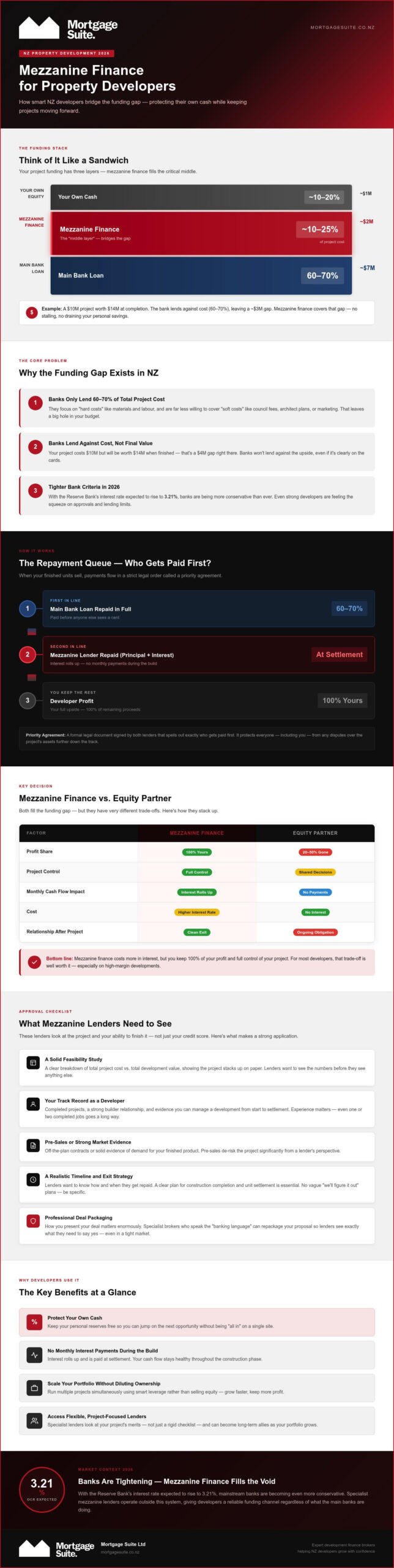
In 2026, the most successful New Zealand developers aren’t necessarily the ones with the deepest pockets; they’re the ones who know how to protect their own cash while still moving projects forward. It’s a demanding environment right now, especially with banks tightening their criteria and the central bank’s interest rate expected to rise to 3.21 percent. You’ve likely felt the frustration of having too much personal equity tied up in one site, or having to pass on a prime opportunity because your cash is trapped by the bank’s lending limits. Utilizing mezzanine finance for property developers NZ is now a sophisticated tool to bridge that frustrating gap between your bank loan and your own capital.

We understand you want to maintain control without draining your personal reserves. This guide will show you how to secure the total funding needed for construction while minimising the amount of your own money you need to put in. We’ll explore how this funding works, how it compares to bringing in a partner, and how to make your project irresistible to lenders so you can keep your momentum regardless of market shifts. It is about finding a steady path so you can grow your business with confidence.

Key Takeaways

  • Understand how to bridge the funding gap between your main bank loan and your own capital by using a “middle layer” of debt.
  • Discover why choosing debt over an equity partner allows you to keep more of your hard-earned profit and maintain full control of your project.
  • Learn exactly what lenders need to see in your feasibility study and track record to approve mezzanine finance for property developers NZ.
  • Find out how expert negotiation and professional deal packaging can help you secure funding even when mainstream banks are tightening their belts.
  • See how to scale your property portfolio in 2026 without draining your personal cash reserves or getting stuck by rigid bank criteria.

Understanding Mezzanine Finance: Filling the Gap in Your Project Funding

Imagine your project funding as a sandwich. At the bottom, you have the main bank loan. At the very top is your own hard-earned cash. In between, there is often a large, empty space because banks in New Zealand are being incredibly careful right now. This middle layer is where mezzanine capital sits. It acts as the bridge that connects what the bank is willing to give you and what you actually need to finish the job. For many, mezzanine finance for property developers NZ is the secret to moving a project from a plan to a reality without having to find millions of dollars in extra personal savings.

Some people worry that looking for extra funding is a sign that a project is struggling. In reality, it’s quite the opposite. Most high-level developers use this as a strategic tool. It allows them to keep their own cash free so they can jump on new opportunities when they appear. It’s about being smart with your money rather than being “all in” on a single site. Using this type of finance shows you’re focused on growth and scale.

Why the ‘Gap’ Exists in NZ Property Development

In 2026, bank criteria are tighter than ever. Banks are focusing heavily on lowering their own risk, often limiting their lending to 60 or 70 percent of the project’s total cost. They love “hard costs” like building materials and labour, but they’re often much less enthusiastic about “soft costs” like council fees, architecture plans, or marketing. This creates a hole in your budget that can be hard to fill with your own pocket money.

There’s also the difference between the “Total Development Value” (what the project is worth when finished) and the “Total Cost.” Banks usually lend against the cost, not the final value. If your project costs $10 million but will be worth $14 million, that $3 million gap is where you’d typically be stuck. Mezzanine funding steps in to cover that specific distance so you don’t have to stall your progress.

The Role of 2nd Tier Lenders in the Mezzanine Space

You won’t usually find this type of funding at your local high-street bank. It almost always comes from specialised lenders who sit outside the main banking system. These lenders are much more flexible because they don’t just look at a credit score or a rigid set of rules. They look at the project itself and your ability to finish it. They’re willing to stand behind the main bank because they understand the New Zealand property market and see the value in a well-planned development.

Working with these lenders requires a slightly different approach. They want to see a partnership rather than just a transaction. That’s where having an expert negotiator who understands the “banking language” makes all the difference. Packaging your deal so these lenders see the same potential in the project that you do is essential. When you present a solid case, these lenders can become your most valuable allies in scaling your business.

How Mezzanine Finance Works: The Mechanics of the ‘Middle Layer’

When you use mezzanine finance for property developers NZ, you are essentially entering into an arrangement where the lender agrees to stand second in line behind your main bank. If we look at the project as a queue for payment, the main bank is at the very front. The mezzanine lender is right behind them. They only get their money back once the main bank has been paid in full from the sale of your finished units. This position is why they are often more interested in the final success of your project than just your current bank balance.

To make this work, both lenders sign a legal priority agreement. This is a formal document that spells out exactly who gets paid first and how much they are entitled to before the next person in line gets a cent. It might sound like a lot of paperwork, but it is a standard part of the process that we handle regularly to ensure everyone is on the same page. Having this clear agreement in place protects you from lenders arguing over the project’s assets later on. It creates a stable foundation for the entire project’s funding.

One of the biggest advantages of this setup is how it treats your cash flow. Unlike a standard mortgage where you have to find money for monthly interest payments, this type of funding is usually added to the loan balance. This means the interest grows with the loan and is paid at the very end when the project is sold. You don’t have to worry about monthly bills while you are still in the middle of construction. It keeps your day-to-day money focused exactly where it needs to be: on the building site. If you want to see how this might look for your specific project, it’s worth having a quick chat with Mortgage Suite Ltd to map out the numbers.

The Ranking of Debt

Ranking of debt is simply the order in which lenders get paid. For you as a developer, this means the mezzanine lender sits behind the main bank. Because they are taking a bigger risk by standing second in line, they will want to see a very strong project plan. If things don’t go according to schedule, the bank gets paid first. This higher risk is why they charge more than a traditional bank, but the trade-off is the flexibility they provide to get your project moving when the bank stops lending.

Interest Rates and Fees: What to Expect

Since these lenders are taking on more risk, you can expect the costs to be higher than your main bank loan. You’ll typically see a fee to set up the loan at the start and sometimes a fee for the duration of the funding. However, because the interest is added to the loan balance, these costs don’t drain your project’s working capital during the build. It’s a strategic choice; you’re paying a bit more for the money, but you’re gaining the ability to keep your own cash for other projects or unexpected costs. It’s a powerful way to use mezzanine finance for property developers NZ to build more than you could with bank funding alone.

Mezzanine Finance vs Equity: Balancing Cost Against Control

When you find yourself staring at a funding gap, you generally have two ways to fill it. You can either take on more debt through a mezzanine loan or bring in an equity partner. While an equity partner might seem like an easy fix because there’s no interest to pay during the build, it’s often the most expensive money you’ll ever use. Most equity partners will want anywhere from 25 to 50 percent of your final project profit. Think about that for a second. You do all the work, manage the builders, and handle the council, yet you give away half the reward just to get the project across the line.

In contrast, mezzanine finance for property developers NZ is what we call non-dilutive capital. You pay a higher interest rate for the privilege of the loan, but you don’t give away any of your company or your project. Once the lender is paid back, every remaining dollar of profit stays in your pocket. It’s the best way to keep yourself in the driver’s seat while ensuring your project actually gets built. You aren’t just saving money; you’re protecting your future growth by keeping your profits for your next big move.

When Equity Makes More Sense

Debt isn’t always the right answer for every scenario. If a project is particularly risky or you’re entering a very volatile market, sharing that risk with a partner can be a smart move. If the project doesn’t perform as expected, the equity partner shares the loss with you. A lender, however, expects to be repaid regardless of the final outcome. We often sit down with developers to weigh up these structured finance options and find the balance that protects their interests while managing the overall risk of the development.

The ‘Return on Equity’ (ROE) Multiplier

The real magic happens when you look at how debt multiplies your personal returns. Let’s say your project makes a $1 million profit. If you had to tie up $2 million of your own cash to finish it, you’ve made a 50 percent return. But if you use mezzanine debt to cover the gap and only use $500,000 of your own money, that same $1 million profit represents a 200 percent return on your capital. You can use our mortgage calculator to see how debt levels affect your numbers and see the impact of different funding structures. It’s about making your cash work as hard as possible so you can scale your business faster and take on more projects at once.

Mezzanine Finance for NZ Developers: 2026 Strategy Guide

Getting Your Funding Sorted: What Lenders Look for in a Developer

Securing approval for mezzanine finance for property developers NZ requires more than just a good plot of land and a set of drawings. You need to think like the lender. They aren’t just looking at the potential profit; they’re looking at the person behind the project. They want to see that you’ve thought through every possible hurdle and have a solid plan to clear them. It’s about building a case that proves the project is going to reach the finish line, no matter what the 2026 market throws at you.

Risk reduction is the name of the game. If you have pre-sales or pre-leases already lined up, you’re in a much stronger position. In a cautious market, these contracts prove that there’s real demand for your finished product. Most importantly, you need a crystal-clear exit strategy. Whether you plan to sell every unit or refinance the whole development into a long-term commercial loan, the lender needs to see exactly how and when they get their capital back. Success breeds trust, so showing your track record of previous completions is vital.

The Professional Feasibility Report

A lender will spend the most time looking at your feasibility report. This document needs to be airtight, covering everything from land costs and construction budgets to GST and a healthy contingency fund. Don’t be tempted to present a “best-case scenario” only. A slightly pessimistic scenario that still shows a profit is often more convincing to a seasoned lender than a perfect one. It shows you’re realistic and helps to minimise any concerns the lender might have about cost overruns. Having a professional Quantity Surveyor report ready to go is also essential, as it provides that crucial independent verification of your numbers.

Your Development Team and Pedigree

The people you choose to work with say a lot about your project’s risk level. Lenders want to know who is managing the build and who designed the plans. Choosing a builder with a strong reputation in New Zealand can actually make your application for mezzanine finance for property developers NZ much more attractive. We suggest presenting a professional CV that highlights your previous successes, including photos, budgets, and timelines of finished projects. You can read about our team’s 20 years of experience in NZ finance to see how we use our own history to help package your deal for the best possible outcome.

If you’re ready to get your project moving and want to see how to present your deal to the right people, let’s talk about your funding options today.

Why Partner with Mortgage Suite Ltd for Your Next Property Development

Finding the right funding is often the hardest part of the job. That is why having Krish Krishna in your corner is such a massive advantage. With over two decades of banking experience, he understands exactly how the system works from the inside. He isn’t just a broker; he’s a seasoned veteran who knows how to navigate the hurdles that often stop projects in their tracks. When you are looking for mezzanine finance for property developers NZ, you need someone who can speak the language of the big banks while also maintaining deep relationships with private funders.

We don’t just pass on your paperwork. We package your deal so it tells a compelling story. We highlight your strengths and address potential risks before the lender even asks. This approach makes your application irresistible to 2nd tier lenders who want to see a professional, well-organised project. Plus, we manage both your senior debt and your mezzanine layer. Having one point of contact for the entire funding sandwich saves you time and ensures both lenders are working in harmony rather than against each other. It’s about making the process as smooth as possible for you.

Whether you are building townhouses in Auckland or a commercial space in Christchurch, we have you covered. Mortgage Suite Ltd provides national coverage across all of New Zealand. We understand the local nuances of different regions and how they affect development costs and timelines. We are here to be your steady hand in a fluctuating market, ensuring you have the support you need to succeed.

We Speak the Language of Both Banks and Private Lenders

We bridge the gap between rigid institutional requirements and the flexible funding you actually need. Our reputation as dedicated negotiators means we don’t take “no” for an answer easily. We push back on banks and fight for the best terms on your behalf. We also believe in the “Mortgage School” approach. We take the time to educate you on your options so you can make the best decision for your business. You’ll never feel like just another file in a system; you’ll feel like a priority partner.

Ready to Scale Your Development Business?

If you want to grow your portfolio without draining your own cash, it’s time to look at smarter ways to fund your projects. Using mezzanine finance for property developers NZ can be the key to unlocking your next big opportunity. We handle the heavy lifting with the financiers and the mountain of paperwork, leaving you free to focus on the build. It’s a much easier way to operate. We invite you to reach out for a no-obligation chat about your next project. You can also see what other NZ developers say about working with us to get a feel for how we operate. Let’s get your next development moving.

Secure Your Funding and Scale Faster

Building a successful property portfolio in 2026 requires more than just construction skills; it demands a clever approach to capital. We’ve explored how bridging the gap between your bank loan and your own cash allows you to keep moving without draining your reserves. By choosing debt over equity partners, you protect your profits and stay in total control of your vision. It’s about working smarter with your available liquidity to ensure your projects never stall.

With over 20 years of banking and mortgage experience, we specialise in navigating the complex world of 2nd tier and development finance. We provide national service for developers across New Zealand, ensuring your deal is packaged perfectly for success. If you’re ready to see how mezzanine finance for property developers NZ can transform your next project, we’re here to help. Book a chat with Krish and the team to get your project funding sorted today. Your next big opportunity is waiting, and we have the steady hand you need to reach it.

Frequently Asked Questions

What is the main difference between mezzanine finance and a standard bank loan?

Mezzanine finance for property developers NZ sits behind the main bank loan and covers the funding gap that banks won’t touch. While a bank loan is secured by a first charge and covers 60 to 70 percent of costs, mezzanine debt is a second charge. It allows you to borrow more against the project’s value without needing as much of your own cash up front. It’s about getting higher leverage for your capital.

How much can I typically borrow through mezzanine finance in NZ?

You can typically borrow enough to bring your total funding up to 80 or even 90 percent of the project’s total cost. The exact amount depends on the project’s strength and your own track record. Instead of being capped by rigid bank limits, this funding looks at the final value of the development. It’s designed to fill that specific hole between your main loan and your personal equity.

Do I need to have a bank loan approved before I apply for mezzanine finance?

It isn’t strictly necessary to have the bank loan finalised, but it certainly helps the process move faster. Most mezzanine lenders want to see that a main lender is already on board or at least very interested in the project. We often work with developers to secure both layers of funding at the same time. This ensures the two lenders agree on the legal priority of payments before you start.

Is mezzanine finance more expensive than other types of property development loans?

Yes, the interest rate is higher because the lender is taking a bigger risk by standing second in line behind the bank. However, it’s often much cheaper than giving away half your profit to an equity partner. You’re paying for the privilege of keeping 100 percent ownership of your project. When you factor in the ability to start sooner and scale faster, the extra cost is often a smart strategic investment.

What happens if my project takes longer than expected to complete?

If your project runs over time, you can usually negotiate an extension with the lender to cover the extra months. Because the interest is added to the loan balance, you won’t have to find monthly cash to cover the delay, but the total amount you owe will increase. This is why having a healthy contingency in your initial study is so important. We help manage these conversations to keep your project moving.

Can I use mezzanine finance for land acquisition or just for construction?

While it’s most common for construction, you can use mezzanine finance for property developers NZ for land acquisition in specific cases. This usually happens when you’ve already secured resource consent or have a very clear plan for the site. Lenders prefer projects that are closer to the starting blocks of building, as this reduces their risk. It’s a great way to secure a site while keeping your cash for the actual build.

What are the common fees associated with mezzanine debt in New Zealand?

You’ll typically see an establishment fee at the start, along with legal costs for setting up the priority agreements. There might also be a management fee charged over the life of the project. Legal fees for both you and the lender are also standard, especially for setting up the Deed of Priority. We make sure all these costs are clearly outlined so there are no surprises when the project is finished.

How long does it take to get mezzanine funding approved and settled?

Approval can happen relatively quickly, often within a week or two if your feasibility study is ready to go. Settlement usually takes a bit longer as it requires coordination between your lawyer, the main bank, and the mezzanine lender. You should generally allow four to six weeks from your first chat with us to having the funds ready to draw. Being organised and having your reports ready is the key to a fast turnaround.

Article by

Krish Krishna

Experienced Financial Adviser with over 46 years of Banking and Mortgage broking experience and over $2.0 Billion in loan settlements.

How Long Does Pre-approval Last in NZ? Your 2026 Home Loan Guide

Imagine you’ve finally spotted a home that ticks every box, but a nagging thought keeps you awake: is my bank offer about to expire? It’s a common worry for many Kiwis, and the most pressing question is usually how long does pre approval last nz-wide. In the current 2026 market, most major banks give you a 90-day window to make your move. That three-month countdown can feel like a high-stakes sprint, especially when you’re trying to balance weekend open homes with the anxiety of shifting interest rates.

We know that the fear of losing a house because your finance expires is incredibly draining. You’ve worked hard to get your deposit ready, and you deserve to shop with total confidence. This guide will show you exactly how to manage your timeline and keep your momentum going without the stress. We’ll explore how to handle those standard expiry dates, the simple steps to organise an extension, and how to stay protected if your financial situation shifts before you sign on the dotted line.

Key Takeaways

  • Learn why the standard 90-day window is the typical timeframe for most New Zealand banks and how to make the most of those three months.
  • Discover exactly how long does pre approval last nz-wide and why you should start the renewal process at least 14 days before your current offer expires.
  • Understand the major lifestyle changes, such as taking on new debt or switching jobs, that could accidentally void your home loan agreement.
  • Find out how to keep your house-hunting momentum high by using a broker’s expertise to access alternative lenders if the big banks change their minds.

Understanding home loan pre-approval in the NZ market

Think of a pre-approval as your “golden ticket” to the New Zealand property market. It’s essentially a bank giving you a high-five and saying they’re likely to lend you a specific amount, provided the house you eventually find meets their criteria. Before you start worrying about how long does pre approval last nz-wide, you should understand what pre-approval means in a practical sense. It’s the bridge between “just looking” and actually being able to sign a contract with confidence.

In plain English, there are two stages to this “yes.” A conditional pre-approval is what most people start with. This means the bank likes your finances, but they still need to check the property reports and valuations for the specific house you want to buy. An unconditional approval is the final green light for a specific property where all the boxes are ticked. Getting this sorted before you step foot in an open home is a total game-changer for your stress levels.

Why you need a “yes” before you start hunting

Walking into an open home without a pre-approval is like going grocery shopping without your wallet. You might see plenty of things you want, but you can’t actually take any of them home. Having that bank letter in your pocket prevents the heartbreak of falling for a property that’s outside your actual borrowing capacity. It also sets a firm boundary for your budget, which is vital if you end up in a heated auction room. Real estate agents will take your offers much more seriously because they know you’re a serious buyer who’s already done the hard yards. If you want to brush up on the basics, our mortgage school is a great place to start. Knowing exactly how long does pre approval last nz-wide helps you plan your weekends so you’re not rushing into a bad deal just because a deadline is looming.

What the bank looks at before giving you the nod

Banks aren’t just looking at your salary; they want to see the whole picture of your financial life. They’ll look closely at your “income vs outgoings.” This is basically a look at what’s coming in versus what you’re spending on things like rent, utilities, and even your daily lattes. They also check the size of your deposit. With the national median house value sitting around $804,303 in mid-2026, having your KiwiSaver funds and savings clearly documented is essential. Finally, they’ll look at your history with money. Staying on top of your bills and keeping a clean credit record shows the bank that you’re a reliable partner. This transparency helps them decide how much they can safely lend you without putting your lifestyle at risk.

The standard timeline: How long your pre-approval stays valid

Once you get that initial “yes” from a lender, the clock starts ticking. In the current New Zealand market, the standard answer to how long does pre approval last nz-wide is usually 90 days. This three-month window is designed to give you enough time to visit open homes, do your due diligence, and put in an offer without the bank’s information becoming stale. It’s a period of stability in what can often feel like a fast-moving process.

Banks prefer this timeframe because your financial life can change quickly. A lot can happen in 90 days; you might get a pay rise, or perhaps you’ve decided to finally pay off that old credit card. By keeping the window to three months, the bank ensures they are lending based on your most current situation. If you’re feeling a bit lost with the timing, you can read more about us and how we guide you through every step of the journey.

The 90-day rule explained

Banks reckon three months is the sweet spot for checking your finances because market conditions shift. For example, with the annual inflation rate at 4.1% in the June 2026 quarter, the cost of living is always on the move. If interest rates rise while you’re house hunting, your “buying power” might actually shrink. This happens because banks use a “stress test” to see if you could still afford your mortgage if rates went even higher. If the market rates go up, their test gets tougher, which might reduce the total amount they are willing to let you borrow. This is why a “full” pre-approval, where the bank has actually seen your documents, is much more reliable than a “soft” indication or a quick chat over the phone.

Do all lenders use the same clock?

While the big mainstream banks usually stick to that 90-day limit, alternative or 2nd tier lenders can sometimes be more flexible. These lenders often look at your situation with a more personal lens, which is helpful if your income is a bit unique or you’re self-employed. They might offer different expiry dates or be more willing to refresh your application without making you start from scratch. Your broker is the best person to keep an eye on the calendar for you. We track these dates across different lenders so you don’t have to. Think of pre-approval as a “rolling” green light; if time does run out, it’s rarely a dead end. Usually, it just means providing a few fresh payslips to show the bank that your situation is still as solid as it was on day one.

Factors that can cut your pre-approval short or change the deal

Even though we’ve established that 90 days is the standard answer to how long does pre approval last nz-wide, that timeline isn’t actually written in stone. It’s more like a weather forecast; it’s accurate as long as the conditions stay the same. If your personal situation or the wider market shifts, the bank has every right to look at your application again. Having seen every market cycle over the last two decades, I can tell you that staying “bank-ready” is just as important as finding the right house.

A pre-approval is a snapshot of your life at a specific moment. If that snapshot changes, the bank’s level of risk changes too. This doesn’t mean you’ll lose your chance at a home, but it does mean you might need to provide fresh information or look at alternative lenders who are more comfortable with your new circumstances.

Big life changes that affect your loan

Switching jobs during your house hunt is one of the most common ways to accidentally reset your clock. Even if you’re moving for a higher salary, banks often prefer to see you’ve passed a probation period before they’ll commit to a long-term loan. Moving from a steady salary to being self-employed is an even bigger shift, as banks usually want to see a solid track record of business income before they say yes again.

New debt is another major hurdle. It’s tempting to grab that interest-free deal on a new couch or upgrade your car while you’re waiting for the right house, but these choices reduce your “buying power.” Every dollar you commit to a car loan or a credit card is a dollar that can’t go toward your mortgage repayments. We also see “spending creep” catch people out; if your bank statements show your monthly bills have shot up since you first applied, a lender might second-guess their initial offer.

The “subject to property” condition

The bank isn’t just lending to you; they’re essentially investing in the house you choose. This is why every pre-approval is “subject to property.” Before they give the final nod, they need to see the Sale and Purchase Agreement and, quite often, a registered valuation. If the valuation comes in lower than the price you’ve agreed to pay, the bank may only lend based on that lower value, leaving you to find the difference.

Specific property issues can also cause a bank to pull back. Things like certain types of cladding or houses with known maintenance problems can make a property too risky for a mainstream lender. If this happens, don’t panic. This is where our experience with 2nd tier lenders becomes a massive advantage, as they often have different rules for properties that don’t fit the standard bank box. You can check out our reviews to see how we’ve helped others navigate these exact hurdles.

How Long Does Pre-approval Last in NZ? Your 2026 Home Loan Guide

Steps to take as your pre-approval nears expiry

If you’ve been spending your weekends at open homes and the calendar is starting to look a bit crowded, don’t panic. It is incredibly common for the house-hunting journey to take longer than the initial three months. While we’ve discussed that how long does pre approval last nz-wide is typically 90 days, reaching the end of that window doesn’t mean you’re back at square one. It’s simply a prompt to check in and ensure your financial “snapshot” is still accurate for the bank.

The secret to a stress-free extension is what we call the 14-day rule. You should start the conversation with your broker at least two weeks before your current letter expires. This gives the bank enough time to process the update without your buying power actually lapsing. If you wait until the very last day, you might find yourself unable to put in a clean offer on a house you love because your finance is technically in limbo.

The renewal process: what to expect

In most cases, renewing your pre-approval isn’t a brand-new application from scratch. If your job, income, and debt levels haven’t changed since your first “yes,” it’s usually just a quick check-up. The bank will want to see that your situation is still ship-shape. This typically means providing your two or three most recent payslips and perhaps a fresh look at your main bank account statements to ensure your spending hasn’t spiked.

A quick chat with us can save you hours of paperwork. We already have your history on file, so we know exactly what the bank needs to see to hit the “refresh” button. Mortgage Suite Ltd handles the heavy lifting and the back-and-forth with the lenders, leaving you free to focus on finding the right property. If you’re curious about the finer details of the lending process, you can learn more at our Mortgage School.

Keeping your credit score healthy

A common worry is whether renewing your pre-approval will hurt your credit rating. Every time a bank does a formal check on your file, it leaves a small footprint. While one or two inquiries for a mortgage are perfectly normal and won’t cause your score to plummet, you want to avoid “too many inquiries” in a short space of time. This is another area where having a broker works in your favour.

Our goal is to keep your buying power strong while protecting your financial reputation. We can often use the information we already have to get an extension or look at alternative lenders without triggering unnecessary new credit checks. If the market shifts or your bank’s rules change during your search, we can pivot quickly to other options, including 2nd tier lenders who might offer more flexibility. If your current offer is about to run out, it’s a great time to get in touch with our team so we can keep your search on track.

Partnering with Mortgage Suite Ltd to secure your dream home

Finding a home is a journey, and having the right guide makes all the difference. When you’re constantly checking the calendar and wondering how long does pre approval last nz-wide, you need more than just a computer-generated bank letter; you need an advocate. Krish Krishna brings over two decades of banking experience to your side of the table. This isn’t just about filling in forms. It’s about having a seasoned mentor who knows exactly how to present your financial story to a lender to get the best possible outcome.

We understand that not every borrower fits into a neat little box. If a mainstream bank decides your situation is too complex, or if your pre-approval expires and they’ve changed their lending rules, we don’t just give up. We specialise in 2nd tier loans and non-bank options that offer a different path forward. This “negotiator advantage” means we can often find solutions that you simply wouldn’t find by walking into a local branch alone. Our goal is to remove the obstacles and make the entire process feel like a walk in the park.

A steady hand in a fluctuating market

The property market has its share of twists and turns, but you don’t have to navigate them by yourself. We keep track of your expiry dates and renewal deadlines so you can keep your eyes on the property listings. Our client-first approach means we stay with you from that very first “yes” all the way through to the day you get your keys. We pride ourselves on being a steady hand when things feel uncertain. If you want to see how we’ve helped other buyers stay confident during their search, you can read what other Kiwis say about us.

Ready to get your pre-approval sorted?

Taking the first step shouldn’t be intimidating. We believe in simple, jargon-free conversations that help you understand your true buying power in today’s market. Whether you’re a first home buyer or looking at a residential investment, now is a great time to get your ducks in a row. We’ll help you figure out exactly how long does pre approval last nz-wide for your specific lender and ensure you’re ready to pounce when the right house appears. If you’re ready to start your journey with a team that puts you first, get in touch with the team at Mortgage Suite Ltd today.

Take the next step toward your new home with confidence

Securing a “yes” from a lender is a massive milestone, but it’s only the beginning of your journey. Knowing exactly how long does pre approval last nz-wide helps you plan your weekends and set a realistic pace for your search. While that 90-day window is the standard starting point, remember that it’s a rolling green light rather than a hard stop. By staying “bank-ready” and keeping an eye on your 14-day renewal deadline, you can keep your momentum high without the stress of finance expiring at the wrong moment.

With over two decades of banking experience, we’ve seen every market cycle and know how to navigate the hurdles that trip up other buyers. We’re experts in both mainstream bank lending and 2nd tier options, which is why we’re so highly rated by New Zealand home buyers. We act as your mentor and negotiator, ensuring you have the best possible chance of success regardless of how the market shifts. Book a chat with Krish and the team at Mortgage Suite Ltd today to get your buying power sorted for 2026. You’ve got a dedicated team behind you, and we can’t wait to help you open the door to your new home.

Frequently Asked Questions

Can I extend my pre-approval if I haven’t found a house yet?

Yes, you can almost always extend your offer if you haven’t found the right property within the initial timeframe. Most lenders allow a renewal for another 90 days, provided your financial situation hasn’t changed. You’ll simply need to provide your latest payslips or bank statements to show the bank that your income and spending are still stable. Understanding how long does pre approval last nz-wide helps you stay ahead of these deadlines.

Does it cost anything to get or renew a pre-approval in NZ?

No, getting or renewing a pre-approval is generally a free service provided by banks and lenders in New Zealand. There are no application fees or hidden costs to find out what you can borrow. This is why it’s such a valuable tool for house hunting; it gives you the confidence to bid at auctions without any upfront financial commitment. If you choose to work with a broker, their service is also typically free for you.

What happens if interest rates go up while I have pre-approval?

If interest rates rise, the bank might reassess how much they are willing to lend you. This happens because they use a “stress test” rate to ensure you can still afford repayments if rates climb even higher. A significant jump in market rates could mean your maximum budget shrinks, even if your income stays the same. This is a key reason why knowing how long does pre approval last nz-wide is vital for your planning.

Can I change banks after my pre-approval expires?

Yes, you are never locked into one bank and can definitely look at other options once your current offer expires. In fact, if your original bank’s rules have tightened, it’s often a smart move to see what other lenders can offer. We often help clients pivot to different banks or even 2nd tier lenders if they find a property that doesn’t fit the standard bank box. It’s all about finding the best fit for your needs.

Is pre-approval a guarantee that I will get the loan?

No, a pre-approval is a conditional commitment rather than a final guarantee. The bank still needs to approve the specific property you want to buy and ensure it meets their standards. They will check the Sale and Purchase Agreement and often require a registered valuation. Final approval also depends on your financial situation remaining exactly the same as it was when you first applied, so avoid taking on any new debt during your search.

Do I need a new pre-approval if I change my budget?

Yes, you’ll need an updated letter if you decide to increase your borrowing amount or if your deposit size changes. While you don’t need a new letter to buy a more affordable house, having an accurate budget ensures you’re looking at the right properties. If your income has gone up or you’ve saved more, a quick chat with your broker can help refresh your “buying power” so you can bid with total confidence at your new level.

How long does it take to get a pre-approval in New Zealand?

You can typically expect an outcome within two to five working days once you’ve submitted all your documents. This timeframe can vary depending on how busy the banks are and whether your application is straightforward or requires a bit more explanation. Having your payslips, bank statements, and identification ready to go before you apply will help speed up the process. We work closely with lenders to ensure your application moves through the system quickly.

What is the difference between pre-approval and approval in principle?

These two terms are essentially the same thing in the New Zealand mortgage market. Both mean the bank has looked at your finances and agreed to lend you a certain amount, provided the property you choose meets their criteria. Whether a bank calls it a pre-approval or an “approval in principle,” it serves the same purpose: it provides the professional assurance you need to show real estate agents and sellers that you are a genuine and prepared buyer.

Article by

Krish Krishna

Experienced Financial Adviser with over 46 years of Banking and Mortgage broking experience and over $2.0 Billion in loan settlements.

Financing a Townhouse Development in NZ: Your 2026 Exit Strategy Guide

Your exit strategy is actually the most important part of your loan application, often carrying more weight than the architectural plans themselves. When you are organising financing a townhouse development nz, lenders aren’t just interested in the bricks and mortar; they want to see a foolproof plan for how they get their money back. It’s easy to feel unsettled when residential building costs continue to climb or when mainstream banks stick to rigid rules that don’t fit your project. You deserve to know that your profit is protected and that you won’t be left holding unsold stock.

This guide will show you how to map out a project finish line that satisfies lenders and secures your margins. We’ll look at how to create a solid exit plan and why 2nd tier finance is a brilliant tool for flexibility when the big banks say no. You’ll gain the confidence to handle the 2026 market, knowing exactly how to protect your investment and move straight onto your next big venture with total certainty.

Key Takeaways

  • Learn why a clear plan to repay your lender is the most important part of getting your project approved in today’s market.
  • Understand the flexible options for financing a townhouse development nz that let you bypass the rigid rules of the big banks.
  • See how non-bank lenders can act as a strategic safety net to protect your profit if building costs or timelines change.
  • Compare the benefits of selling your units for an immediate profit against switching to a long-term loan to keep them as rentals.
  • Gain the tools to build a solid backup plan so you can realise your gains and organise your next project with total confidence.

What is a Property Development Exit Strategy and Why Does it Matter?

Simply put, an exit strategy is your roadmap for paying back the money you borrowed once the building work is done. It’s a vital part of the real estate development process, acting as the final chapter that proves your project is a success. When you’re looking at financing a townhouse development nz, the start is exciting, but the finish is what keeps the bank happy. Lenders aren’t just looking at your architectural plans; they’re looking at how you’ll get their money back into their hands.

Lenders often care more about your exit than your entry because that’s where the actual risk lives. If you don’t have a clear way to settle the debt at the end, you might find yourself stuck in a “fire sale.” This is a stressful spot where you’re forced to sell your units at a heavy discount just to pay back the lender. It’s a quick way to see years of planning and hard work vanish. In the 2026 market, where residential building costs rose 1.1% in the June quarter, having a solid exit plan is your best tool for protecting your profit.

The Lender’s Perspective: What They Are Looking For

Lenders want to see that your numbers add up for the current environment. They look for what we call “credible exits,” which are paths to repayment grounded in reality rather than hope. A credible exit is a clear, documented route to paying off the debt that doesn’t rely on luck or a perfect market. This might include confirmed pre-sales where buyers have already signed on the dotted line, or a formal letter from a bank promising to take over the debt with a long-term loan once the units are finished. They want to know that even if the market shifts slightly, the project remains a safe bet for their capital.

Why a “Single Plan” Approach is Risky

Relying on just one way to finish your project is a massive gamble. If your only plan is to sell every unit the moment they’re built, a temporary market dip can leave you stranded with high-interest debt and no way to clear it. Most lenders now require a secondary fallback option before they’ll even consider financing a townhouse development nz. Think of this backup like a spare tyre; you hope you don’t need it, but you can’t realistically start the journey without it. Having a Plan B, such as keeping the units as rentals, gives you the breathing room to wait for a better selling window while still meeting your financial obligations.

The Three Most Effective Ways to Exit Your Townhouse Project

Choosing your path forward depends entirely on your long-term goals and the temperature of the 2026 market. Once your townhouses are finished, you need a clear route to transition from high-interest construction debt to your final financial outcome. Whether you want a quick cash injection or a lifelong stream of rental income, your choice will dictate how you structure the project from day one. Financing a townhouse development nz requires looking past the construction phase to ensure you aren’t left with a debt you can’t service when the hammer falls on the final nail.

Strategy 1: Selling for a Profit (The Clean Break)

The most common goal for many developers is the “flip.” You finish the build, sell the units, pay off the lender, and pocket the remaining profit. This is the fastest way to get your capital back so you can jump into your next venture. Pre-sales are the secret weapon here. By securing buyers before the first sod is turned, you significantly lower the lender’s risk. When you’re organising financing a townhouse development nz, having pre-sales in place can often unlock better terms and smoother approvals because the bank sees a guaranteed exit. It removes the stress of wondering if the units will sell once they’re finally on the market.

Strategy 2: Refinancing to Hold (The Wealth Builder)

If you prefer building long-term wealth, you might choose to keep the units as rentals. This involves switching from a construction loan to a lower-rate residential investment loan. With one-year fixed rates for investment properties in August 2026 sitting around 4.75% to 4.99%, this move allows you to benefit from capital growth while the tenants pay down your mortgage. It’s a great way to build a portfolio, but you need to make sure the numbers work. You can use our mortgage calculator to check if the expected rental income will comfortably cover your new loan repayments. This strategy is particularly effective when the rental market is strong and property values are steadily rising.

Strategy 3: The “Keep and Sell” Hybrid

A hybrid approach offers the best of both worlds and is increasingly popular among savvy New Zealand developers. You might sell three out of four townhouses to clear all your debt with the lender, leaving the final unit completely debt-free. This “pure profit” unit becomes a high-yield asset in your portfolio without you needing to tip in more of your own cash. It’s a brilliant way to grow your net worth while maintaining excellent cash flow. This method provides a safety net; if the market isn’t quite right for selling all units, you can pivot and keep more of them as rentals. If you’re unsure which path fits your specific project, we can help you explore the most profitable options for your situation.

Contingency Planning: What to Do When Plan A Hits a Snag

The reality of building in New Zealand is that time is your biggest variable. It usually takes between 12 and 18 months to take a project from the first shovel in the ground to the final code compliance certificate. A lot can happen in that window. When you started financing a townhouse development nz, the market might have been soaring, but by the time you’re ready to sell, things could look different. Unexpected building delays or the 3.5% annual rise in construction costs can quickly eat into the profit you worked so hard to calculate.

A solid fallback strategy isn’t about being pessimistic. It’s about staying in control of the situation even when things get a bit hairy. Without a Plan B, you risk losing the property to the bank during a temporary dip or being forced into a deal that doesn’t serve you. By preparing for the “what-ifs” now, you ensure that a single snag doesn’t derail your entire financial future. It’s much easier to make calm decisions when you already have a secondary path mapped out.

Market Shifts and Price Adjustments

Imagine your townhouses are finished, but the market has shifted and they’re worth 10% less than your initial appraisal. This is where your “equity cushion” becomes your best friend. This cushion is the gap between what you owe the lender and what the property is worth, often made up of your own cash or the value in the land. In the 2026 market, a 20% margin of error is a standard safety net that most successful developers use to protect themselves. It means that even if prices soften, you still have enough room to pay back the loan without dipping into your personal savings or facing a shortfall.

Bridging the Gap with Short-Term Finance

Sometimes, the units are perfect and the price is right, but the buyers are just taking a little longer to show up. If your construction loan is nearing its end and the lender is knocking, you can use bridging finance to take the pressure off. This short-term option lets you pay off the original construction lender, giving you an extra few months to find the right buyer. When you are looking at financing a townhouse development nz, remember that bridging finance is a strategic tool rather than a last resort. It means you don’t have to accept a low-ball offer just because you’re in a hurry to settle the debt. You can learn more about how these structures work in our guide to property development loans. This breathing room is often the difference between a project that just breaks even and one that delivers a healthy return.

Financing a Townhouse Development in NZ: Your 2026 Exit Strategy Guide

The 2nd Tier Advantage: How Non-Bank Lenders Save the Day

Mainstream banks have really tightened their belts lately. In August 2026, many developers are finding that the big banks stick to rigid rules that don’t always suit the reality of a busy building site. If you are organising financing a townhouse development nz, you might find that traditional lenders demand a level of pre-sales that feels out of reach before you’ve even broken ground. This is where 2nd tier lenders become your most valuable asset. They aren’t just a backup plan; they’re a strategic tool that looks at the common sense of your project rather than just ticking boxes on a corporate form.

At Mortgage Suite Ltd, we specialise in finding these alternative paths when the big banks say no. We don’t just find you a loan; we help you see how these lenders can actually save your project if things stall or if your original bank pulls back. Using a non-bank lender gives you the flexibility to keep moving without being held hostage by a bank’s changing appetite for risk. We act as your expert negotiator to ensure you get a deal that keeps your profit margins intact.

Why 2nd Tier Lenders are More Flexible

The biggest advantage of a 2nd tier lender is their focus on the big picture. While a mainstream bank might demand that every single unit is sold before they release a cent, non-bank lenders often require far fewer pre-sales. They look closely at the value of the finished project and your own track record as a developer. If you have a solid plan and a great site, they’re often willing to back you even if you don’t fit the standard bank profile. This is a fair dinkum solution for projects that are fundamentally sound but need a lender who can think outside the square.

Using Non-Bank Loans to “Bridge to Bank”

Many successful developers use a 2nd tier loan as a temporary bridge to get the build finished. Even though the interest rates are higher, usually starting from 9.5% in early 2026, the flexibility they offer can be worth every cent. Once the townhouses are built and you have your code compliance certificate, the risk for a mainstream bank drops significantly. At that point, you can often refinance back to a traditional bank at a lower rate. This strategic move allows you to keep the momentum going on financing a townhouse development nz even if your primary bank has had a change of heart about your project. It’s a clever way to keep your capital moving and ensure you don’t miss out on the next big opportunity.

If you’re feeling stuck with a bank that doesn’t understand your vision, we can help you explore a more flexible path forward with a lender who sees the value in your project.

How to Execute Your Exit Strategy with Mortgage Suite

At Mortgage Suite, we believe that financing a townhouse development nz is about much more than just signing a loan agreement. It’s about building a comprehensive plan that carries you from the first site visit through to the day you settle your debt. Krish Krishna brings over 20 years of banking experience to the table, which means he understands the inner workings of both mainstream banks and 2nd tier lenders. He knows exactly what makes a credit manager say “yes” and, more importantly, how to structure your application so it stands out for all the right reasons from the very start.

We act as your dedicated advocate and negotiator throughout the entire process. If a mainstream bank offers a deal that feels too restrictive or demands too many pre-sales, we don’t just accept it as the only option. We look for alternative paths or negotiate better terms that protect your profit and your sanity. Our goal is to ensure you aren’t just getting across the finish line, but doing so with the financial reward you deserve for all your hard work and investment. We bridge the gap between the rigid world of institutional banking and your personal needs as a developer.

Our Consultative Approach

Our process starts with a simple, honest conversation about your goals. We want to know if you’re looking for a quick clean break by selling the units or if you’re building a long-term rental portfolio to secure your future. Once we know where you’re headed, we help you organise your documentation so it’s “bank-ready” before you even apply. This proactive step saves weeks of back-and-forth and shows lenders that you’re a professional who understands the 2026 market. You can see how this personal approach has helped other developers by reading our client reviews.

Ready to Get Sorted?

The best time to plan your way out of a loan is before you even put a shovel in the ground. Many people wait until the build is nearly finished to think about their exit, but that often leaves you with fewer options and much more stress if the market shifts. By sorting your strategy early, you can build with total confidence, knowing exactly how you’ll move on to your next venture. Don’t let the paperwork or bank rules slow you down. Reach out to us for a chat about your next townhouse project; we’re here to help you get the result you’re after.

Secure Your Project’s Future Today

Your project’s success isn’t just about the build; it’s about the finish line. By planning your exit strategy before you even break ground, you protect your hard-earned profit and ensure you’re ready for whatever the 2026 market throws your way. Whether you choose to sell immediately, hold for long-term growth, or use a hybrid approach, having a solid Plan B is your greatest asset. It gives you the freedom to make decisions based on profit rather than pressure.

When you’re organising financing a townhouse development nz, you don’t have to go it alone. With over 20 years of banking expertise, we act as your dedicated negotiators to find the best terms possible. We are specialists in 2nd tier lending solutions, providing the essential flexibility you need when mainstream banks feel too rigid. We’ll help you navigate every challenge so you can move on to your next venture with total confidence. Let’s map out your project’s finish line together; contact Mortgage Suite today.

We’re ready to help you turn your townhouse vision into a profitable reality.

Frequently Asked Questions

What is the most common exit strategy for small townhouse developments?

The most common way to finish a project is selling the completed townhouses to pay off the construction debt. This allows you to realise your profit quickly and move on to your next build. While keeping units as rentals is growing in popularity, most small-scale developers prefer the clean break of a sale. It clears the books and provides the capital needed for the next site acquisition without carrying long-term debt.

Do I really need pre-sales to get a development loan in 2026?

In 2026, mainstream banks almost always require pre-sales to cover a significant portion of the loan. However, if you are organising financing a townhouse development nz through a 2nd tier lender, they often have much more relaxed rules. They might allow you to start building with few or even no pre-sales if the project’s value and your experience are strong. This flexibility is why many developers choose non-bank options to get moving faster.

Can I change my exit strategy halfway through the project?

You can certainly pivot your plan, but it’s vital to keep your lender in the loop. If you originally planned to sell but decide to keep the units as rentals, you’ll need to arrange a new long-term loan to pay off the construction finance. This is a common move when the market softens. Just ensure your new loan is approved before the construction debt is due to avoid any stressful gaps in your funding.

What happens if my townhouse doesn’t sell by the time the loan is due?

If your units don’t sell by the time the loan is due, you have a few options to avoid a forced sale. You could look at bridging finance to give you more time or a residual stock loan to lower your interest costs while you wait for buyers. These tools act as a safety net, ensuring you don’t have to accept a low offer just because the clock is ticking on your original loan.

Is 2nd tier lending much more expensive than a big bank?

Non-bank lenders do charge higher interest rates, often starting from 9.5% in early 2026, compared to mainstream bank rates of 6% to 8%. While the interest is higher, the total cost might be lower when you consider the smaller pre-sale requirements and faster approval times. For many projects, the extra interest is a fair trade for the flexibility and speed that allows the development to actually go ahead.

How much deposit do I usually need for a property development loan in NZ?

Most New Zealand development lenders require you to contribute between 25% and 40% of the total project cost as equity. This can be in the form of cash or the value already held in the land. Having a larger deposit of 30% to 35% generally makes it much easier to secure competitive financing a townhouse development nz. It shows the lender you have skin in the game and provides a safety buffer for everyone involved.

Can I use the equity in my own home as part of my exit strategy?

Using the equity in your family home is a very common way to fund the deposit for a townhouse project. Instead of needing a massive pile of cash, you can use the value built up in your current property to secure the new loan. This is a strategic way to get started, but it’s important to understand how it affects your total debt. We can help you calculate how much equity you can safely tap into.

What is a “residual stock loan” and how does it help with exits?

A residual stock loan is a specific type of finance used for units that are finished but haven’t sold yet. It allows you to pay off the expensive construction loan and replace it with a cheaper, more flexible facility. This is a brilliant exit tool because it lowers your monthly interest costs while you wait for the right buyers. It takes the pressure off your cash flow and protects your final profit margins.

Article by

Krish Krishna

Experienced Financial Adviser with over 46 years of Banking and Mortgage broking experience and over $2.0 Billion in loan settlements.

Mortgage for Self Employed NZ: The 2026 Guide to Getting Approved

You’ve spent years building a successful business, only to have a bank manager look at your tax returns and tell you that you don’t earn enough to buy a family home. It’s a frustrating irony. While you’re contributing to the 17% of New Zealand’s GDP generated by the self-employed, the traditional lending system often makes you feel like a second-class citizen. Securing a mortgage for self employed NZ business owners shouldn’t feel like a battle against your own success, especially when your accountant is doing their job by minimising your taxable income.

We know that your bank statements tell a much richer story than a single line on a tax summary. It’s completely normal to feel overwhelmed by the endless paperwork or anxious about how a fluctuating income looks to a rigid credit department. This guide is designed to cut through that confusion and show you exactly how to present your finances to get a “yes”. You’ll learn how to navigate 2026 bank requirements, understand the “add-backs” that boost your borrowing power, and discover why a non-bank lender might be the partner your business actually deserves.

Key Takeaways

  • Discover how to tidy up your personal and business bank statements 90 days before you apply so the bank sees exactly what they want.
  • Learn the hidden ways lenders calculate your income and how to protect your borrowing power even if your accountant has reduced your taxable profit.
  • Find out why 2nd tier lenders are often the best choice for a mortgage for self employed NZ business owners who don’t fit into a standard bank box.
  • Understand the “add-back” process that lets you count certain business expenses as income to help you qualify for a larger loan.
  • Gain a clear path to approval by using two decades of banking expertise to negotiate with lenders on your behalf.

Why being your own boss makes banks nervous (and how to fix it)

Being your own boss is the ultimate Kiwi dream. You have the freedom to call the shots and build something of your own. However, for a bank, that freedom often looks like “risk”. Mainstream lenders are built on a foundation of predictability. They love seeing a steady salary hit a bank account every fortnight. When you’re self-employed, your income might go up and down depending on the season or a big project. This fluctuation makes credit departments nervous because they can’t easily put you into a standard box.

The reality is that the problem usually isn’t how much you earn. It’s how that income is presented. Getting a What is a mortgage? approved as a business owner isn’t impossible; it just requires a different strategy. You can’t just hand over a few payslips and call it a day. Securing a mortgage for self employed NZ requires showing the bank that your business is a reliable engine that can support a long-term commitment. You can learn more about how banks think and how to prepare your finances at our mortgage school.

The difference between how you and the bank see profit

You likely look at your business and see a growing venture with healthy cash flow and happy clients. The bank looks at your financial statements and sees a list of potential liabilities. Your accountant’s job is often to reduce your taxable income to save you money at tax time. While that’s great for your pocket, it can hurt your borrowing power. Lenders apply a “stability test” to see if your profit is consistent. They want to know that if the market dips, you can still meet your repayments without stress.

The common hurdles for sole traders and company directors

If you’re a sole trader, the biggest hurdle is usually mixing your personal and business money. Banks will scrutinise your bank statements to see if your business is actually funding your lifestyle or if it’s struggling to stay afloat. It’s a common trap that’s easily fixed with a bit of organisation. By keeping these accounts separate, you provide a clear window into the business’s actual health.

Company directors face a different set of questions. The bank will look closely at your shareholder salary and any earnings you’ve kept in the business. They want to see that the company is strong enough to keep paying you even during quiet months. To improve your chances, start thinking like a bank manager. Look for patterns of growth and keep your records tidy. If you can prove your business has a steady pulse, you’re halfway to a “yes”. We see the hard work behind the mortgage for self employed NZ application and know how to present that value to the right lender.

Cracking the code: How lenders actually calculate your income

Most banks in New Zealand want to see your last two years of financial statements to get a handle on your earnings. They typically take the profit from year one and year two, then average them out to find a middle ground. This is their way of checking for stability, but it can be incredibly frustrating if your most recent year was much better than the one before. If you earned $80,000 in 2024 but jumped to $140,000 in 2025, a standard bank might still only “count” you as earning $110,000. It feels like they are ignoring your hard-earned growth and punishing your success.

This is where the “Add-back” method becomes your secret weapon. Add-backs are non-cash expenses or one-off costs that increase your real borrowing power. By identifying these specific items, we can often show the lender that your actual cash flow is much higher than what your tax return suggests. It’s about bridging the gap between what your accountant says to the IRD and what the bank needs to see to approve your mortgage for self employed NZ application.

The magic of “Add-backs” explained simply

Banks are looking for your “true” income, so they allow us to add back certain expenses that don’t actually affect your daily cash flow. We look for these three common items first:

  • Depreciation: This is a “paper loss” for things like vehicles or equipment. It reduces your tax bill, but the money didn’t actually leave your bank account this month.
  • One-off expenses: If you spent $20,000 on a new website, a major office move, or a specific piece of machinery, that’s a one-time cost. It won’t happen again next year, so the bank can often ignore it.
  • Interest on business loans: Lenders often add this back because they are testing your ability to handle your new home loan, not your old business debt.

What if you only have one year of accounts?

Sometimes a business is too new for the two-year rule, or perhaps you’ve recently changed your business structure from a sole trader to a company director. While the big banks might show you the door, certain flexible lenders are happy to look at just one year of accounts if the business is performing well. This is common for high-growth sectors where the first year was spent setting up and the second year is where the real profit kicked in.

You can use our mortgage calculator to see how these different income figures change what you might be able to borrow. Understanding these nuances is the difference between a decline and an approval. If you want to see how your specific business numbers stack up, it’s a good idea to talk to an expert who can present your mortgage for self employed NZ case to the right lender.

Bank vs Non-Bank: Finding the right fit for your business

Most Kiwis head straight to the “Big Four” banks when they want a home loan. It’s a natural first step, but for a business owner, it can be a disheartening one. These mainstream lenders are set up for simplicity. They prefer applicants with a fixed salary and a tidy PAYE history. If your situation is even slightly complex, you might find yourself facing a brick wall. However, a “no” from a major bank isn’t the end of the road. It’s often just a sign that you need a different path to secure a mortgage for self employed NZ business owners.

This is where 2nd tier lenders, or non-bank lenders, come into play. These institutions specialise in borrowers who don’t fit into a standard box. They have the flexibility to look at the “why” behind your numbers rather than just the “what”. They understand that a dip in profit might mean you were reinvesting in growth, not that your business is failing. Learn more about 2nd tier lender New Zealand options to see how they differ from the traditional banks.

When to choose a 2nd tier lender

There are several scenarios where a non-bank lender is actually the smarter first choice. If you have been in business for less than two years, or if your company structure is particularly complex, 2nd tier lenders are far more likely to listen. They are also the primary providers of “Low Doc” (low documentation) loans. These are perfect if your full financial statements aren’t ready but you have other ways to prove your income, such as GST returns or business bank statements.

It’s important to be realistic about the trade-off. Because these lenders take on more perceived risk, their interest rates are typically higher than the “special” rates offered by mainstream banks. As of mid-2026, rates for these alternative loans often start around 6.35% and can go higher depending on your specific profile. You might also expect an establishment fee of 1% to 2%, but for many, this is a small price to pay for the keys to a new home.

The “Bridge” strategy: Moving back to the bank

You don’t have to stay with a non-bank lender for the entire life of your loan. We often use them as a “bridge”. This strategy involves getting you into your home now using a 2nd tier lender, then spending the next 12 to 24 months tidying up your financials. Once you have a clean track record of repayments and two years of solid accounts, we can look at refinancing you back to a mainstream bank with lower rates.

This approach is a particularly smart move for home loans for first home buyers who are self-employed. It allows you to get onto the property ladder while house prices are moving, rather than waiting years for your paperwork to be “perfect” for a big bank. We act as your partner throughout this entire transition, ensuring you always have a clear path toward the best possible deal for your mortgage for self employed NZ.

Mortgage for Self Employed NZ: The 2026 Guide to Getting Approved

The 90-day game plan to get your application mortgage-ready

Preparation is the difference between an immediate “yes” and a long, drawn-out “maybe”. When you apply for a home loan, the bank isn’t just looking at your business profit; they are looking at your personal financial habits. They will scrutinise every line of your personal and business bank statements to see how you handle money. The goal is to show a clear, consistent pattern of saving and spending that proves you can handle the responsibility of a mortgage for self employed NZ borrowers.

Getting your ducks in a row before you even talk to a lender is the best way to avoid unnecessary stress. Think of this 90-day window as a chance to present the absolute best version of your financial life to the credit manager. It’s about removing any “red flags” that might give a bank an excuse to decline your application.

Tidying up your bank statements

In the three months leading up to your application, you need to be on your best behaviour. Avoid “un-arranged overdrafts” or late fees at all costs. To a bank manager, a $15 overdraft fee looks like a sign of poor cash flow management, even if it was just an oversight. It’s also vital to keep your business and personal spending strictly separate. If you’re constantly dipping into the business account to pay for groceries, it makes the bank’s job much harder and can slow down your approval significantly.

You should also look at reducing “discretionary” spending where possible. Those daily café runs or weekend shopping trips might not seem like much, but they can lower your “affordability score”. Banks calculate how much you can borrow based on what’s left over after your daily living costs. By tightening the belt for 90 days, you show the lender that you have the discipline to manage a larger commitment and a successful mortgage for self employed NZ.

The paperwork checklist for self-employed Kiwis

Having a tidy folder makes for a much smoother application process. Banks have a zero-tolerance policy for tax debt, so ensure your GST and income tax payments are completely up to date before you submit anything. To get started, you will need to gather the following:

  • Your IR3 summaries for the last two financial years.
  • A full set of financial accounts, including your Profit & Loss and Balance Sheet.
  • Confirmation from your accountant that your tax affairs are in order.

If you’re feeling unsure about which documents you need or how to present them, check out our Mortgage School for more tips on document prep. We’ve seen every possible scenario and know exactly what a credit manager is looking for. To ensure your application is as strong as it can be, you can start your 90-day preparation with us today.

How an expert broker negotiates a “Yes” for you

A mortgage broker isn’t just a middleman who passes papers from one person to another. When you are looking for a mortgage for self employed NZ, a broker acts as your advocate and chief negotiator. We don’t just “submit” an application and hope for the best. Instead, we build a comprehensive case that highlights why you are a fantastic borrower, even if your tax returns don’t tell the whole story. With over 20 years of banking experience, Krish Krishna knows exactly how to speak the bank’s language and what buttons to push to get a deal over the line.

Understanding the “inside” of a bank’s decision-making process is a massive advantage for our clients. We know the specific criteria each lender uses and, more importantly, we know their current appetites. Some banks might be wary of certain industries, while others are actively looking to grow their small business portfolio. You can read our client reviews to see how this insider knowledge has turned a “no” into a “yes” for countless Kiwi business owners.

The power of the “Cover Letter”

The numbers on a Profit & Loss statement are just data points. They don’t show your personal passion, your 15 years of industry expertise, or the major contract you just signed for the coming year. That’s why every application we send includes a detailed cover letter. We tell the “story” behind your business numbers. If there was a dip in profit because you moved offices or upgraded your fleet, we explain that clearly so the bank manager sees it as an investment in growth rather than a sign of struggle.

Our goal is to remove obstacles before the bank even has a chance to bring them up. By pre-empting their questions and providing the answers upfront, we make it much easier for a credit manager to approve the loan. We highlight your business’s future potential and your proven track record, ensuring the mortgage for self employed NZ process feels like a partnership rather than a confrontation.

Your partner in property

Running a business is a full-time job, and you don’t have the hours to waste on a constant back-and-forth with a bank. We handle the stress, the follow-up calls, and the technical queries so you can stay focused on your clients. We aren’t interested in one-off transactions; we want to be your steady hand in a fluctuating market for years to come.

You can learn more about us and our passion for helping Kiwis get ahead. We’re here to ensure that being your own boss helps you get into a home, not holds you back. Whether you are buying your first place or growing an investment portfolio, we provide the seasoned professionalism you need to succeed.

Take the next step toward your new home

Securing a mortgage for self employed NZ business owners doesn’t have to be a source of stress. By understanding how lenders view your income and using strategies like “add-backs” or 2nd tier lending as a bridge, you can overcome the hurdles that often stop others. A bank’s rigid rules aren’t the final word on your financial success. With the right preparation and a clear 90-day plan, you can present a case that even the toughest credit manager will respect.

At Mortgage Suite Ltd, we aren’t just processing applications; we’re building partnerships. Krish Krishna uses over 20 years of expert banking experience to navigate complex loan profiles and find the right fit for your unique business. As a passionate Kiwi-owned and operated brokerage, we specialise in finding solutions when mainstream banks say no. Don’t let your business success hold back your home ownership dreams. Book a free, honest chat with Krish to sort your mortgage today. We are ready to help you move forward with confidence.

Frequently Asked Questions

Can I get a mortgage if I have been self-employed for less than two years?

Yes, you certainly can, though mainstream banks usually prefer a 24-month history. If your business is performing well after just one year, we can look at specialist lenders who prioritise current cash flow over long-term history. These lenders often use your GST returns or latest bank statements to verify your income. This flexibility allows you to secure a home loan without waiting for multiple years of tax returns to be finalised.

How much deposit do I need for a self-employed home loan in NZ?

Most self-employed borrowers will need a 20% deposit for an existing owner-occupied home. While some first-home schemes allow for 5%, these have strict income caps that many business owners exceed. If you are looking at an investment property, you will generally need 30%. Having a solid 20% deposit is often the “hard rule” for 2nd tier lenders in 2026, as it offsets the perceived risk of fluctuating business income.

What documents do I need to provide if I do not have a formal accountant?

If you manage your own books, you can still apply by providing your IR3 summaries directly from myIR. You will also need to provide at least six months of business bank statements and your most recent GST returns. These documents help the lender see the “real-time” health of your business. We specialise in helping business owners organise this paperwork to ensure it meets the strict requirements for a mortgage for self employed NZ.

Can I use my business profit to pay for my house deposit?

Yes, you can use retained earnings or business profit for your deposit, usually by paying yourself a dividend or a director’s salary. The lender will want to see that withdrawing this cash won’t negatively impact your business’s ability to pay its bills or trade effectively. It is a good idea to chat with us early so we can help you time this withdrawal correctly without making the bank nervous about your cash flow.

What happens if the bank declines my self-employed mortgage application?

A decline from a mainstream bank is often just a “not today” rather than a “never”. We start by reviewing the bank’s feedback to see if the issue was your income calculation, deposit size, or account conduct. Often, we can move the application to a 2nd tier lender who has more flexible rules. Alternatively, we can create a 90-day plan to fix the specific issues and reapply once your financial profile is stronger.

Is the interest rate higher for self-employed borrowers?

If you meet the standard criteria of a mainstream bank, your interest rate will be the same as any other borrower. However, if you require a “Low Doc” or specialist loan because your financials are complex, the rates are typically higher. In 2026, these alternative rates often start from 6.35%. While this is higher than a standard “special” rate, it provides the flexibility needed to get you into a home sooner.

Can I get a mortgage if I have some tax debt with the IRD?

Mainstream banks have a zero-tolerance policy for tax debt, but specialist lenders are often more pragmatic. If you have a formal repayment plan in place with the IRD and a history of making those payments on time, we can often find a solution. In some cases, we can even structure the new mortgage to pay off the tax debt entirely. This clears your record and simplifies your monthly outgoing payments into one manageable loan.

How does a 2nd tier loan help me get into a house sooner?

2nd tier lenders focus on your ability to afford the loan today rather than sticking to rigid historical rules. They are far more likely to accept a shorter business history or alternative proof of income, such as six months of bank statements. This means you don’t have to wait years for your tax returns to catch up with your actual business success. It is a faster path to securing a mortgage for self employed NZ when banks say no.

Article by

Krish Krishna

Experienced Financial Adviser with over 46 years of Banking and Mortgage broking experience and over $2.0 Billion in loan settlements.

Rental Property Loan Requirements NZ: Your 2026 Guide to Getting Sorted

What if the biggest barrier to growing your portfolio isn’t the size of your bank balance, but simply knowing which door to knock on? It is a common hurdle in 2026, where lending rules seem to change just as you are getting comfortable. Many Kiwis feel stuck between confusing LVR limits and those strict debt-to-income ratios that can make mainstream banks feel out of reach. It is exhausting trying to keep up with interest deductibility changes while worrying if your cash flow can handle a 9% stress test. We understand that behind every application is a goal for your family’s future, not just a set of numbers on a spreadsheet.

This guide clears the air by detailing the specific rental property loan requirements nz lenders expect right now. You will discover how to use existing equity instead of cash, the difference between buying new versus existing properties, and the checklist you need to apply with total confidence. Whether you are looking at a 30% deposit for an existing home or a 20% deposit for a new build, we provide the professional roadmap to help you get your investment plans sorted.

Key Takeaways

  • Understand why a 30% deposit is the standard starting point for existing homes and how new builds might offer a path with just 20% down.
  • Learn how lenders “shade” your rental income and what you need to meet the rental property loan requirements nz banks use to test your serviceability.
  • Identify which property types are on the bank’s “black list” to ensure the home you choose is actually one they are willing to fund.
  • Discover how 2nd tier lenders can provide a lifeline if a mainstream bank says no, giving you a second chance at securing your investment.
  • Use our practical checklist to tidy up your personal spending and gather the “paperwork powerhouse” needed for a stress-free application.

The 2026 Deposit and Equity Rules for NZ Landlords

Standard bank policy for an existing investment property usually starts with a 30% deposit. While this might feel like a high bar to clear, it is designed to ensure the market remains stable. If you are looking at a brand-new build, the rules are often more relaxed; many lenders only require a 20% deposit. This exemption is a strategic way to encourage more supply in the market, making it a popular choice for those looking to meet the rental property loan requirements nz lenders set with less upfront capital.

We are also seeing a rise in “rentvesting” across the country. This is where first-home buyers choose to rent where they want to live while buying a rental property in a more affordable area. Because the Housing in New Zealand market has become so varied, this strategy allows people to get a foot on the ladder without sacrificing their lifestyle. It is a clever way to build wealth while the 2026 market continues to evolve.

Calculating Your Useable Equity

Most of our clients do not actually use cash for their deposit. Instead, they use the equity built up in their own home. Banks generally want you to leave a 20% buffer in your primary residence. Anything above that 20% mark is what we call “lendable equity.” For example, if your home is worth NZ$1,000,000 and your mortgage is NZ$500,000, your lendable equity isn’t the full NZ$500,000. It is the amount above the NZ$200,000 buffer, which is 20% of the value. To find your specific “magic number” and see how much you could potentially borrow, our mortgage calculator is an excellent place to start your planning.

Cash vs. Equity: Which is Better?

Choosing between using cash or equity often comes down to your long-term goals and tax structure. Since 1 April 2025, property investors can claim 100% of their mortgage interest as a tax-deductible expense. This makes borrowing for an investment property quite efficient. Many seasoned investors prefer to keep their cash in an offset account or a high-interest savings fund for emergencies, while using home equity to fund the rental purchase. This approach keeps your personal and investment debt separate and easy to manage. With property values shifting, 2026 is the perfect time to get a fresh valuation. You might find you have more “house power” than you realised a year ago.

Income and Serviceability: Proving You Can Handle the Repayments

Serviceability is essentially the bank’s way of asking, “Can you still afford this loan if life gets expensive?” While having a deposit is a great start, proving you can handle the ongoing repayments is often the biggest hurdle for investors. In 2026, meeting the rental property loan requirements nz lenders demand involves more than just showing a decent salary. Banks are now looking closely at your Debt-to-Income (DTI) ratio. For most investors, your total debt cannot exceed seven times your gross annual income. It is a firm boundary that has changed how many Kiwis approach their next purchase.

Lenders are also very cautious about how they calculate your potential earnings. They don’t just take your expected rent at face value. Instead, they “shade” the income, usually only counting between 60% and 75% of the total rent. This buffer accounts for times when the property might be empty, or when you have to pay for unexpected repairs and rates. On top of that, even if you secure a fixed rate around 4.8%, the bank will stress-test your application at a much higher rate, currently around 9%. They want to be absolutely certain you are protected if interest rates climb in the future.

Rental Yield and Appraisals

Before a bank gives you the green light, they will require a formal rental appraisal from a registered property manager. This document proves what the property is likely to earn in the current market. Choosing a property with a high rental yield is vital because it directly supports your serviceability calculation. You need to look beyond the purchase price and consider the net income after insurance, maintenance, and council rates are paid. If the numbers are tight, the bank may see the property as a risk rather than an asset. If you are unsure how your specific income will be viewed, you can learn more about our approach at Mortgage Suite Ltd.

Self-Employed and Unique Income

If you work for yourself, the paperwork trail is a bit more involved. Banks typically want to see two years of stable financial statements to feel confident in your earning power. We often help clients present their “business story” to lenders, highlighting growth and consistency that a simple tax return might miss. For those whose situations don’t fit the rigid boxes of mainstream banks, 2nd tier lenders can be a fantastic alternative. They often offer more flexibility for self-employed individuals or those with unique income streams, ensuring your investment goals don’t stall just because of a complex payslip.

Property Requirements: What Kind of House Will the Bank Fund?

When you apply for a loan, the bank isn’t just looking at your bank statements; they are looking at the house itself. If a property is hard to sell, it is hard to finance. This is why the physical state and legal title of the house are central to rental property loan requirements nz. Some properties are on a “black list” for major lenders. This includes tiny homes under 40 square metres, properties with monolithic cladding and no cavity system, or the notorious “leaky buildings.” If a house has structural issues or significant unconsented work, most banks will simply walk away. They want security that holds its value, not a project that might become a liability.

Title types also play a huge role in your success. A fee simple title is the gold standard because you own the land and the building outright. Cross-lease and unit titles are common in our major centres, but they require extra homework. For unit titles, the bank will want to see the last few years of body corporate minutes and proof of full replacement insurance. If the body corporate has a poor maintenance history or a low sinking fund, the bank might see it as a risk. It is about ensuring there are no hidden costs that could sink your ability to pay the mortgage.

The New Build Advantage

Buying brand new has become a popular strategy for meeting the rental property loan requirements nz because of the LVR exemptions. As we mentioned earlier, you can often get in with a 20% deposit instead of the usual 30%. The government and banks prefer these because they increase the housing stock for all Kiwis. However, 2026 has taught us to be cautious with sunset clauses. If a project is delayed or a builder runs into financial trouble, you need to ensure your contract protects your deposit and gives you an out if things go south.

Healthy Homes and Compliance

Since 1 July 2025, every private rental in New Zealand must comply with the Healthy Homes Standards. If a property doesn’t meet these rules for heating, insulation, or ventilation, it is a massive red flag for a lender. They may even withhold part of the loan until you prove the work is finished. We always recommend checking the council’s Land Information Memorandum (LIM) for unconsented works before you sign a sale and purchase agreement. If you are planning a “fixer-upper,” talk to us early. We can often help you structure the loan to include those renovation costs from day one, making the process much smoother.

Rental Property Loan Requirements NZ: Your 2026 Guide to Getting Sorted

When the Big Banks Say No: Exploring 2nd Tier Lending

Getting a decline from a mainstream bank can feel like a dead end. But in the 2026 property market, it is often just a sign that you don’t fit a very narrow, rigid set of rules. The “Big Four” banks are heavily restricted by debt-to-income (DTI) ratios and aggressive stress testing. If your situation is even slightly outside the norm, you might struggle to meet the standard rental property loan requirements nz banks demand. This is exactly why 2nd tier lenders exist. They offer a lifeline to investors who have a strong strategy but don’t quite match the high-street profile. For a deeper look at these options, check out our guide on 2nd tier lenders in New Zealand.

Non-bank lenders are particularly helpful if you have a “credit blip” from the past, a complex income structure as a contractor, or if you are slightly short on the standard 30% deposit for an existing home. They don’t just look at a computer-generated score; they look at the person behind the application. They understand that a temporary dip in income or a missed bill three years ago doesn’t necessarily make you a high-risk borrower today.

The Pros and Cons of Non-Bank Loans

The main trade-off with a non-bank lender is cost versus flexibility. You will likely pay a higher interest rate than the 4.79% or 4.99% fixed rates currently offered by major banks. However, the benefits often outweigh the extra interest. Non-bank lenders can move much faster, sometimes providing an answer in days rather than weeks. They are also more willing to look at the “big picture” of your finances. We often use these loans as a bridge; you secure the property now, and once you have a year of clean accounts or the property value increases, we help you refinance back to a mainstream bank at a lower rate.

How Mortgage Suite Negotiates for You

We specialise in loans that do not fit standard bank criteria. With over 20 years of banking experience, we know exactly how to package your application to show a lender why you are a good bet. We act as your advocate, negotiating with both banks and private lenders to find the best possible fit for your goals. We have helped many investors get “sorted” after being turned away elsewhere. If you have been told “no” by your bank, reach out to us today to explore your alternative options and get your investment plans back on track.

How to Get Your Loan Approved: A Practical Checklist

Once you understand the deposit rules and property types, it’s time to get your own house in order. Meeting the rental property loan requirements nz lenders set is much easier when you present a clean, organised financial profile. Banks don’t just look at what you earn; they look at how you spend. Preparation is the difference between a quick “yes” and a frustrating “we need more information” email. By taking a few intentional steps before you submit your application, you can significantly increase your chances of success.

Getting a pre-approval is your most powerful tool. It allows you to hunt for properties with confidence, knowing exactly what your budget is. In a competitive market, being able to make an unconditional offer because your finance is already sorted gives you a massive edge over other buyers. It turns you from a “maybe” into a serious contender in the eyes of real estate agents and sellers.

Your 30-Day Pre-Application Plan

In the month leading up to your application, you should enter a “clean up” phase. Banks typically look at your last three to six months of bank statements to gauge your spending habits. Small changes can make a big impact on your serviceability. We recommend focusing on these key areas:

  • Reduce credit limits: Even if you don’t use your credit cards, the bank counts the full limit as a potential debt. Lowering a NZ$10,000 limit to NZ$2,000 can boost your borrowing power.
  • Close BNPL accounts: Accounts like Afterpay or Zip are viewed as debt. It is best to close these and show you can manage your lifestyle without them.
  • Show consistent savings: Ensure your statements show that you are living within your means and, ideally, still adding to your equity or savings.

Booking a chat with Krish early in this process is a smart move. We can help you map out your long-term goals and identify any potential red flags before the bank sees them. You can see how we have helped other Kiwis navigate this journey by reading our reviews.

The Power of a Mortgage Broker

Going directly to your local bank branch limits you to just one set of rules. If you don’t fit their specific criteria, they will simply say no. As your broker, we compare dozens of different lenders, from the big high-street names to specialised 2nd tier providers. We know which lenders are currently “hungry” for investment business and which ones have the most flexible rental property loan requirements nz investors can benefit from. We take the stress out of the back-and-forth negotiations, using 20 years of banking experience to advocate for your best interests. We don’t just find you a loan; we find you the right strategy for your future.

Ready to Grow Your Property Portfolio?

Getting your investment property sorted in 2026 doesn’t have to be a source of stress. While the rental property loan requirements nz banks use are strict, they are much easier to manage when you have a clear plan. Remember that a 30% deposit is standard for existing homes, but new builds offer a faster path with only 20% down. Most importantly, don’t let a “no” from a mainstream bank stop you. There are flexible 2nd tier options available that can bridge the gap while you build equity and clean up your accounts.

With over 20 years of banking experience, we have seen every scenario and know how to negotiate on your behalf. We provide national coverage to help Kiwis secure residential investment loans that actually fit their unique situation. Our team specialise in complex approvals and 2nd tier lending, acting as your mentor through the entire process. Talk to Krish and the team at Mortgage Suite about your investment goals today and let’s get your next property purchase across the line. Your future portfolio is waiting.

Frequently Asked Questions

Do I really need a 30% deposit for a rental property in NZ?

A 30% deposit is the standard requirement for existing properties, but you can often secure a new build with just 20% down. This difference exists because the government wants to encourage more housing supply. If you don’t have the cash, we can look at using the equity in your current home to meet these rental property loan requirements nz lenders have in place. It’s a common strategy that lets you grow your portfolio without touching your savings.

Can I use my KiwiSaver to buy an investment property?

No, you cannot use your KiwiSaver funds to purchase an investment property. KiwiSaver is strictly designed for your first home, which you must live in, or your retirement. While it is a great tool for getting on the ladder initially, once you move into the world of residential investment, you will need to rely on your own cash savings or the equity built up in your current home instead.

What is the Bright-line test and does it affect my loan?

The Bright-line test is a tax on any profit you make if you sell a residential property within a specific timeframe. While it doesn’t directly change your mortgage approval, lenders consider it part of your overall financial strategy. If you plan to sell quickly, you need to account for the tax hit on your capital gains. Always talk to an accountant to see how this fits with your long-term investment goals.

How does interest deductibility work for landlords in 2026?

From 1 April 2025, property investors can claim 100% of their mortgage interest as a tax-deductible expense. This is a significant change that has improved cash flow for many Kiwi landlords in 2026. When we assess your rental property loan requirements nz, this deductibility makes the property’s income look much stronger on paper. It essentially reduces your taxable income, making the investment more sustainable over the long term.

Will the bank consider the potential rent as part of my income?

Yes, banks will certainly count your potential rental income, but they won’t use the full amount. Most lenders “shade” the rent, typically only counting 60% to 75% of what the property manager’s appraisal suggests. This buffer covers costs like insurance, rates, and maintenance. They want to ensure you can still meet your repayments even if the property is empty for a few weeks or costs more to run than expected.

What happens if my rental property sits vacant for a few weeks?

Lenders expect your property to be vacant occasionally, which is why they only count a portion of the rental income during your application. Having a small “rainy day” fund is essential for covering the mortgage during these gaps. If a property sits empty for longer than expected, it can impact your cash flow, but a well-structured loan with a bit of a buffer will keep your investment safe while you find new tenants.

Is it harder to get a loan for an apartment than a house?

It can be slightly more complex to finance an apartment than a standalone house. Lenders have strict rules about size, often requiring the apartment to be at least 40 square metres excluding balconies. They also look closely at the body corporate minutes and the building’s maintenance history. If the apartment is too small or the building has structural issues, mainstream banks might decline the loan, though 2nd tier lenders can sometimes help.

Can I get an interest-only loan for my rental property?

Yes, interest-only loans are a popular choice for many New Zealand investors. They allow you to keep your monthly repayments lower, which can help with your initial cash flow. Most banks will offer an interest-only period of one to five years before requiring you to switch to principal and interest. It’s a strategic way to manage your finances, especially if you are focusing on capital growth rather than paying down debt immediately.

Article by

Krish Krishna

Experienced Financial Adviser with over 46 years of Banking and Mortgage broking experience and over $2.0 Billion in loan settlements.

Home Loan with Defaults in NZ: Get a Mortgage in 2026

What if a single “no” from a major bank wasn’t the final word on your dream of owning a home? It’s incredibly frustrating to feel like a past financial slip-up is standing between you and your own front door. We understand the sting of being turned away by the big banks, especially when you have worked hard to get your finances back in order. You aren’t alone in feeling a bit embarrassed by old mistakes, but those hurdles don’t have to define your future.

The reality is that securing a home loan with defaults nz is still a very achievable goal in 2026. You don’t need to get lost in confusing industry jargon or settle for a “no” just because your history isn’t perfect. We are here to help you find a lender who looks at the big picture of your life today, rather than just a number on a screen. This guide will walk you through the non-bank lending options available under the latest FMA regulations and provide clear, simple steps to help you prepare an application that finally gets you the keys to your own place.

Key Takeaways

  • Realise that a past credit issue doesn’t have to end your dream, as there are many paths to a mortgage outside the big banks.
  • Learn how to secure a home loan with defaults nz by understanding why you might need a larger deposit and how to plan for it.
  • Find out why 2nd tier lenders are often the best fit for Kiwis who don’t meet standard bank criteria but are ready to buy.
  • Discover five clear steps to tidy up your financial profile so you can present a strong, reliable case to potential lenders.
  • Understand how expert guidance can help you move past rejection and finally get the keys to your own home.

Can you get a home loan with defaults in NZ? The honest truth

You might have heard that a credit default is the end of the road for your home-buying dreams. That simply isn’t true. While the big banks might make you feel like you’ve failed a test you didn’t know you were taking, the reality in 2026 is much more flexible. Securing a home loan with defaults nz is entirely possible if you know where to look and how to tell your story. Alternative lenders are now a massive part of the market, growing at a nearly 14% compound annual rate over the last five years because they offer solutions where banks offer roadblocks.

What exactly counts as a default in New Zealand?

In the New Zealand credit landscape, a default is usually recorded when a payment of at least $125 is more than 30 days overdue. This could be anything from an old power bill you forgot during a house move to a missed credit card payment or even a court judgement. These marks stay on your credit record for five years, even after you’ve paid them off. Lenders look at these records when understanding your credit score to gauge how you handle financial commitments. However, lenders view a ‘paid’ default much more favourably than an ‘unpaid’ one. It shows you’ve taken responsibility and cleared the air, which counts for a lot when we negotiate on your behalf.

Why banks say no (and why that’s okay)

The ‘Big Four’ banks in New Zealand have very little appetite for risk. They use rigid computer systems that often automatically decline applications the moment a default appears. This is partly due to their own internal policies and partly because of the Credit Contracts and Consumer Finance Act (CCCFA). As of July 1, 2026, the Financial Markets Authority (FMA) has taken over as the conduct regulator for the CCCFA, ensuring all lenders are incredibly thorough with their affordability checks. Banks prefer the “easy” cases, but a rejection from them isn’t a final verdict on your character or your future. It just means you don’t fit their narrow criteria, and it’s time to look at lenders who value your current financial health over a five-year-old mistake.

Alternative lenders specialise in looking at the “big picture”. They want to know why the default happened and what has changed since then. If you can show a stable income and a clear pattern of regular savings now, many non-bank lenders are happy to partner with you. This shift in the lending landscape means that a past slip-up is now just a speed bump, not a dead end.

How defaults and credit marks influence your borrowing power

When you apply for a home loan with defaults nz, lenders aren’t just looking at your past; they’re trying to predict your future. Think of your credit report as a financial CV. If there’s a default on there, a lender sees it as a sign of potential risk. To balance this out, they might change the terms of the deal. For example, while a borrower with a perfect history might get away with a 10% deposit, you might be asked to provide 20%. This extra equity gives the lender a safety net, making them more comfortable to say yes.

Risk also influences the interest rate you’ll pay. Because non-bank lenders take on cases that the “Big Four” won’t touch, they often charge a slightly higher rate to offset that risk. However, this doesn’t have to be permanent. Many of our clients use these loans as a stepping stone, staying with an alternative lender for a few years until their credit is clear, then moving back to a mainstream bank. If you’re a first-home buyer, you might also look into the Kāinga Ora First Home Loan scheme, though having a default can make eligibility more complex without the right guidance.

The ‘Big Three’ credit bureaus in NZ

In New Zealand, your financial history is tracked by three main agencies: Centrix, Equifax, and Illion. It’s quite common for your score to vary between them because they each use their own unique formula to calculate risk. One might have a record of an old debt that the others don’t. We always recommend getting a free copy of your report from all three bureaus before you start your journey. Knowing exactly what’s on your file allows us to address any issues head-on rather than being surprised halfway through an application.

The ‘Big Picture’ approach to lending

The good news is that modern lending is moving away from simple “pass or fail” scores. Specialists now take a “big picture” approach. They look at the size of the default; a $200 forgotten phone bill from three years ago is treated very differently to a $5,000 credit card default from last month. They also want to understand the “why” behind the mark. If you can show that a default happened during a period of genuine hardship, like a medical emergency, and that you’ve had a stable income ever since, it carries a lot of weight. Lenders primarily care about your “servicing capacity” – your ability to comfortably handle the repayments today. You can use our mortgage calculator to see how different loan sizes might fit into your current budget.

If you’re feeling unsure about where you stand, it’s often helpful to chat with a specialist who can look at your specific situation and find the right path forward.

Bank vs. 2nd tier lenders: Finding the right fit for your situation

When you’re searching for a home loan with defaults nz, you’ll quickly find that the world of lending is much wider than just the household bank names you see on every street corner. Second tier lenders are fully regulated financial institutions that operate outside the traditional banking model. They don’t have the same rigid “tick-box” systems as the big banks, which allows them to be much more flexible. These lenders are often the perfect fit for Kiwis who are self-employed or those who have had a few credit dings in the past.

The core philosophy here is to use these lenders as a stepping stone. You aren’t necessarily signing up to stay with them for the next thirty years. Instead, we help you secure a loan that gets you into your home now, rather than waiting five years for your credit record to clear. Once you’ve proven yourself with a period of consistent, on-time repayments, we can then look at moving you back to a mainstream bank with a lower interest rate. It’s a proactive strategy that prioritises your long-term goal of home ownership over a temporary hurdle.

The benefits of going non-bank

One of the biggest advantages of working with an alternative lender is the speed and the human touch. While a big bank might take weeks to process a complex application, non-bank lenders often provide much faster approval times because they have less red tape. They are also far more willing to consider “low-doc” applications. This is a lifesaver for self-employed people who might have a complicated income structure that traditional banks simply don’t understand. They take a much more empathetic approach to how defaults are viewed, looking for the context behind the numbers rather than just issuing an automated decline.

What to watch out for with alternative loans

While these loans offer a vital lifeline, you need to go into the process with your eyes wide open. Because these lenders take on more risk, their fee structures are different. You should expect to see establishment or application fees, which can range from $2,000 to $5,000 depending on the complexity of your situation. Some loans might also have shorter fixed-term periods. It is also vital to ensure your lender is a reputable member of an independent dispute resolution scheme like Financial Services Complaints Ltd (FSCL). We take pride in our long-standing reputation for connecting clients with trustworthy, ethical lenders who provide a clear path forward. Our job is to ensure you understand every cost upfront so there are no surprises down the track.

Home Loan with Defaults in NZ: Get a Mortgage in 2026

Five steps to take before applying for a home loan with a default

Preparation isn’t just about ticking boxes; it’s about building a story that makes a lender feel safe. When you’re aiming for a home loan with defaults nz, showing that you’ve learnt from the past is your greatest asset. It’s about proving that the person who missed that payment years ago isn’t the same person applying for a mortgage today. Organising your documents and cleaning up your recent history early saves a massive amount of stress once the application process begins.

Step 1: Get your credit file in order

You can’t fix what you haven’t seen. Start by requesting your free report from the main bureaus. Errors are surprisingly common; perhaps a debt you paid off is still showing as outstanding. If you have the spare cash, clearing any remaining defaults is a massive win. A “paid” status looks much better to a specialist lender than one that’s still hanging over your head. Most importantly, stop applying for new credit. Every “hard enquiry” for a store card or car loan can lower your score further and raise red flags for a mortgage lender.

Step 2: Build a ‘clean’ six-month history

Lenders love recent stability. For the next six months, treat every bill like a high-stakes test. Your rent and utilities must be paid on the exact day they are due. We also suggest cooling it with “buy now, pay later” services like Afterpay or Laybuy. While they’re convenient, some lenders view a high volume of these transactions as a sign of tight cash flow. Even a small, regular savings contribution shows you have the discipline to manage a mortgage. This period of “clean” banking proves you’ve moved past previous financial hurdles.

Step 3: Work with a specialist mortgage broker

This is where the magic happens. A specialist broker doesn’t just pass on your documents; they package your application to highlight your strengths. We know which 2nd tier lenders will be most sympathetic to your specific situation. Part of our process involves helping you write a clear, honest explanation for your past credit issues. One well-constructed sentence explaining a period of illness or redundancy can be the difference between a decline and an approval. You can learn about our approach at Mortgage Suite and see how we’ve helped hundreds of Kiwis move past their credit history.

Getting your finances ready before you approach a lender is the best way to turn a “no” into a “yes”. If you’re ready to start the process, you can book a consultation with our team to review your current position and find the best path forward.

How Mortgage Suite helps you navigate alternative lending in 2026

Securing a home loan with defaults nz requires more than just a standard application; it requires a strategy. We’ve spent over two decades working inside the New Zealand banking and brokerage world, so we know exactly how the systems work from the other side. This experience allows us to act as your advocate, translating your financial history into a language that non-bank lenders understand. We specialise in those “non-standard” loans that don’t fit the rigid criteria of the big banks, ensuring your application gets the human attention it deserves.

Our role is to be your negotiator. We don’t just pass your papers along; we fight for your approval by highlighting your current strengths and your ability to manage debt responsibly now. We also look beyond the immediate “yes”. For many of our clients, a 2nd tier loan is a strategic first step. We help you map out a clear plan to improve your credit standing over the next few years, with the ultimate goal of refinancing you back to a mainstream bank once your record is clear.

A personalised partnership, not just a transaction

We believe that every Kiwi deserves a fair go at home ownership, regardless of a less-than-perfect credit file. Our team takes the time to listen to the story behind your numbers because we know that life happens. Whether you are part of the many first-home buyers trying to enter a tough market or an investor looking to grow your portfolio, we provide a steady hand. You won’t find any confusing corporate jargon here. We prefer honest, jargon-free conversations that keep you informed and empowered throughout the entire process.

Ready to see what’s possible?

If you’re tired of being processed by a computer and want a professional who values personal connection, let’s talk. You can start by using our mortgage calculator to see how your budget might look with different lending options. It’s also worth reading through our client reviews to see how we have helped other New Zealanders move past their defaults and into their own homes. When you’re ready, book a chat with Krish and the team. We are here to show you that your dream of home ownership is still very much alive, and we have the expertise to help you reach it.

Take the first step toward your new home

Your financial history doesn’t have to be a permanent barrier to your future. As we’ve explored, securing a home loan with defaults nz is a realistic goal when you have the right strategy and the right partners. By focusing on a clean six-month banking history and looking beyond the big banks, you can find a lender who values your current stability over past mistakes. Specialist non-bank lenders offer a vital bridge, allowing you to move into your own home while you rebuild your credit score.

At Mortgage Suite, we bring over 20 years of industry experience to every conversation. We are passionate advocates for first-home buyers and specialists in navigating the complex world of 2nd tier lending. We don’t just see a credit file; we see a person ready for a fresh start. If you’re ready to stop letting a past default hold you back, we are here to find a way forward together.

Book a no-obligation chat with the Mortgage Suite team today and let’s discover what’s possible for your situation. You’ve done the hard work to get your finances back on track; now let us handle the negotiations to get you home.

Frequently Asked Questions

Will a default stop me from getting a mortgage in NZ forever?

No, a credit default is only a temporary hurdle rather than a permanent block. While mainstream banks might decline your application today, specialist lenders focus on your current ability to pay rather than past mistakes. Most credit marks disappear from your record after five years, but we can often help you secure a home loan with defaults nz much sooner by using alternative lending paths.

How much extra deposit do I need if I have bad credit?

You will likely need a 20% deposit to secure a loan with a default. While some buyers with perfect credit can sometimes access 10% deposit options, lenders usually require a larger safety net when credit issues are present. This extra equity reduces the lender’s risk and makes it much easier for them to feel comfortable approving your home loan application.

How long does a default stay on my NZ credit report?

A default stays on your New Zealand credit file for five years from the date it was first listed. This timeframe applies whether the debt is paid or unpaid. Once you clear the debt, the status on your report changes to “paid,” which lenders view much more favourably, but the record itself remains visible until the five-year period ends.

Can I get a home loan if my default is still unpaid?

Yes, it is possible to get a home loan with an unpaid default, but your options will be more limited. Some specialist lenders will consider these cases if you have a very strong explanation and a significant deposit. However, we always recommend clearing the debt before applying, as it significantly improves your chances of approval and helps you secure a better interest rate.

Are interest rates much higher for non-bank home loans?

Interest rates for non-bank loans are generally higher than those offered by the “Big Four” banks. Because these lenders take on more risk by helping Kiwis with defaults, they charge a premium, often ranging from 1% to 3% above standard bank rates. Most clients view this as a short-term solution to get into a home while they work on clearing their credit history.

Can I use KiwiSaver for a deposit if I have a default?

Absolutely. Having a credit default does not stop you from withdrawing your KiwiSaver funds for a first home purchase. As long as you meet the standard KiwiSaver withdrawal criteria, you can use that money toward your deposit. The default only affects your ability to borrow the remaining balance from a lender, not your right to access your own savings.

What is the difference between a 2nd tier lender and a loan shark?

Second tier lenders are professional, regulated financial institutions that must follow New Zealand’s strict responsible lending laws. They are reputable alternatives to traditional banks. Loan sharks are often unregulated, charge extreme interest rates, and don’t provide the same consumer protections. We only partner with established, ethical 2nd tier providers who are committed to your long-term financial success.

How do I clear a default from my credit record early?

You cannot usually remove a legitimate default before the five-year mark. If the default is a genuine error, you can dispute it with the credit bureau to have it removed immediately. Otherwise, the best path is to pay the debt so the record is marked as “paid.” This shows lenders you have taken responsibility for the mistake and cleared your obligations.

Article by

Krish Krishna

Experienced Financial Adviser with over 46 years of Banking and Mortgage broking experience and over $2.0 Billion in loan settlements.

Property Development Finance Requirements NZ: Your 2026 Guide to Getting Funded

The difference between a multi-million dollar development getting the green light and a flat “no” from the bank often has nothing to do with the land itself. It’s about how you package your proposal to meet the specific property development finance requirements nz lenders demand in 2026. If you’ve ever felt like the big banks are constantly moving the goalposts, you’re not alone. It’s a common frustration for many Kiwi developers, whether you’re worried about having enough “skin in the game” or fearing that a lack of past experience will kill the deal before it even starts.

We understand that the path to funding can feel like a maze, but it doesn’t have to be a source of stress. This guide is designed to give you total clarity on what’s actually required to get your project across the line. We’ll walk you through a clear checklist of expectations, explaining the vital differences between mainstream banks and the more flexible 2nd tier lenders who often see the potential that others miss. By the time you’ve finished reading, you’ll have the confidence to present your project to a broker, knowing exactly how to bridge the gap between your vision and the capital you need.

Key Takeaways

  • Learn why development funding is paid out in stages rather than a lump sum and how this structure supports your construction timeline.
  • Discover why you typically need 30-35% equity and how to meet the property development finance requirements nz lenders look for by leveraging your professional team’s experience.
  • Understand the differences between mainstream banks and 2nd tier lenders so you can choose the right path for your specific project and pre-sale levels.
  • Find out how to build a professional “Development Pack” that tells a compelling story and includes a realistic budget with a 10-15% safety net.
  • See how partnering with a seasoned negotiator can take the pressure off and help you move through the bank approval process with confidence.

What is Property Development Finance and How is it Different?

Property development finance isn’t just a standard mortgage with a fancy name. While a home loan helps you buy an existing house, development finance is specifically designed for those who want to build from scratch or undertake a major renovation. To understand What is Property Development and how it’s funded, you have to look at the project as a business venture rather than a personal purchase. It’s a specialised tool that bridges the gap between a vacant lot and a finished set of titles.

One of the biggest differences is how you receive the money. Unlike a standard loan where you get the cash in one lump sum at settlement, development funding is released in stages, often called progress payments. This keeps the lender safe because they only release funds once a specific part of the build, such as the foundations or the roof, is signed off by a professional. Lenders also focus heavily on what the project is worth when finished, rather than just what the land is worth today. Because you aren’t living in the property and making repayments from a weekly salary, the interest is usually added to the loan balance. This means you don’t have to worry about finding the cash for monthly payments while the builders are on site, as the total cost is settled at the very end.

Standard Home Loan vs. Development Finance

A standard home loan relies on your personal income to prove you can afford the mortgage. However, the property development finance requirements nz lenders set focus much more on the project’s potential profit. These loans are also much shorter, usually lasting between 12 and 24 months. Because there are more moving parts and risks involved in a construction project, the requirements are naturally a bit stricter than a simple house purchase. At Mortgage Suite Ltd, we help you navigate these differences so you can focus on the build itself. If you want to dive deeper into these structures, our Mortgage School provides a great breakdown of how they work.

Why the ‘Exit Strategy’ is Your Most Important Detail

Lenders are primarily interested in one thing: how they get their money back. This is where your exit strategy comes in. An exit strategy is the pre-planned method of clearing the debt once the project finishes. Most developers do this by selling the completed units or moving the debt into a long-term investment loan. Banks especially love seeing you sell units before they are finished, which involves buyers signing contracts before the building is even complete. It proves there is a market for your project and reduces the lender’s risk. Meeting the property development finance requirements nz banks have in place often starts with proving that your plan to pay them back is solid and realistic.

The Core Property Development Finance Requirements in NZ

Securing funding for a project in Aotearoa involves more than just a firm handshake and a set of blueprints. Lenders look for specific markers of stability before they’ll commit to a deal. The most critical of the property development finance requirements nz lenders focus on is your equity. While a first home buyer might get away with a 20% deposit, developers usually need to bring 30% to 35% of the total project costs to the table. This “skin in the game” acts as a buffer against market shifts and ensures you’re fully committed to the outcome. If your equity is tied up in other land, we can often look at using that as security, provided the valuations are current and robust.

Beyond the cash, your experience level is under the microscope. If you don’t have a long list of successful projects, you can offset this by surrounding yourself with a top-tier professional team. Banks want to see that you’re working with experts who understand the nuances of New Zealand’s property industry. A detailed profitability check, or feasibility study, is also non-negotiable; it must prove that the project remains profitable even if costs rise or sale prices dip slightly. Having your resource and building consents already approved makes you far more attractive to a lender because it removes a massive layer of timing risk that could otherwise stall the build.

The Financial ‘Must-Haves’

Lenders need to see that you have enough “rainy day” funds to cover unexpected cost overruns. To satisfy the property development finance requirements nz banks have in place, you’ll need to provide a transparent breakdown of your project costs, including:

  • Actual building costs: This covers the physical materials and labour required to get the building off the ground.
  • Other expenses like fees and interest: These are the “invisible” costs like council fees, architect bills, and the interest on your loan.
  • GST handling: A clear plan for how GST will be managed throughout the build is vital for your cash flow.

If you aren’t sure how these figures should look on your application, you can learn more about us and how we help package these financials for a bank’s approval.

Your Development Team Matters

A bank’s best friend is a reputable builder who provides a fixed-price contract. This gives the lender certainty that the project won’t suddenly double in cost halfway through. They’ll also likely require a Quantity Surveyor to monitor the spend and sign off on those progress payments we discussed. This professional acts as an independent auditor, ensuring that the money being drawn down matches the work actually completed on-site. At Mortgage Suite Ltd, we act as the bridge between you and the capital. We help you organise these complex details into a professional pitch that speaks the bank’s language and highlights the strength of your team. If you’re ready to see how your proposal stacks up, a quick chat with the experts at mortgagesuite.co.nz can help you identify any gaps in your application before you present it to a lender.

Mainstream Banks vs. 2nd Tier Lenders: Choosing Your Path

Choosing your lender is one of the most significant decisions you will make in your development journey. It is about finding a partner who understands your vision and your timeline. In New Zealand, the landscape is broadly split into two camps: the mainstream banks and the 2nd tier, or non-bank, lenders. While the property development finance requirements nz banks set usually come with the lowest interest rates, they also come with the most paperwork and “hoops” to jump through. Banks are naturally very careful. They want to see absolute compliance with New Zealand’s building regulatory system and a spotless financial history before they even think about opening the vault.

However, being declined by a major bank isn’t the end of the road for your project. In fact, for many developers we work with at Mortgage Suite Ltd, a 2nd tier lender is actually a better fit for their specific situation. These lenders often focus on the common sense of a project. They look at the profit potential and the quality of the build rather than just ticking boxes on a computer algorithm. While their rates might be a bit higher, the speed and flexibility they offer can be the difference between securing a prime piece of land and losing it to a competitor.

When to Stick with a Major Bank

Mainstream banks are the best fit for experienced developers who have plenty of cash to put in and a significant number of pre-sales already locked in. If you have a long, proven track record and your personal financial history is clean, the lower interest rates of a major bank can save you a lot of money. They typically require a very high level of financial stability, which means you’ll spend more time proving you can afford the repayments even if things don’t go perfectly. To understand how these big institutions view your application, you can Check our Mortgage School for more on bank criteria.

The Benefits of 2nd Tier Lending

Speed is usually the biggest reason people choose a 2nd tier lender. Sometimes you need to settle on a land purchase quickly, and these lenders can often move much faster than a big bank can finish their morning coffee. They are also far more flexible when it comes to pre-sales. While a bank might demand a very high level of pre-sales to show how much of the loan is covered by sales, a non-bank lender might fund the project with far fewer, or even none at all, if your equity position is strong enough. This allows you to start building sooner and potentially sell the finished units for a higher price later. We often act as the bridge to these alternative paths, ensuring your project doesn’t stall just because a traditional bank isn’t the right fit for the property development finance requirements nz you are currently meeting.

Property Development Finance Requirements NZ: Your 2026 Guide to Getting Funded

How to Build Your ‘Development Pack’ for a Successful Application

Think of your development pack as a professional business plan for your project. Lenders aren’t just looking at a pile of numbers; they’re looking for a narrative that proves you have control over every detail. To meet the property development finance requirements nz lenders expect, your application needs to be organised and transparent. Start with a one-page Executive Summary. This is your chance to tell the “story” of the build, explaining what you’re creating and why that specific location will succeed. It sets the tone for the entire proposal and helps the lender see the vision behind the blueprints.

Next, you’ll need to provide a detailed budget. This shouldn’t just be a rough estimate; it needs to be a line-by-line breakdown of every cost, from the initial earthworks to the final landscaping. You must include a 10-15% contingency for those unexpected surprises that always pop up on a building site. Following this, include a market analysis. You need to prove that there is genuine demand for your finished product, whether you plan to sell the units or rent them out. Finally, lenders will require a personal financial statement. Even though the loan is for a project, they still need to see that you are a safe pair of hands with a stable financial background.

The Feasibility Spreadsheet

The feasibility spreadsheet is where the rubber meets the road for any lender. It should clearly outline the land purchase price, estimated build costs, professional fees, and your plans for handling GST. Most lenders look for a net profit margin of at least 15-20% to ensure the project can withstand a few bumps in the road. A contingency fund is a non-negotiable requirement for any NZ construction project. If your margins are too thin, the bank will likely see the project as too risky, regardless of how beautiful the designs are.

Getting the Right Advice Early

One of the biggest mistakes developers make is waiting too long to seek professional financial advice. Talking to a broker before you sign a Sale and Purchase agreement is vital. At Mortgage Suite Ltd, we can “pre-vet” your project, identifying potential red flags before you’re legally committed to the land. This saves you significant time and potentially thousands of dollars in lost deposits. You can even calculate your potential repayments with our tool to get an early sense of how the interest costs will impact your bottom line. If you want to ensure your application hits the mark the first time, reach out to the team at mortgagesuite.co.nz for a confidential chat about your next project.

Why Partnering with Mortgage Suite Ltd Makes the Difference

When you’re staring down the complex property development finance requirements nz lenders demand, it’s easy to feel like just another file in a giant machine. That’s where we step in. Our founder, Krish Krishna, brings over two decades of banking experience to your side of the table. He’s seen how the big banks operate from the inside, which means he knows exactly how they think and what they need to see to say “yes”. We don’t just pass on your paperwork; we act as your dedicated negotiator, taking the stress out of the constant back-and-forth that usually defines the funding process.

One of the biggest advantages of working with Mortgage Suite Ltd is our reach. While most people only think of the big four banks, we have access to a wide range of lenders, including those 2nd tier options you won’t find on the high street. As we’ve discussed, these alternative paths are often the key to getting a project off the ground when traditional banks are being too cautious. We’re with you from the very first shovelful of dirt until the final sale is settled, providing a steady hand in what can often be a fluctuating market. We pride ourselves on being the bridge between your vision and the capital needed to build it.

A Personalised Approach to Finance

We believe that successful development is built on strong partnerships. We don’t just “process” applications; we take the time to build relationships and truly understand what you want to achieve with your build. Whether you’re a seasoned pro or tackling your first project, we tailor our advice to your specific goals. You can See what our clients say about us to get a feel for how we work, or Learn more about our team and history to see the depth of expertise we bring to every deal. Our mission is to make the property development finance requirements nz process feel like a collaborative journey rather than a hurdle.

Ready to Get Started?

It doesn’t matter if you have a full set of council-approved plans or you’re just starting to sketch ideas on a napkin. We’re always happy to have a chat and provide some initial guidance. You don’t need to have everything figured out before you call us; that’s what we’re here for. Let’s see if we can get your project off the drawing board and into reality. We’ll handle the heavy lifting of the finance requirements so you can focus on what you do best: building the future of New Zealand’s housing. Reach out to the team at mortgagesuite.co.nz today and let’s start the conversation.

Turning Your Vision into a Completed Project

Success in the New Zealand property market often comes down to how well you can navigate the fine print before the first brick is laid. By now, you should have a clearer understanding of how to build a robust feasibility study and why your choice of lender can make or break your project’s timeline. Whether you’re dealing with a major bank or a more flexible non-bank provider, the secret is in the preparation of your development pack.

Meeting the property development finance requirements nz lenders expect doesn’t have to be a solo mission. With over 20 years of professional banking expertise, we specialise in finding solutions even when the traditional banks say no. We provide national service for developers across the country, acting as your mentor and negotiator to ensure you get the best possible terms for your build. If you’re ready to move from the planning phase to the construction site, book a chat with Krish to discuss your project today. We’re here to help you turn those blueprints into a profitable reality.

Frequently Asked Questions

How much deposit do I need for a property development in NZ?

You generally need a deposit of 30% to 35% of the total project costs to meet the property development finance requirements nz lenders set. While home buyers often look at a 20% deposit, development is seen as higher risk. Banks typically require more cash upfront, but some non-bank lenders might allow you to use the increased value of the land if you have already secured resource consent.

Can I get a development loan with no previous experience?

You can certainly get funding without a personal track record if you surround yourself with a professional team. Lenders look for a reputable builder with a fixed-price contract, a qualified architect, and a quantity surveyor. By leveraging their experience, you prove to the bank that the project is in safe hands. This collective expertise often matters more than your individual history as a first-time developer.

What is the typical interest rate for property development finance in 2026?

In 2026, interest rates for non-bank development finance typically start from 9.5% and go up depending on the project’s risk. Mainstream banks offer lower rates, often between 6% and 8%, but their criteria are much harder to meet. You should also budget for establishment fees, which usually range from 1.5% to 3% of the total loan amount, alongside your monthly interest costs.

Do I need pre-sales to get my development loan approved?

Mainstream banks usually demand enough pre-sales to cover the entire loan amount before they’ll release any funds. However, 2nd tier lenders are much more flexible. They might require only a few pre-sales or even none at all if you have a high level of equity in the land. This allows you to start building sooner and potentially sell for a higher price once the project is finished.

How long does it take to get development finance approved?

The timeframe depends entirely on the type of lender you choose. Non-bank lenders can often provide an initial offer within a few days and settle the loan in under two weeks. Mainstream banks move much more slowly, often taking four to eight weeks to process the mountain of paperwork required. Having a complete development pack ready to go is the best way to speed up the process.

What happens if my construction costs go over budget?

If your costs exceed the budget, you’ll first dip into the 10% to 15% contingency fund that lenders require you to set aside. If the overruns go beyond that, you will usually need to provide more of your own cash to cover the gap. Lenders are very hesitant to increase a loan mid-build, so having a realistic, professional budget from the start is absolutely vital for success.

Can I use the equity in my family home as a deposit for a development?

Yes, using the equity in your family home is a very common way to fund a project. You can often take out a separate loan against your home to provide the cash deposit needed for the development. This is a great way to get started if you have plenty of equity but limited cash savings, provided you can still meet the lender’s overall servicing requirements for both loans.

What is a Quantity Surveyor and do I really need one?

A Quantity Surveyor (QS) is a professional who manages the construction budget and signs off on progress payments. Most lenders in New Zealand will insist on a QS for any project involving multiple units or significant costs. They act as an independent set of eyes, ensuring that the work claimed by the builder has actually been completed before the bank releases more of your funding.

Article by

Krish Krishna

Experienced Financial Adviser with over 46 years of Banking and Mortgage broking experience and over $2.0 Billion in loan settlements.

Best NZ Investment Property Mortgage Rates: 2026 Guide

What if the bank offering you the lowest headline rate is actually the one most likely to stall your portfolio’s growth? It’s easy to feel overwhelmed by the constant stream of conflicting offers, especially when you’re also trying to figure out how the current Debt-to-Income (DTI) rules, capped at seven times your income for investors, affect your borrowing power. You probably feel frustrated when mainstream banks say no, even when you know your strategy is solid. Finding the best mortgage rates for investment property nz should be about more than just a lucky number; it’s about securing your financial future.

We agree that the current market feels like a maze of shifting regulations and “special” offers that don’t always apply to your specific situation. We’ll show you how to look past the flashy headlines to find an investment loan that actually helps you build wealth in today’s New Zealand market. In this 2026 guide, we’ll explore how to keep your property cash-flow positive, how to structure your loan to save on tax now that interest is fully deductible, and how to finally get that “yes” from a lender who understands your long-term goals.

Key Takeaways

  • Learn why the lowest advertised interest rate isn’t always the smartest choice for the long-term health of your property portfolio.
  • Understand how the latest Debt-to-Income limits and your deposit size directly influence the specific offers you’ll receive from lenders.
  • Discover how to secure the best mortgage rates for investment property nz by focusing on a loan structure that keeps your cash flow positive.
  • Master the art of “grooming” your bank statements months in advance to make your application look far more attractive to banks.
  • Find out how a professional partner can negotiate better terms on your behalf and take the stress out of the application process.

Finding the best mortgage rates for your NZ investment property in 2026

Let’s be honest: the NZ property market has seen a fair bit of change lately. We’ve moved through the highs of the New Zealand property bubble into a more calculated and cautious era. For anyone hunting for the best mortgage rates for investment property nz, the game has shifted significantly. It’s no longer just about which bank has the flashiest billboard or the most aggressive marketing campaign. Banks now look at investors through a much sharper lens than they do owner-occupiers. They view investment properties as higher risk because, if things go pear-shaped, people usually fight harder to keep the roof over their kids’ heads than they do for a rental property. This perceived risk is why investment rates often come with stricter equity requirements or slightly different pricing structures than a standard home loan.

Why ‘cheap’ isn’t always ‘best’

It’s incredibly tempting to grab the lowest number you see on a comparison website. However, that “cheap” rate often comes with strings attached that can trip you up later. You might find yourself locked into a contract with massive break fees or a total lack of offset facilities that could have saved you more in the long run. If you plan to renovate or sell the property in the next eighteen months, a rigid, low-rate fixed term could actually end up costing you thousands more than a slightly higher, more flexible option. Loan value is the total cost of ownership over the entire life of the debt, accounting for every fee and the price of lost flexibility. Don’t let a small saving today lead to a massive bill tomorrow when your circumstances change.

The 2026 New Zealand lending landscape

In 2026, the lending climate is defined by a renewed focus on stability. While interest deductibility is now fully back at 100 percent, the Reserve Bank’s Debt-to-Income (DTI) rules mean your income is under the microscope like never before. For investors, this limit is generally capped at seven times your annual income. The Official Cash Rate (OCR) continues to dictate what hits your hip pocket each month, making it vital to understand the mechanics behind these shifts. You can find a more detailed breakdown of these interest drivers in our guide to mortgage rates nz. Banks are being choosy because they have to be. They aren’t just looking for a 35 percent deposit on existing properties; they’re looking for a borrower who can weather a storm without missing a beat. Securing the best mortgage rates for investment property nz now requires a strategy that balances these regulatory hurdles with your personal financial goals.

What actually decides the rate you’re offered?

Lenders don’t just have one set rate that they hand out to everyone who walks through the door. Instead, they use their own ways of calculating how safe a loan is to decide how much they’ll charge you. Your personal financial health acts as a blueprint for the interest rate you’ll eventually pay. While you might be looking for the best mortgage rates for investment property nz, the bank is looking at how likely you are to pay them back without a struggle. Your ability to show you can afford the repayments is now often more important than the actual house you’re buying. If the bank’s stress test suggests you’d struggle if rates rose by another 2 percent, they’ll either decline the loan or offer less attractive terms.

Understanding LVR and DTI in 2026

The factors that dictate your offer are your deposit size and your debt levels. For most existing investment properties in New Zealand, 35 percent equity is the magic number. If you have less than this, you’ll likely face higher interest costs or extra fees. You can find more details on these requirements in the official government guide to buying property.

The Debt-to-Income rules are the real game-changers for 2026. For investors, the limit is generally seven times your annual gross income. If you own several properties, this calculation includes the debt on every single one of them. To improve your position before you apply, consider these steps:

  • Close down unused credit cards or store limits. Banks count the full limit as debt even if you owe nothing.
  • Pay off high-interest car finance to free up your monthly cash flow.
  • Look into a new build investment, which often allows for a lower 20 percent deposit and different rules.

Mainstream banks vs. 2nd tier lenders

If a mainstream bank says no because your situation is a bit different, don’t worry. Mainstream banks love simple applications with a standard salary or wages. However, if you’re self-employed or have a more complex setup, a 2nd tier lender New Zealand might be a better fit. These alternative lenders are often more flexible with how they look at your money. For example, while a big bank might only count 75 percent of your rental income toward your ability to pay, an alternative lender might count the full 100 percent. This can be the difference between getting the green light or being stuck on the sidelines. If you’re unsure where you fit, reaching out to the team at Mortgage Suite Ltd can help you find the right path forward without the stress of multiple bank declines.

Comparing your options: Fixed, floating, and interest-only

Choosing the right structure for your loan is where the real money is made or lost in property investing. While everyone wants the absolute lowest number, the best mortgage rates for investment property nz are only as good as the flexibility they offer your portfolio. In a 2026 market where rates have shown some volatility, locking in a fixed rate provides a much-needed shield of certainty. For example, several major banks are currently offering one-year fixed terms around the 4.75 percent to 4.99 percent mark for those with enough equity. This allows you to forecast your expenses with precision, knowing exactly what your outgoings will be for the next twelve months regardless of what happens in the global economy.

Floating rates usually sit higher, often between 6.04 percent and 6.64 percent, but they serve a specific purpose. They’re perfect for investors who expect a lump sum of cash or want the freedom to make extra repayments without facing heavy fees for breaking a contract. If you’re looking for a balance between stability and freedom, interest-only terms can be a powerful tool. By only paying the interest, you lower your monthly commitment, which can be essential for keeping your rental income higher than your expenses while you’re growing your assets.

Fixed vs. Floating: Which way should you jump?

Many successful investors choose to split their loans into different fixed terms. You might put half on a one-year fixed rate and the other half on a two-year term. This strategy of staggering your loan end dates ensures that your entire debt doesn’t come up for renewal at the same time, protecting you from a sudden spike in market rates. Rate locking is simply the process of securing a specific interest rate for a set period so that your repayments stay the same even if market rates climb. Having a small floating portion is also a smart move if you want to use an offset account. This allows your rental income or personal savings to reduce the debt the bank charges interest on, meaning you only pay for the difference, which can save you thousands over the life of the loan.

The power of interest-only terms

Interest-only is often called the investor’s secret weapon because it helps your monthly cash flow. Since mortgage interest is now 100 percent deductible for tax purposes, many investors prefer to keep their debt levels higher on their rentals while using their spare cash to pay down the debt on their own family home. However, you need to be aware of the “sunset” period. This is the point where your interest-only term ends and the loan changes so you have to start paying back both the interest and the original amount borrowed. When this happens, your monthly costs can jump significantly. It’s vital to plan for this change well in advance. For a deeper look at how to manage these terms, check out our guide on residential investment property loans NZ. Securing the best mortgage rates for investment property nz is only the first step; the real success comes from a setup that supports your long-term growth.

Best NZ Investment Property Mortgage Rates: 2026 Guide

How to snag a better deal than the advertised rates

Reckon the rate on the website is the final word? Think again. Most banks treat those advertised numbers as a starting point for negotiation, especially for investors with a solid track record. To secure the best mortgage rates for investment property nz, you need to present an application that’s so clean the bank’s credit team can’t find a reason to say no. This process is often called “grooming” your accounts. For at least six months before you apply, you want your bank statements to show disciplined spending and consistent savings. It’s about making the bank’s job easy so they see you as a low-risk partner rather than just another file on their desk.

Step-by-step: Preparing your application

Getting your financial house in order before you approach a lender is essential. It’s not just about what you earn, but how you manage what you have. Follow these steps to make your application stand out:

  • Step 1: Minimise your ‘uncommitted’ credit. Banks look at the total limit on your credit cards and store accounts, not just what you owe. If you have a $15,000 limit but only use $500, they still factor in that full $15,000 as potential debt. Closing these unused accounts can instantly boost your borrowing power.
  • Step 2: Consolidate your debts. If you have a car loan and a separate personal loan, rolling them together can show better servicing ability by reducing your total monthly outgoings and simplifying your financial profile.
  • Step 3: Organise your rental appraisals and tax records early. Having your paperwork ready to go shows you’re a professional who knows the market. This builds trust with the lender from day one and ensures there are no dramas during the approval process.

The ‘Broker Advantage’ in rate negotiations

This is where having a veteran negotiator in your corner changes the game. We don’t just send an application to one bank and hope for the best. Instead, we pit the banks against each other to see who blinks first. Our 20 plus years of experience in the New Zealand market means we know which buttons to push and which lenders are currently hungry for investment business. Sometimes the absolute best mortgage rates for investment property nz aren’t with the big four, but with smaller lenders you might never have heard of.

We handle the hard yakka of the paperwork and the back and forth negotiation, ensuring you get a “yes” that actually helps you build wealth. We’ve seen every market cycle since 2000 and know how to navigate this one to your advantage. If you’re ready to see what’s possible beyond the standard bank offers, talk to our team of expert mortgage brokers today and let us do the heavy lifting for you.

Why Mortgage Suite makes the hard yakka easy

Finding the best mortgage rates for investment property nz shouldn’t feel like a second job. We know that the paperwork, the constant emails, and the worry about whether you’re getting a fair deal can be exhausting. That’s why we’ve built a service that takes the weight off your shoulders. We’ve seen every market cycle since 2000, from the boom times to the more challenging years. We know how to navigate the current 2026 landscape because we’ve been here before. Our approach isn’t about a quick transaction; it’s about building a long-term partnership where we help you grow your wealth property by property. We handle the tricky bits so you can focus on finding your next great investment.

We understand that every investor’s situation is unique, and we take the time to listen before we act. This isn’t just about a one-off loan; it’s about having a steady hand to guide you through the fluctuating New Zealand market. We speak plain English, not bank-talk. Our goal is to give you straightforward advice that gets results, ensuring there are no dramas along the way. Whether you’re looking for your very first rental or you’re a seasoned pro with a massive portfolio, we have the expertise to help you move forward with confidence.

Meet Krish and the team

Krish Krishna leads the team with over two decades of banking experience. This deep understanding of how banks operate is your secret weapon for securing the best mortgage rates for investment property nz. Because Krish has sat on the other side of the desk, he knows exactly how banks think and what they need to see to say “yes.” We’ve earned a reputation as dedicated negotiators who won’t take no for an answer. If a mainstream bank turns you down, we don’t just give up. We look at alternative options, including 2nd tier loans, to find a way forward that keeps your investment goals on track. We offer a national service across New Zealand, so no matter where your next property is, we’re here to help.

Ready to get your investment sorted?

Getting started is as easy as a quick, no-obligation chat. In our first conversation, we won’t just talk about numbers. We’ll talk about your strategy, your timeline, and what you’re hoping to achieve. It’s a consultative process designed to make you feel supported and confident. We’ll answer your questions, clear up any confusion about the current rules, and start mapping out a plan that works for you. There’s no pressure and no complex jargon; just professional guidance from people who genuinely care about your success. Let’s find the best rate for your investment property together and get your portfolio moving in the right direction.

Secure your property future today

Building a profitable property portfolio in 2026 requires more than just picking the lowest number on a bank’s website. Success comes from looking beyond the headline interest rate to find a structure that truly supports your specific goals. Whether that means using interest-only terms to maximise your cash flow or carefully grooming your accounts to impress a lender, a proactive strategy is your best asset. Finding the best mortgage rates for investment property nz is a journey that involves strategic positioning and expert negotiation.

Accessing both mainstream and 2nd tier lenders is much simpler when you have a partner who understands the nuances of complex investor portfolios. With 20+ years of industry experience, we handle the hard yakka and the paperwork to ensure the process is no dramas for you. We’ll do the heavy lifting. Book a free chat with our investment loan experts today and let’s get your next move sorted. You’ve done the research; now it’s time to take the next step toward building your wealth with confidence.

Frequently Asked Questions

What is the average interest rate for an investment property in NZ right now?

As of August 2026, one-year fixed rates for investment properties generally sit between 4.75 percent and 4.99 percent among the major banks. Variable or floating rates are significantly higher, often ranging from 6.04 percent to 6.64 percent. These figures change frequently based on wholesale funding costs, so it is always best to check the latest offers before making a final decision on your loan structure.

Can I use the equity in my own home to buy an investment property?

Yes, you can certainly use the equity built up in your family home to fund the deposit for an investment property. This is a common strategy for Kiwi investors to avoid using their own cash. By re-mortgaging a portion of your home’s value, you can create the 35 percent deposit required for an existing rental property without needing to save for years.

Do investment properties always have higher interest rates than home loans?

Investment properties do often have slightly higher rates because banks reserve their “special” discounts for owner-occupiers with at least 20 percent equity. While the base rates might look similar, investors sometimes face additional margins or fewer fee waivers. Securing the best mortgage rates for investment property nz requires looking past standard home loan advertisements to find products specifically designed for rental portfolios.

How much deposit do I really need for an investment property in 2026?

In 2026, you generally need a 35 percent deposit for an existing residential investment property. This means you can borrow up to 65 percent of the property’s value. However, if you are looking at a new build, the rules are often more relaxed, usually requiring only a 20 percent deposit. These limits are set by the Reserve Bank to manage risk in the housing market.

What happens if my bank declines my investment loan application?

If a mainstream bank declines your application, you still have several options through 2nd tier or alternative lenders. These lenders often have more flexible criteria and might look more favourably on self-employed income or complex financial situations. While their interest rates can be slightly higher, they provide a vital bridge for investors who don’t fit the rigid boxes of the major institutional banks.

Is it better to fix my investment loan for one year or five years?

Most investors in the current 2026 market are choosing shorter terms like one or two years to maintain flexibility. Fixing for five years provides long-term certainty but can be risky if market rates drop significantly during that time. A shorter term allows you to review your strategy more frequently and adjust your portfolio as the economy shifts or your personal circumstances change.

How do the new DTI rules affect my ability to get a good rate?

The Debt-to-Income (DTI) rules limit your total borrowing to seven times your annual gross income for investment purposes. This means that even if you have a massive deposit, your income might prevent you from getting the best mortgage rates for investment property nz if your total debt is too high. It forces a focus on your actual ability to pay the loan back comfortably.

Can a mortgage broker really get a better rate than I can get myself?

A mortgage broker can often secure a better deal because they have the power to negotiate with multiple lenders simultaneously. We know which banks are currently under quota and more likely to offer a discount to win your business. Beyond just the interest rate, we also negotiate for better terms and cash-back offers that you might not get by walking into a branch yourself.

Article by

Krish Krishna

Experienced Financial Adviser with over 46 years of Banking and Mortgage broking experience and over $2.0 Billion in loan settlements.