
Mortgage Rates Are Coming Down – How Long Should I Fix For?

Mortgage Rates Are Coming Down - How Long Should I Fix For?

It happened!

Mortgage holders nationwide rejoiced at the recent RBNZ decision to lower the OCR.

The slight reduction from 5.5% to 5.25% has triggered a wave of rate cuts from all the major lenders.

So, the question now becomes, how long should I fix for?

Is it best to pick the shortest term as rates are on the way down, or would a slightly longer term create more savings?

Let’s explore the answer to that question now.

The Decision We’ve All Been Waiting For

On the 14th August, the Reserve Bank announced that it was cutting the OCR to 5.25%. It was the welcome news that we’d all been waiting for.

The response from the banks was almost instant.

ANZ trimmed their rates within minutes of the OCR announcement and it has been a bit of a race to the bottom since then. As we always knew it would be, the OCR was a major driver for creating lower interest rates, but it’s been helped by favourable wholesale rates too.

So, just how far are these rates going to go down?

How Low Can It Go?

As long as inflation continues to behave, the Reserve Bank has indicated there are more OCR cuts to come. But how many will there be and when will they happen?

Each of the major lenders is expecting a relatively steady downward track. They are all predicting two more OCR cuts in 2024, one at each of the October and November meetings. Then, predicting a downward trend at future policy meetings.

What they don’t agree on is how low the OCR will get and how long it will take to get there. Predictions range from a low of 3.75% by the end of 2025 to a low of 2.5% by mid-2026. In the shorter term, updated forecasts are predicting that the OCR will fall to 4.9% by the end of the year.

While we don’t know the exact numbers yet, we can all celebrate the fact that we seem to be beyond the peak of this cycle and better days are coming for our bank accounts!


What Does That Mean For Mortgage Rates?

So, if the OCR does settle somewhere between 2.5% and 3.75%, what will that mean for interest rates and your mortgage repayments?

Let’s reflect back on what rates looked like the last time the OCR was at that point. The year was 2015 and there wasn’t a whisper of a global pandemic in the air! The OCR was sitting at a stable 3.5% which translated to an average 1-year rate of approx 5.9% and a 2-year rate of 6.1%.

Will we see the same rates again this time around?

Well, that’s a question that is a little harder to answer. It is hard to predict exactly where mortgage rates will land. What we do know is that homeowners with more than 20% equity in their homes and a good payment history will still continue to enjoy lower special rates than what are advertised on the bank websites.

But, how low will those rates be? It’s fairly safe to assume that we probably won’t enjoy the 2% rates seen during the pandemic as those were created in extenuating circumstances. It’s more likely that the one and two year mortgage rates will settle in the bracket of 5% and 6%.

With all that in mind, what is the best move for your mortgage right now?

How Long Should You Fix For?

With the promise of a downward trend in place, the question is, how long should I fix for in the current market?

As always, the answer to that question will depend on your personal circumstances and plans – such as whether you are planning to remain in your home long term, invest or upgrade to a different property. But, there are some general considerations that can help you make a decision.

Let’s talk long term rates. At this moment, they might look pretty attractive, after all those are the rates with the 5% at the start of the number! But, if mortgage rates continue to trend downwards for the next year or so, they might end up looking pretty expensive pretty soon.

Anything more than two years is potentially going to cost you more in the long run. There is a reason that the one year rate is always so popular. It might cost you a little more upfront, but it does allow you to be agile in a market when rates are trending down. Chances are, locking in a one-year rate now will give you some small savings on what you are currently paying and will allow you to capitalise on the upcoming cheaper rates that are being forecasted for 2025.

In saying all of that, we strongly recommend speaking with an experienced mortgage adviser before making any decisions regarding your interest rates. That way, you can receive expert, personalised advice about the best move for your family right now.

Here at Mortgage Suite, we would welcome the opportunity to chat about your plans and secure the best possible interest rate deal for your circumstances. Get in touch with us today for an obligation-free consultation.

Why Are Mortgage Rates Going Down When The OCR Isn’t?

Why Are Mortgage Rates Going Down When The OCR Isn’t?

In the last couple of weeks, the major banks have all announced reductions in their fixed term rates.

This is exciting news for borrowers and those with mortgage rates about to come up for renewal.

But, one factor remains constant… the OCR.

It has sat at 5.5% since May 2023. So, what is causing the mortgage rates to decrease?

Let’s look into that now.


Mortgage Rates Are Decreasing

Back on 11th July, Westpac was the first of the major banks to announce significant cuts to their fixed term mortgage and term deposit rates. They knocked 25 basis points off the popular one-year term to bring it down to 6.89%.

In the week that followed, the other major banks followed suit, reducing many of their fixed term rates also.

Then, in another shock move, just 14 days after they initially cut those rates, Westpac announced another round of rate cuts. This round of cuts were largely to match the rates their competitors had announced following the initial flurry.

We are eagerly awaiting a potential response from the other major lenders in the market to see who will be next to make the move to become the market frontrunner. As of 30th July, the major bank with the lowest 6-month rate was ASB with 6.99%.

So, why the sudden race to the bottom?


Why Are Mortgage Rates Going Down?

In previous months, we’ve indicated that the decision to move fixed term interest rates is largely tied to the OCR. But, the OCR has remained at 5.5% for the last eight Reserve Bank review sessions.

So, why are rates suddenly going down?

Well, there a couple of reasons for this. The first one is there’s a strong expectation that OCR cuts aren’t as far away as the Reserve Bank initially indicated. In their last policy announcements, they indicated things needed to remain restrictive until inflation is within the target band, meaning that the OCR would likely remain at its current level until the second half of 2025.

But, economists are not so sure this is the case. There are fears that the Reserve Bank may have gone too far with the restrictions and that OCR cuts need to made sooner rather than later. The general consensus around this is the cuts will come in November, but some are saying this could happen as early as August.

These recent fixed rate cuts could be a sign that the major banks are pre-empting an OCR drop with cuts of their own.

The second reason for the cuts could be because wholesale rates have “collapsed” in the last week. Wholesale rates are what banks are charged to borrow money from central sources. With the two-year swap rate hitting a low of 4.19%, it is the lowest rates seen in two years. It is thought the reduction has occurred thanks to market expectation that the Reserve Bank is planning OCR cuts sooner than they had initially indicated.

When the wholesale rates are lower, it costs less for the banks to borrow money. They can then pass those savings onto their customers, meaning the potential for lower interest rates.


When Will The Major Reductions Come?

It is very much a case of WHEN rate cuts will come now, not IF. This is great news for borrowers as interest rates are set to go down, but when will that be exactly?

That’s a question many people are asking while juggling the constant cost of living pressure. And it’s a question that might be particularly important to ask if you have a fixed term mortgage due for renewal soon.

As we mentioned earlier, the official prediction from the top economists is that we will likely see the first OCR cut in November. The feeling behind that prediction is that the Reserve Bank will want to see the latest inflation figures to confirm things are finally sitting in the 1-3% bracket they have been aiming for and these figures are not released until late October.

However with the economy continuing to look weak and June 2024 reporting the lowest number of new mortgages recorded since detailed data collection began, economists are suggesting that the OCR should be cut sooner.

However, due to the fact that the Reserve Bank indicated that rates increases may be required in their May 2024 announcement, it is unlikely they would do a complete 180 to introduce a cut in the August update. However, it’s not out of the realm of possibility!

What is more likely is a potential cut in October, as the Reserve Bank will be armed with reports about employment, GDP and business (which will give an updated view of how the economy is tracking) by then.

So, what is the verdict?

At this stage, the only thing that’s clear is that we don’t know anything definitely. The mentality of survive until 2025 is still very much alive! So, our recommendation would be to seek expert advice from the team here at Mortgage Suite before making any decisions about your mortgage.

We can offer tailored advice based on your financial goals and situation, aligned with what we believe is the best choice in the current market. Reach out to our team today for a no obligation chat.

Why Is It Taking So Long For Inflation To Go Down?

Inflation. It is a word we’ve heard a lot of in NZ recently.

It is the reason monetary policy remains so tight and why the OCR has not yet come down.

So, why is it taking so long for the tough regulations set by the Reserve Bank to take effect?

Why is inflation so persistent?

Let’s have a look at the answer to this question now and what the predictions are for when we might start to see some relief in mortgage rates.


Why Won’t Inflation Go Down?

It is well known that the Reserve Bank (RBNZ) is being tough with its monetary policy to try and get inflation under control. The RBNZ want inflation to be within the target range of 1-3%. As of the last update, inflation is currently 4%. So, we are still sitting outside the target band.

Inflation is inching down slowly. It reduced by 0.6% between quarter 4 of 2023 and quarter 1 of 2024. But, on the whole, inflation is still being “sticky”. Why is that?

Inflation became so high largely because strong demand outstripped supply. The pandemic and other global events (like war) reduced the world’s ability to produce goods and services and also disrupted global supply chains. That meant prices for goods went up to meet demand in shortened supply, and people were willing to pay, meaning the economy remained strong.

Unemployment was virtually non-existent due to low migration throughout the pandemic. When the borders reopened, many people chose to leave NZ, further reducing the pool of workers. The appetite for businesses to pass their rising costs onto consumers has been high, and people began to expect price increases, fuelling further inflation.

That is why the RBNZ have had to take a hard line with the OCR, to restrict the economy and stop the price increases, thereby putting a stop to inflation.

Of course, these policies take time to have an effect on the economy, hence persistent or sticky inflation. As we’ve mentioned previously, there can be an 18-month lag between measures being announced and the effects being felt. That’s why it is taking so long for inflation to go down.


When Can We Expect A Change?

There are signs that we are winning the war on inflation. With budgets tight and the cost of living threatening many families, businesses know they cannot keep passing costs onto their customers. So, they will seek to make savings in other areas. Often, this causes unemployment rates to rise.

Fuel costs are also starting to drop. This is positive for the entire nation as everyone has somewhere to be and the cost for getting there will be lower. Shipping and transport costs will also be less of a burden on businesses and consumers. Many supply chains have recovered after the pandemic and national weather events, increasing the availability of vital goods. All of this adds up to reduced demand and inflationary pressure.

But, when will we see the change?

The latest inflation figures will be released on July 17. This will be a key indicator of when we can expect relief from the RBNZ. These figures will tell the story of whether the restrictive measures are really working.

It feels like inflation figures should be tracking down as in recent weeks the economy has become quite flat – spending has lessened and there are signs that the job market is tightening. If that is the case and inflation figures have gone down, the RBNZ will have more confidence to begin lowering the OCR, resulting in interest rates finally dropping.


What Are Economists Predicting?

We’ve heard every possibility being suggested in the first half of 2024. There has been talk that the OCR will go up, that it will come down, or that it will remain unchanged for the rest of the year.

The RBNZ are still sticking to their plan that we won’t see an OCR cut until August 2025. But the major banks are suggesting otherwise. In fact, BNZ econimists are of the opinion that interest rate cuts need to start as soon as inflation is under control.

Opinions of the major banks have ranged on when we should expect the first OCR cuts to happen. Initially they were all predicting February 2025, but in the last few weeks opinion has shifted.

“All the major banks are now pencilling in an OCR move down in November this year. The BNZ says the markets have priced in a 45% chance of an October cut and are absolutely convinced it will have happened by November.” [source]

While this is an exciting prospect, we need to keep in mind that this is still a prediction and not a certainty at this stage. As always, we would 100% recommend that you seek the advice of an experienced financial advisor, like the team here at Mortgage Suite, before making any decisions in regards to mortgages.

We’d welcome the opportunity to help you make the best decision for your situation. So, reach out to us for an obligation free chat about your mortgage or borrowing plans.


New Debt-To-Income Ratios: What You Need To Know

The Reserve Bank has indicated that the debt-to-income ratios they had been signalling will be introduced from 1 July 2024.

We’ve previously discussed debt-to-income ratios, but now that the Reserve Bank has confirmed what their regulations will look like, it’s timely to explore DTIs in greater detail!

So, what are they exactly and how might they impact the borrowing power of New Zealanders?

Let’s discover the answer to those questions now.


What Is A Debt-To-Income Ratio?

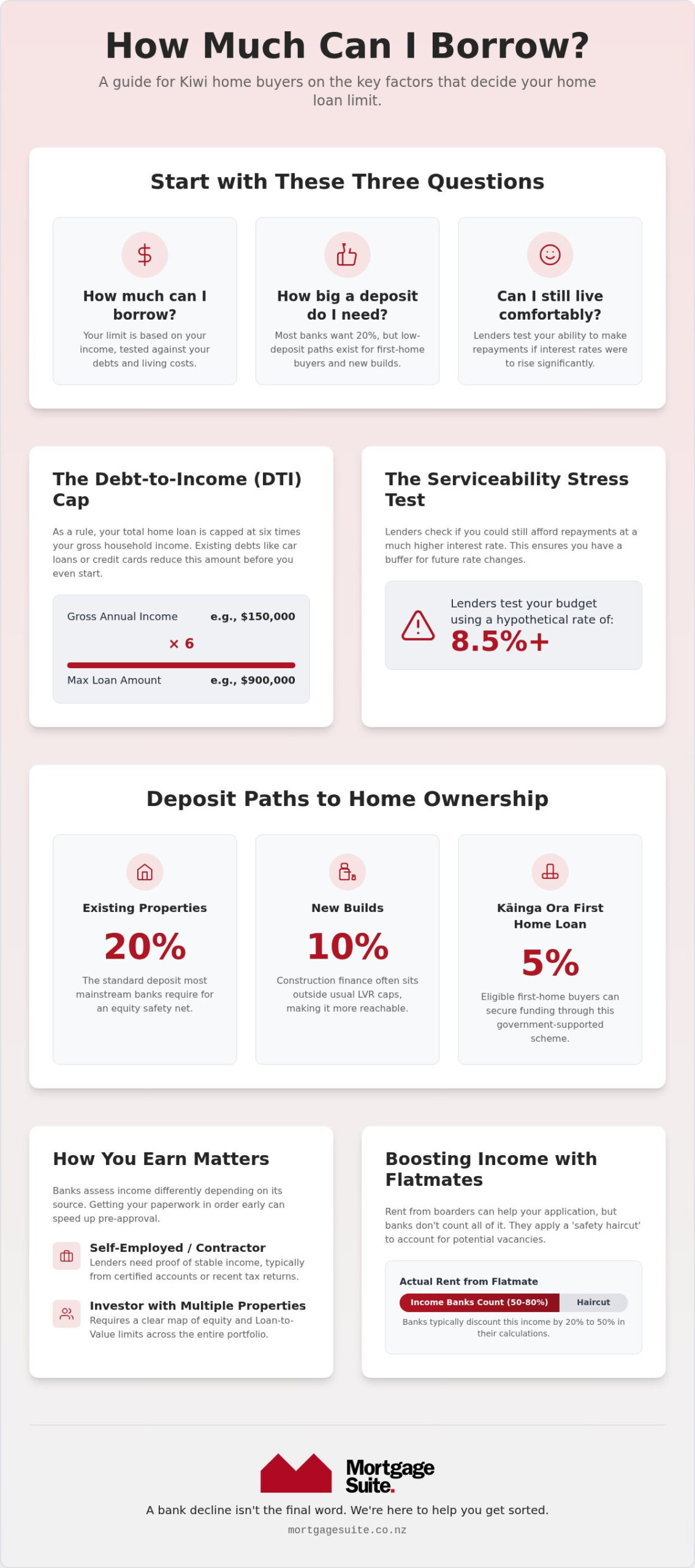
The debt-to-income ratio being introduced by the Reserve Bank is a financial metric used to assess the ability of borrowers to manage their debt repayments in relation to their income. It’s calculated using the following formula:

Total Debt ÷ Gross Income = DTI Ratio​

That formula includes the following components:

  • Total Debt: An individual’s total debt includes all their outstanding debts, such as mortgages, personal loans, car loans, and credit card debt.
  • Gross Income: This refers to the borrower’s total pre-tax income from all sources.
  • DTI Ratio: The score that is assigned to an individual to demonstrate their borrowing power.

In practical terms, if a borrower has total debts amounting to $500,000 and a gross annual income of $100,000, their DTI ratio would be 5 (or 500%).


Why Is A DTI Important?

The Reserve Bank believes that the debt-to-income ratio is a good indication of what a person is financially capable of borrowing. They feel it is a critical measure to help banks, financial institutions and other lenders determine the risk associated with lending.

Having a low debt-to-income ratio indicates that you are a relatively safe lending option as you should be able to maintain debt repayments in your current circumstances. However, having a high debt-to-income ratio could indicate that you are over-leveraged and may struggle to meet your repayment obligations if your income were to decrease or interest rates were to rise.

By setting limits on debt-to-income ratios, the Reserve Bank is aiming to curb risky lending practices. If they limit high DTI lending, then it is less likely borrowers will take on excessive debt, reducing the risk of defaulting during economic downturns. They also want to ensure house prices don’t blow out as high levels of mortgage debt can drive up house prices, creating bubbles in the property market.


New Zealand’s New Debt-To-Income Restrictions

On 1 July 2024, the new debt-to-income restrictions will come into effect. Banks will need to comply with the new restrictions from this date.

“The DTI restrictions will allow banks to make 20% of new owner-occupier lending to borrowers with a DTI ratio over 6 and 20% of new investor lending to borrowers with a DTI ratio over 7.

LVRs will be eased to allow banks to make 20% of owner-occupier lending to borrowers with an LVR greater than 80% and 5% of investor lending to borrowers with an LVR greater than 70%.

‘Having both the DTI and LVR restrictions in place means we can better focus them on the risks that they are designed for while achieving the same or better overall level of resilience in the financial system. Therefore, activating DTIs means that we can ease LVR settings too.’ Christian Hawkesby, Reserve Bank deputy, says.” [source]


What Does It Mean?

Under the new restrictions, the new debt-to-income restrictions mean that a bank or financial institution can lend up to six times an individual’s gross income (that’s the amount you make before tax is applied) for an owner-occupied property. For an investor, they are able to lend up to seven times the gross income.

There are some exceptions to that though, under the new rules banks are able to make 20% of their lending outside of those restrictions. So, they will have the discretion to assess on a case by case basis borrowers who are outside the standard DTI criteria.

In the current market, these changes are unlikely to have much impact as high interest rates are preventing people from taking large mortgages they can’t manage. But, when mortgage rates go down, debt-to-income ratios could potentially come into play more.

The biggest thing would be if house prices were to increase significantly compared to household incomes or if interest rates were to rapidly fall. At this stage, that is not predicted to happen. The Reserve Bank has indicated they don’t intend to drop the OCR until at least 2025 and house prices are expected to stay muted for the next little while.


Where To From Here?

We still find ourselves in uncertain times. While the introduction of DTIs might not have much impact in the short term, it doesn’t change the fact that no one is certain of what lies just around the corner!

We still don’t know when mortgage rates will go down and there was even talk in the last OCR review that the cash rate might even increase later in the year. The latest RBNZ forecasts don’t have the OCR falling until September 2025, which feels like a very long time away!

What can you do in the meantime?

Well, we know many families are feeling the economic squeeze right now, so we would strongly encourage anyone concerned about their current lending, looking to refix existing lending, or who wants to explore the potential of new borrowing to seek the expert advice of a mortgage specialist.

We would love the opportunity to help you decide the right path for your current financial situation and long-term goals. Chat with our friendly and experienced team today for honest and practical advice that you can trust.

Are Short Term Mortgage Rates Better Than Longer Ones?

Are Short Term Mortgage Rates Better Than Longer Ones?

Are Short Term Mortgage Rates Better Than Longer Ones?

The question on everyone’s lips… when will mortgage rates start going down again?

Many economists are predicting that interest rates have reached their peak. And people are voting with their actions – 56% of new loans, bank switches and top ups are currently fixed at terms of 1 year or less.

But of course, you never know what could be just around the corner for the economy.

So, with that in mind, is a short term mortgage rate the way to go right now?

Let’s explore your options.

The Benefits Of A Fixed Term Mortgage

We’ve previously talked about the benefits of a fixed term mortgage. For a start, fixed term rates are generally lower than any floating option. Currently, floating rates are upwards of 8.6% and the highest fixed term rates are sitting just above 7.2%.

But, it is not just the cost saving that is beneficial. With a fixed term rate, you can gain certainty about how much your mortgage will cost you each month which makes it easy to budget for. This means it can be easier to manage your finances, giving you a sense of stability in a volatile market.

When interest rates are high, like they are currently, it can feel scary to fix your mortgage for any length of time because you will likely have to lock in a rate that is higher than what you are currently paying. But often, fixed terms still work out better for Kiwi households.

How Long Should I Fix For?

The Reserve Bank’s latest figures show as many as 59% of existing mortgages will have to move to higher interest rates in the next 12 months. That means the worst of the mortgage pain has not yet been felt by all households.

But, just how high will those higher rates be?

The answer is, no matter what happens between now and the end of 2024, interest rates will be higher than the glory days of 2021 when the average one year term was 2.2%.

So, how long should you fix for?

The answer to this question depends on your personal circumstances and your plans for the short and long term future. Short term mortgage rates are still high in comparison to the longer fixed terms. As of 30 April, BNZ have their 1 year rate listed at 7.24% and their 3 year rate at 6.65%. That is quite a significant difference.

Is Shorter Better?

The popularity of short term fixed rates is rising. In December, 36% of new loans, top ups and bank switches were fixed for one year or less. But, by February, that number was up to 56%. It shows an increasing preference to fix for a shorter term in case the interest rates drop in the near future.

While the logic is sound for this decision, it may not necessarily be the best strategy to fix for the shortest term possible. Here is an example scenario from BNZ chief economist, Mike Jones:

It’s possible to fix for two years now at about 6.80%. Alternatively, a borrower could fix for one year at about 7.25% and then, assuming rates do fall, roll onto a lower one-year rate in a year’s time.

“To ‘break-even’ on the shorter-term strategy, the one-year rate in a year’s time needs to be about one percentage point lower, so about 6.30%, based on current market pricing.” [source]

He says that while the scenario is possible and there could be value in fixing for one year at a time, forecasts don’t always go to plan. There could also be value in looking at a slightly longer term depending on your circumstances.

What’s The Plan?

So, how long should you fix your mortgage for if it is coming up for renewal soon? A short term mortgage rate or something slightly longer?

While there is uncertainty in the air as to when the rates will finally begin to drop, it is best to seek advice from a mortgage broker to see what is the right option for you. Fixing for a shorter term can give you the flexibility to jump on rate reductions or work with the property market. Whereas fixing for a slightly longer term gives you a better rate upfront and a set figure to budget for.

We’d welcome the opportunity to chat with you and establish which is going to be the best option for you in this current market. Get in touch with us today for a no obligation chat about your mortgage.

Where Does Your Money Go When Interest Rates Rise?

Where Does Your Money Go When Interest Rates Rise?

In the last couple of years, interest rates have crept up and up.

In fact, many people’s mortgage rates have doubled since 2021.

We know the OCR has climbed, but is that the whole reason for skyrocketing interest rates?

With banks still recording record profits, you might be wondering where the extra money you are now paying for your mortgage actually goes.

Let’s take a look at the answer to where your money goes when interest rates rise.


Where Does My Money Go?

When interest rates rise, does the bank just pocket the extra money that you are paying?

The answer to that question is no. While banks are run as a business that needs to return a profit to their shareholders, they don’t simply take your additional interest payments as profit. Like any business, they have a product to sell and costs to cover. It just feels a little confusing as their product is money itself.

They need to lend out money at a higher rate than it costs them to acquire it. Plus, they need to cover all the usual costs of running a business, such as their staff and operational costs. Put simply, for the bank to continue functioning effectively, it needs to bring in more money than it gives out.

Interest rates bring funds into the banks. When their costs increase, interest rates must also increase to ensure the bank still operates with a profit.


The Role Of The OCR

To be able to lend money out, the bank must first obtain the funds to lend. One source of funding is from deposits in their customer’s checking and savings accounts, along with term deposits, loans, credit cards and the like.

The banks will put your money to work. While it is sitting in your accounts, you are effectively lending it to the bank, and they will pay you interest in return. Of course, your money is never gone, you can still access it at any time you need to.

In addition to using bank deposits as funding, the banks will also borrow money from the Reserve Bank and international sources. The OCR determines the cost of borrowing from the Reserve Bank. When this cost of borrowing goes up, the costs are passed down to the bank’s customers.

Likewise, if the OCR were to drop and the cost of borrowing fell, the bank would pass the savings onto its customers with lower mortgage rates. Movement in the OCR is one of the main reasons we see interest rates rise and fall.


Predicting The Future

When it comes to setting interest rates, there is an element of uncertainty for the banks. That is because, they cannot predict what will happen in one, two, or five years time. So, they need to factor that element of uncertainty into their rates.

For example, in 2021 all rate terms were under 3%. Now, in 2024, rates are above 6 and 7%. The cost of maintaining a 5-year fixed term that was agreed in 2021 has risen significantly which will ultimately impact the bank’s margin.

While using their expert economists to make reasonable predictions about what will happen in the future, there will always be unexpected circumstances that occur, such as a global pandemic! So, the interest rates they set must take a degree of uncertainty into account.


Your Money

As you can see, the extra money you pay does not just get gobbled up by your bank. It is simply that the cost of borrowing and lending increases and decreases depending on what is happening in the local and global economy. So, proportionally, the bank doesn’t take any more of your money when interest rates increase.

And, they may even end up giving some back to you. When mortgage rates go up, so does the amount of interest the bank will pay to you for any money you have in savings accounts etc.

But, no matter what the current financial state of the country is, you don’t want to pay more interest than necessary! A mortgage broker can help you with advice that is specific to your current situation, but as a general rule, it is wise to follow these tactics.

When mortgage rates are low and you expect them to increase, it is often best to lock in a longer term fixed rate for an element of financial stability. However, when mortgage rates are due to go down, shorter term fixed rates or even floating home loan rates can allow you to capitalise on any rate cuts when they occur.


When Will Rates Go Down?

The exact answer to the question of when interest rates will go down is still not clear. However, there is hope that positive news is not too far away. Many economists believe that we have finally hit the peak of mortgage pain.

We have already seen very minor reductions in rates and internationally, the interest rate cycle has turned. In the latest Monetary Policy Statement, the Reserve Bank has indicated they intend to keep the OCR at a steady level for a while longer, with potential cuts forecasted for the end of 2024.

Each of the major banks has varying opinions on when those cuts might take place, with some predicting August, some saying November, and others predicting cuts won’t happen until 2025. Opinions are still very much divided. The good news is that there’s a consensus that interest rate cuts are coming!

So, before making any decisions about refixing your mortgage or taking out new borrowing, we wholeheartedly recommend speaking with an experienced mortgage broker, like the team here at Mortgage Suite. We can give you helpful advice on what is the best move for your individual circumstances. Get in touch with us now.

Why Are Interest Rates So Volatile Right Now?

Why Are Interest Rates So Volatile Right Now? | Mortgage Suite

2023 closed with the promise of interest rate relief hanging in the air.

The inflation numbers were going in the right direction and all the predictions were for the OCR to drop at some point in 2024, and interest rates with it.

Now, we sit on the eve of the first OCR decision of the year and we are being warned it could go up.

How did we get here and when will we see the relief we have been promised?

Let’s explore.

Why So Volatile?

The Reserve Bank has been very clear on its stance that they do not expect the OCR to drop until late 2025. Up until a few weeks ago, most economists were predicting otherwise. Some had forecasted as many as four rate cuts this year.

Then suddenly, ANZ is warning that the OCR could actually go up in the first review of 2024. While it is currently the only bank speaking of this potential, it is an about-face from the predictions we were hearing last year.

So, what has caused this change in opinion?

The Reserve Bank has indicated that the main reason that the OCR remains high (and could go higher still) is due to stubbornly resistant inflation. Despite some promising signs like weaker GDP data appearing and wholesale swap rates dropping at the end of 2023, the market has since reversed.

Because of that, predictions have changed.

Will The OCR Go Up Or Down?

The Reserve Bank is due to make an announcement on the OCR this week. ANZ is standing firm on the possibility that it could increase 25 basis points and rise to 5.75%. All other major banks are predicting that it will remain constant at 5.5%, the level it has sat at since May 2023. However, they have not ruled out the possibility of an increase.

What they are all in agreeance on is that the OCR is not ready to go down… yet.

This volatility is very common in a market that is about to change. There are signs that the Reserve Bank’s efforts are working. Inflation is tracking down, albeit slower than they would hope. Employment rates are also easing, but again, slower than the Reserve Bank would like.

The economy is shrinking, but migration rates remain high bringing much needed skills to NZ and making it easier for businesses to hire the talent they need. Great for the businesses, but not so great for the employment figures that impact the Reserve Bank’s decisions!

All of this indicates that things are heading in the right direction, but are they heading there fast enough to maintain the OCR at 5.5%? Only the Reserve Bank can decide that.

What Does It Mean For New Zealanders?

Everyone is starting to feel the pinch on their household budget. Rising interest rates and living costs are putting pressure on lots of NZ households. Unfortunately, that pain is not over yet and may even get worse before it gets better.

There is always a lag in changes to monetary policy and the resulting effects on everyday households. The OCR has been high for a long time now. Back in September 2021, the average interest rate on mortgage debt was 2.8%. Right now, it is sitting at 5.9% and is expected to rise to 6.3% in the next 6 months as homeowners continue to roll off their fixed rates set two and three years ago. Relief from these rates is still a way off.

While current monetary policy is working, it is happening much slower than expected. For that reason, the Reserve Bank is hesitant to make changes too soon and undo the work that has been done so far. They do not want to cut the OCR now only to have to raise it much higher in the future because of cutting too soon.

The best thing to do right now is to sit tight and try to weather the storm. Change is coming, we just don’t know exactly when it will be.

What’s The Plan?

In this particularly volatile period of finances, we urge you not to rush into any decisions. Change is coming, so making sensible decisions now is paramount.

Longer term interest rates may look attractive now, but you do not want to be fixed at a high rate for multiple years if change is on the horizon. While we can’t predict exactly when interest rate cuts will happen, we know they are coming. In the meantime, we can offer our best guidance based on a number of factors.

So, whether your interest rates are due to come up for renewal or you are considering buying or selling, now is definitely a time when you want expert financial advice.

Chat with a trusted mortgage advisor, like the team here at Mortgage Suite so that you can make the best move for your circumstances in the current volatile market.

What Will Happen To Interest Rates In 2024?

what-will-happen-interest-rates-in-2024

New year, new interest rates?

That’s what most mortgage holders are hoping for anyway!

But, will it actually happen?

Let’s take a look at what’s been happening in the world of finance and property over summer and what the economists think will happen to interest rates in 2024 – the 12 months ahead.

Inflation

On 24 January, the new inflation figures were released. Currently, inflation is sitting at 4.7%. This is down from a peak of 7.3% in June 2022, but still outside the Reserve Bank’s targeted window of 1-3%. However, they had forecasted an inflation rate of 5% for this quarter, so there is evidence that the measures put in place to tame inflation have been working.

For the fourth consecutive month, food prices have decreased with a 0.1% fall in December 2023. It is hoped that annual food price inflation should fall below 3% by mid-2024 bringing some much-needed release to household grocery budgets. The prices of petrol, accommodation, tobacco and alcohol also eased in December, which was part of what helped inflation track downwards.

Senior economist Mark Smith has noted that the Reserve Bank will still be wary about the risk of inflation being stuck above their target of 3%. They are likely to maintain the OCR at a restrictive level for as long as it takes for inflation to sit below their 3% target on a sustained basis.

OCR

Right, so inflation is tracking down, does that mean we will see a reduction in the OCR? As we know, the OCR is a key determining factor in setting mortgage interest rates.

So, will the OCR go down? The answer is yes, but the rate cuts might not be as soon as we’d hoped.

The facts are that economists believe it won’t be long until we see the Reserve Bank switch from fighting inflation to reviving demand. There was even talk that the positive impact of the monetary tightening tactics implemented by the Reserve Bank was working well enough that we might see a cut in the first quarter of this year.

However, the big five banks are less optimistic about that happening. ANZ and Westpac are predicting no OCR cuts until February 2025, but that mortgage rate cuts could be seen earlier. ASB is predicting the first OCR cut in August 2024 and BNZ has a similar opinion, that the OCR will be cut in the third quarter of 2024. Kiwibank believes the OCR rate cut will take place in November. [source]

The Reserve Bank itself has not given any indication of when cuts might take place. And they are unlikely to give any warning for fear it might trigger backward progress on the good results they are achieving with inflation. However, inflation is not the sole consideration. They do not want to hold out too long, risking the economy falling into a state where significant stimulus will be needed to revive it. [source] It is a unique balancing act!

We can take comfort that across the board, OCR rate cuts are on their way. The only thing that is unclear right now is when these cuts will happen. We’ll keep you updated on what’s happening in the market on a monthly basis. If you haven’t already done so,   to receive the latest news straight to your inbox.

Property Market

The bottom kind of fell out of the property market in 2023, so what does 2024 look like?

The predictions are that the market will recover, but prices are not going to soar like they did in 2020 and 2021. Experts are expecting a small amount of growth in 2024.

They also believe that people are ready to buy and sell again. “Not because it’s boom and not because we’ve got past the bust, but the fact that it will be normal. We’ll see normal transactions, we’ll see stability in prices.” [source]

In the current market, things are quite predictable on the lending front. Borrowing is down, and with interest rates still showing no real signs of mercy, it is no surprise that shorter fixed terms are being favoured right now. [source]

Interest Rates

So, what does all this mean for interest rates in 2024?

Well, for a start, there is a bit of good news. Banks are currently more willing to negotiate and offer discounts in order to secure or retain customers. We are starting to experience that “there are big differences between what the banks’ advertised rates are and what can be negotiated” [source] This is especially true if you have a good payment history and more than 20% equity in your property.

In saying this, there seems to be more scope for negotiation on the longer term rates – 3, 4 and 5 year fixed terms – and less on the shorter term rates. The question is, are they hoping to tempt customers with a longer term fixed rate, knowing that all rates are predicted to come down in the not-too-distant future?

Late 2023 also had some encouraging signs with longer term interest rates being trimmed modestly. This was largely a result of international wholesale rates dropping by more than 100 basis points.

Whether short and long term fixed rates will drop in 2024 will be determined by inflation, wholesale rates and the OCR. It is expected that interest rates in 2024 will trend downward, the only question is when that will happen.

The best advice we can give you is to get in touch with a reliable mortgage broker, like the team here at Mortgage Suite, before making any major decisions this year. That includes buying and selling property, but also refixing current interest rates. So, drop our team a line, we’d love to hear from you!

10 Top Holiday Season Money Saving Tips

10 Top Holiday Season Money Saving Tips

It is almost that time of year again.

Sleigh bells will be ringing, the weather is warming (hopefully), and you’ll be shopping up a storm for pressies and ingredients for the family Christmas meal.

But, this Christmas might feel a little different to previous ones. Especially if you’ve just refixed your mortgage at a much higher interest rate.

So, we’ve been busy making a list of all the nice things you can do to save some money these holidays so that you can avoid Santa’s naughty finance list!

10 Holiday Season Money Saving Tips

1: Set A Budget

It is super easy to overspend at Christmastime once you start grabbing presents for the family, decorations and groceries. But you can avoid breaking the bank by setting a budget for what you will spend this December. It doesn’t mean you need to scrimp and save, but be realistic about what you can afford when choosing the number.

2: Go Digital

Christmas cards are lovely, but once you buy the card and the postage for multiple recipients, the costs can start to add up. So, why not go digital and send electronic cards this year? Or record a video message with the family to share around. Cost effective, but still super personal. Plus, you never have to worry about it getting lost in the post!

3: Shop The Sales

In the leadup to Christmas, there will be plenty of sales at all your favourite shops. So, keep an eye out for holiday sales, discount codes and promotions when shopping for your gifts. It pays to start shopping early so that you can catch any sales that are run, not panic buying whatever is left on Christmas Eve!

You can also look for ways to take advantage of discounts in your regular spending. Some utility providers or other services offer discounts if you pay on time or via direct debit.

4: Secret Santa

If you have a big family, the cost of gifts can soon add up. Instead of buying a gift for everyone, Secret Santa is a cool way to still have fun and keep the costs down. To do Secret Santa, put each family member’s name on a piece of paper and put it in a hat, then each draw out a name. That is the person you have to buy for.

If Secret Santa isn’t your jam, then you can kick the fun up a level and play Santa Grab instead. Everyone brings a small wrapped gift and they are placed in a pile. Everyone takes a turn to either unwrap a gift from the pile or to steal a gift someone else has already unwrapped. Proceed onwards until all guests end up with a gift to take home.

Not only are these games fun, but they significantly cut down the gift spend as you are only buying one present.

5: Homemade Gifts And Experiences

Who says you need to gift a store-bought present? Why not get creative with fun homemade gifts or offers of help? Bake cookies, crochet snugglies, pot plant cuttings, or offer to mow someone’s lawn once a month. There are plenty of ways you can give a lovely, thoughtful gift that costs very little.

You can also use recycled materials to wrap your gifts or go rustic with some brown paper and twine.

6: Meal Planning Or No Planning

When it comes to holiday food, you can plan as much or as little as you like. Setting a meal plan will stop you from buying unnecessary groceries, minimising overspending.

Or, throw the plan out the window completely and ask your guests to simply bring a dish with them. The surprise of what kind of food you will receive is part of the fun!

Remember that you don’t have to invest in fancy treats either, you can make or bake your own budget friendly options that will probably taste better anyway!

7: Minimise Travel

Christmas Day can be hectic when you are trying to visit multiple households. Take a step back and look at what you could do to minimise the travel. Could you all meet somewhere central for a blended Christmas celebration? Or maybe visit one relative this year and save the others for next year, taking turn about.

Flights are notoriously expensive over the holiday period, as is accommodation. Perhaps you could plan to have a small family Christmas at home and then visit your relatives for a mid-winter Christmas to save on travel costs.

8: Cut Discretionary Spending

Take a look at your monthly expenses to see if there is anything you can trim over the holidays. For example, if you are a rugby fan, you might be able to pause any Sports subscriptions until the season starts again, or pause other services you won’t be using over the summer.

If you have family coming to stay, look at ways you can share expenses so that no one person has to cover the cost of everything.

9: Put Money In

Look for ways that you can inject money into your budget, rather than taking things out. You could potentially sell unwanted items or things from your garden, rent a room if you have extra space, or even Air BnB out your house if you are going to be on a summer holiday.

10: Examine Your Mortgage

One of the biggest holiday expenses you are likely to have will be your mortgage repayments. So, it’s worth exploring whether or not you can save some money there. The best way to do this is to have a chat with a mortgage broker, like the trustworthy team here at Mortgage Suite.

We can explore all the different options available, like refinancing, securing a different interest rate, restructuring your borrowing, or switching lenders. Any of these options could potentially create savings for you.

So, why not get in touch with our team now for an obligation-free chat? Book a time to speak with us now.

Are Interest Only Loans A Way To Save Money On Your Mortgage?

Are Interest Only Loans A Way To Save Money On Your Mortgage?

As we all watch mortgage rates climb higher still, you’d be forgiven for trying to find ways to save some money each month.

There is only so far budgeting and cutting out luxuries will get you.

Sometimes, you might feel like a more drastic saving plan is needed.

Part of that exploration might include looking for ways you can save on your mortgage. Recently, we’ve had some queries about interest only loans so thought we’d provide greater detail about what they are along with some ways you might be able to save money on your mortgage.


What Is An Interest Only Loan?

Well, kind of like the name sounds, an interest only loan is a type of mortgage where you only make payments towards the interest portion of your home loan. You don’t make any repayments towards the principal portion of the loan. For this reason, interest only loans are for a fixed term and are usually approved for no longer than five years.

They also carry a large number of restrictions due to the intensified risk of debt and house prices in the current market. That means lenders need a really justified reason for allowing interest only lending right now, and some don’t even offer it


Can You Save Money With An Interest Only Loan?

So, can this type of loan save you money?

Well, it might seem like they are an option to reduce costs in the short term as the actual payment amounts will be lower. However, you will actually end up paying more in the long term as the interest is always calculated based on the principal amount of the loan. So, because the principal is not reducing as it would in a standard mortgage repayment, you will end up paying more interest over the term of the loan.

Usually, an interest only loan is more suited for property investors who may be able to claim some of the interest as a tax deduction. But, they can also be beneficial for first home buyers who are looking to make the first year of repayments more manageable or homeowners who are looking to sell their property soon.


Other Ways To Save On Your Mortgage

If an interest only loan is not necessarily the answer, what other ways are there to potentially save on your mortgage costs? Well, here are some suggestions:

Talk to the Experts

The first piece of advice we can offer is to talk with a respected mortgage broker like the team here at Mortgage Suite. That way, we can give you tailored advice based on your individual financial situation. This includes chatting about your current mortgage (if you have one) and what your future plans entail. Then, we can give you informed advice about the best options for you and your family.


Shop Around

Sometimes a different lender might be able to provide you with a different rate or a better incentive than your current lender. So, it pays to shop around to see what kind of deal you can get. A mortgage broker can help you do this and can also recommend the best potential option for your individual needs.


Negotiate

There is no rule to say you need to take the first interest rate offer you are given! You can try to negotiate a better rate or have your mortgage broker negotiate on your behalf. Often, if you have a good credit rating and strong financial history you may be able to secure a better deal.


Fixed or Floating

As we’ve discussed in the past, there are merits and drawbacks for both floating and fixed options. Fixed mortgage rates give you consistency and certainty about what your repayments will be, this can help you to budget better. However, floating rates can work if you have a variable income where you might be able to put more of your mortgage some months or if you want to capitalise on any changes in the market.


Loan Structure

The structure of your loan can sometimes be modified to create a better deal for your current situation. That can include modifying the term of it, splitting it into different portions with different interest rates, or even splitting some between fixed and floating rates.

There is not one set structure that suits everyone, so have a chat with your mortgage broker about what might be the best option for you.


Use Offset Accounts

Some lenders offer offset accounts as part of your mortgage package. Basically, any money you have in those accounts is offset against your mortgage balance which can reduce the amount of interest you need to pay. Double check with your bank if this could be an option for you.


Be Mindful Of Fees

Make sure you are aware of any fees associated with your mortgage and try to minimise incurring any. Some lenders will charge a fee if you make additional repayments or if you break a fixed term rate. There can also be penalties if you miss a payment, so it always pays to be proactive and contact your bank if you think you won’t be able to pay on time.


Regularly Review

Take the time to periodically review your budget and financial goals. Then, chat with your mortgage broker to ensure that they are in line with your current mortgage structure and adjust your strategy if your income, expenses or personal circumstances have changed.


Could You Be Saving Money?

The Reserve Bank is predicting that pockets of household financial stress are likely to grow in the medium term due to rising debt servicing burdens. Loan arrears have been steadily increasing in the past year, but most households have been able to manage to date by cutting discretionary spending.

What is noticeable though, is that mortgage holders have been missing repayments on other debt at a greater rate, suggesting that there are debt servicing strains out there. [source]

So, it is only natural that mortgage holders might be seeking ways to save money as 2023 comes to a close. If that sounds like you, then we’d love the opportunity to chat about how we might be able to help. Get in touch with the Mortgage Suite team today for an obligation free discussion about what 2024 could look like for your mortgage.